Shen Collection, Middle Volume
Radical: Insect (chóng)
Kangxi Strokes: 14
Page 1088, Entry 08
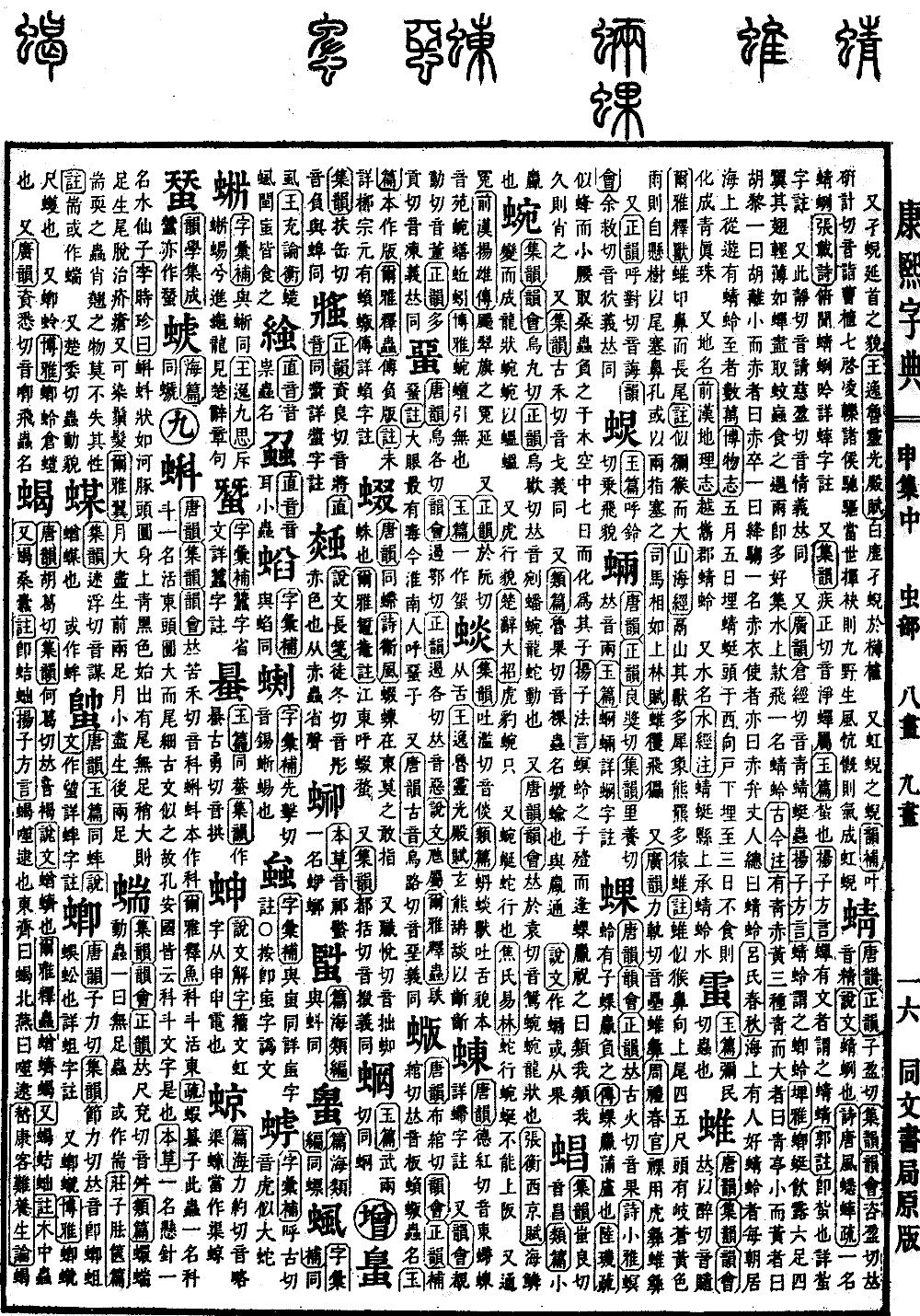
Pronounced wan. Panwan refers to the movement of dragons and snakes.
Also pronounced yuan. Wanwan describes the appearance of a dragon. From the Western Capital Rhapsody (Xijing Fu) by Zhang Heng: The sea fish transforms into a dragon, appearing as wanwan and yunyun.
Also describes the manner in which a tiger walks. From the Great Summons (Dazhao) in the Songs of Chu (Chuci): The tiger and leopard walk with a swaying gait.
Also spelled wanyan, which refers to the movement of a snake. From the Forest of Changes (Yilin) by Jiao Yanshou: The snake moves with a swaying gait and cannot climb the slope.
Also used interchangeably with yuan. From the Biography of Yang Xiong in the History of the Former Han (Qian Han Shu): Fluttering the banners of the meandering flags.
Also pronounced yuan (rising tone). Wanshan refers to an earthworm. According to the Guangya dictionary, wanshan is a type of crawling creature. In the Yupian dictionary, it is also written in a variant form.