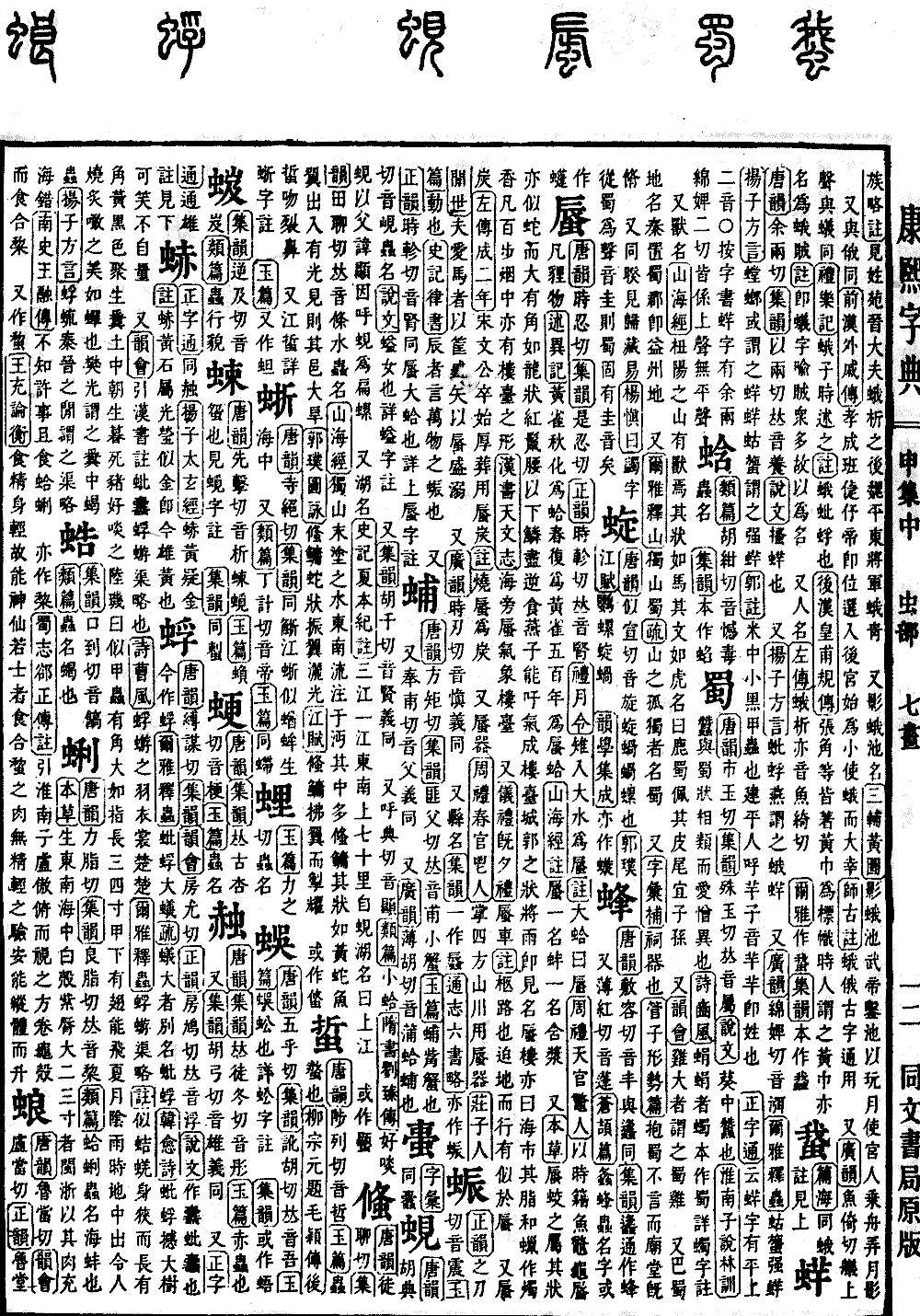
Shen Collection, Middle Volume
Radical: Insect (chóng)
Shu
Kangxi Strokes: 13
Page 1084, Entry 04
Pronounced shu. Pronounced shu. The pronunciation is the same as the word for belong (shu).
Shuowen Jiezi (Explaining Graphs and Analyzing Characters) defines this as the silkworm found in mallow leaves.
Huainanzi (Huainan Masters), in the chapter "Discourse on the Forest," notes that while the silkworm and the Shu insect are similar in appearance, people feel differently toward them.
Book of Odes (Shijing), in the "Odes of Bin" section, uses this character to write the word for a type of caterpillar, which was originally written as this character. See the entry for the character meaning caterpillar for further details.
It also refers to a type of beast. The Classic of Mountains and Seas (Shan Hai Jing) records: On Mount Niuyang there is a beast that resembles a horse in shape but has tiger-like markings, called the Lush-shu. Wearing its fur and tail is said to be beneficial for procreation.
According to the Yunhui (Collection of Rhymes), a large species of chicken is called a Shu chicken.
It refers to the Bashu region, a place name. During the Qin Dynasty, Shu Commandery was established, which corresponds to the area of Yizhou.
According to the Erya (Approaching Elegance), in the section "Explaining Mountains," an isolated mountain is called a Shu. The commentary states: A mountain that stands alone and lofty is called a Shu.
According to the Zihui Bu (Supplement to the Collection of Characters), it refers to an implement used for sacrificial rites. The Guanzi (Master Guan), in the chapter "Configuration of Power," mentions holding a sacrificial vessel in silence while the temple is being prepared.
It is synonymous with the character for stare (kui), as seen in the Guicang Yi (Return to the Storehouse Book of Changes).
Yang Shen states: The character for clean (juan) uses this character as a phonetic component and is pronounced like the character for jade tablet (gui), which suggests that this character originally held the pronunciation gui.
Textual research: In the Erya (Approaching Elegance), in the section "Explaining Mountains," the phrase regarding the isolated mountain has been emended from isolated mountain to the isolated one based on the original text.