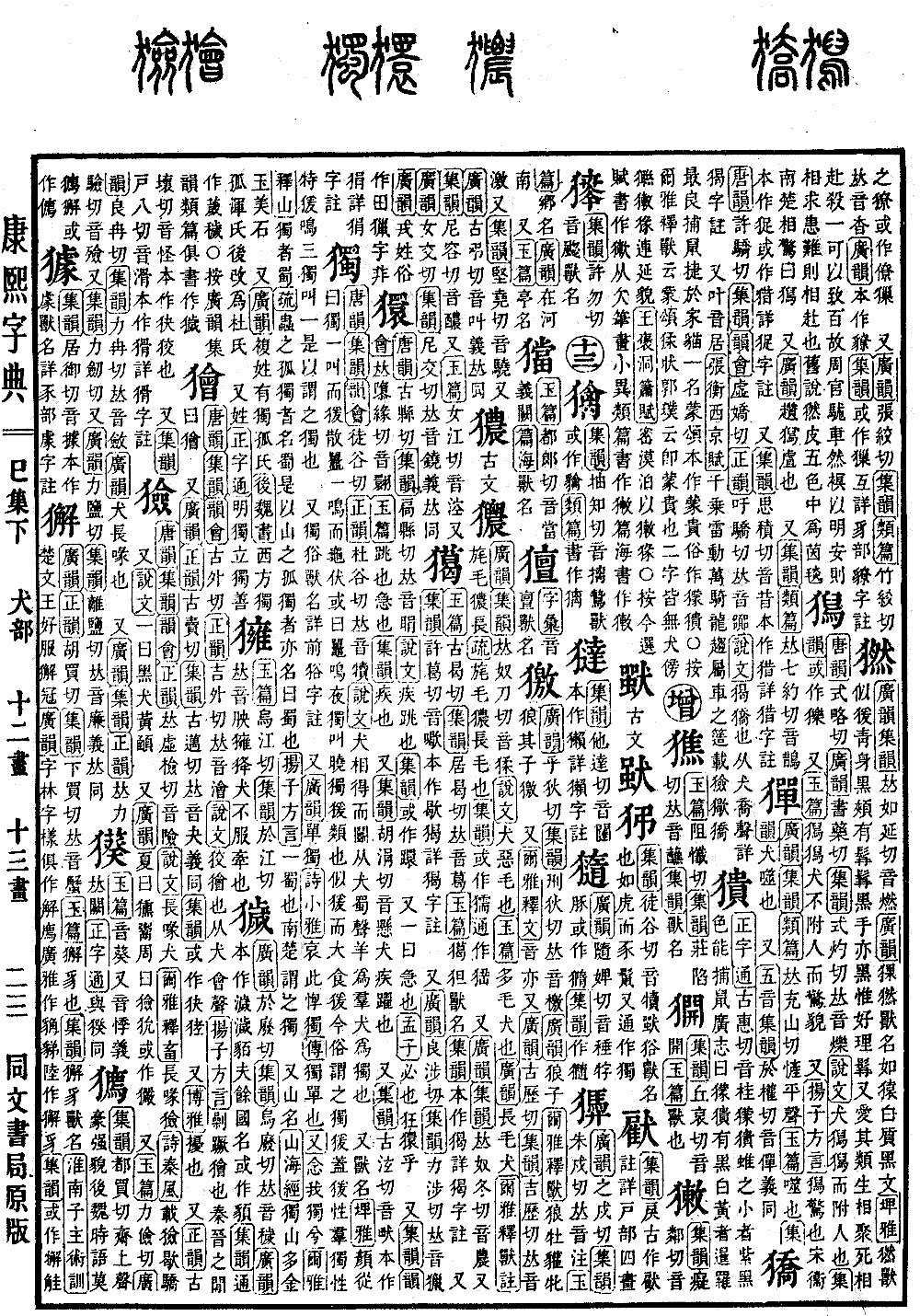
Si Collection, Lower Volume
Radical: Dog (quǎn)
17 strokes
Page 719, Entry 02
Pronounced du (rising tone).
Shuowen Jiezi (Shuowen) states: Dogs meeting and fighting. Derived from the radical Dog, with the sound of Shu. Sheep enjoy being in groups, while dogs prefer to live alone.
It is also the name of a wild beast. Piya states: Yan Cong says the ape disperses when the Du calls, and the alligator bows when the turtle calls. Some say the alligator calls at night while the Du calls in the morning. The Du is a type of ape. It resembles an ape but is larger and eats apes. It is commonly called the lone ape. Because apes are gregarious and the Du prefers solitude, and because an ape calls three times while the Du calls once, it is called Du.
Also, Du is the name of a wild beast. See the notes for the preceding character for details.
Also, Guangyun defines it as alone or single.
Book of Odes (Shijing), Lesser Odes: Pity this helpless, lonely one.
Commentary: Du means single.
Also: Thinking of my loneliness.
Erya, Explanation of Mountains: That which is lonely is called Shu.
Commentary: Insects that are solitary are called Shu, therefore those in the mountains that are solitary are also called Shu.
Yang Xiong, Dialect (Fangyan): One is called Shu. In Southern Chu, it is called Du.
Also, the name of a mountain. Classic of Mountains and Seas (Shanhaijing): Du Mountain, which contains much gold, jade, and beautiful stone.
Also, Guangyun notes the compound surname Dugu.
History of Northern Wei (Houweishu): The Dugu Hun clan of the west, later changed to the Du surname.
Also, a surname.
Zhengzitong: Ming Dynasty person Du Li, Du Shan.