Shen Collection, Middle Volume
Radical: Insect (chóng)
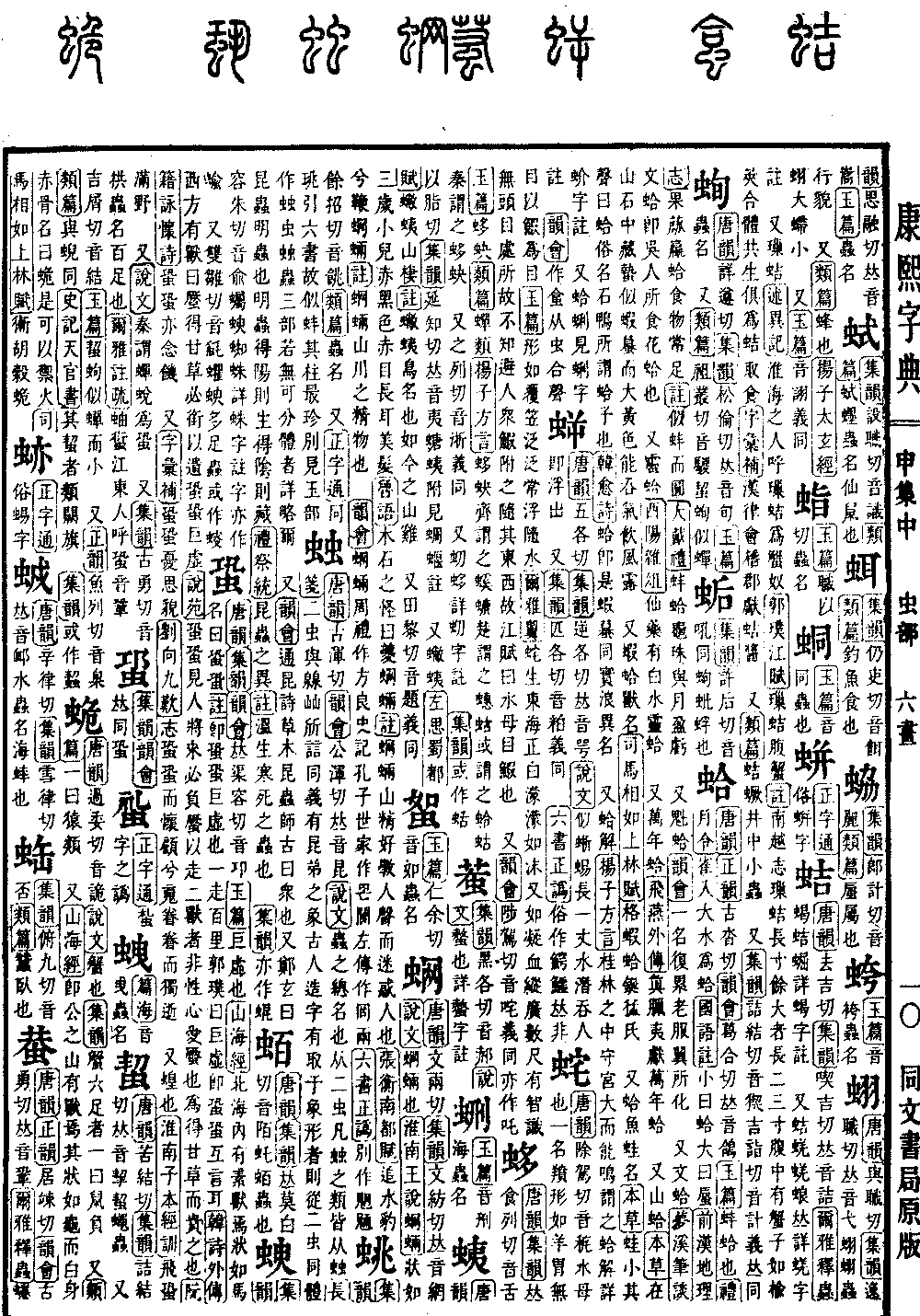
蛩
Kangxi strokes: 12
Page 1082, Entry 25
Tang Rhyme (Tangyun), Collected Rhymes (Jiyun), Dictionary of Rhymes (Yunhui): Pronounced qiong.
Jade Chapters (Yupian): A giant void.
Classic of Mountains and Seas (Shanjinhai): Within the Northern Sea there is a white beast, shaped like a horse, named qiongqiong.
Commentary: This refers to qiongqiong, which is a giant void, capable of running one hundred miles in a single sprint. Guo Pu states: Giant void is the same as qiongqiong; they are mutually explanatory terms.
Han Poetry Outer Commentary (Hanshi waizhuan): In the west there is a beast called jue; when it finds sweet grass, it must hold it in its mouth to give to the qiong. The qiong is a giant void.
Garden of Stories (Shuoyuan): When the qiongqiong sees a person approaching, it must carry the jue on its back to run away. The nature of these two beasts is not one of affection for the jue; they value it only because of the sweet grass it obtains.
Ruan Ji, Poems of Chanting Thoughts (Yonghuaishi): The qiongqiong also ponders hunger.
Supplement to the Collection of Characters (Zihuibu): Qiongqiong, the appearance of worried contemplation.
Liu Xiang, Nine Sighs (Jiutan): My ambition is anxious and filled with backward glances; I drift alone, attached and longing.
Also, a locust.
Huainanzi, Explaining the Roots (Benjingxun): Flying locusts fill the fields.
Also, Shuo Wen: In the Qin state, the molted skin of a cicada is called qiong.
Also, Collected Rhymes (Jiyun): Pronounced gong. An insect name, a centipede.
Erya, Commentary and Sub-commentary (Erya zhushu): The you (house centipede) is called qiong by the people of Jiangdong. Pronounced gong.