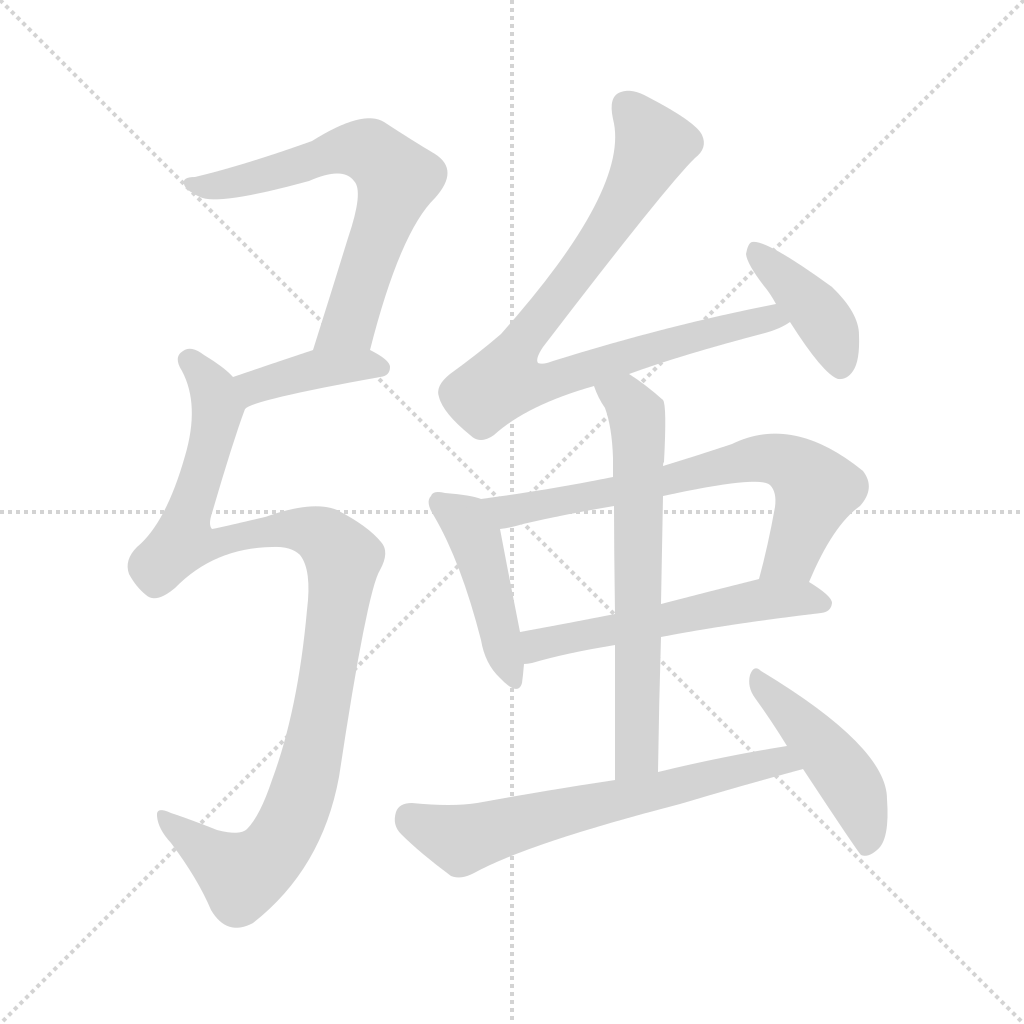
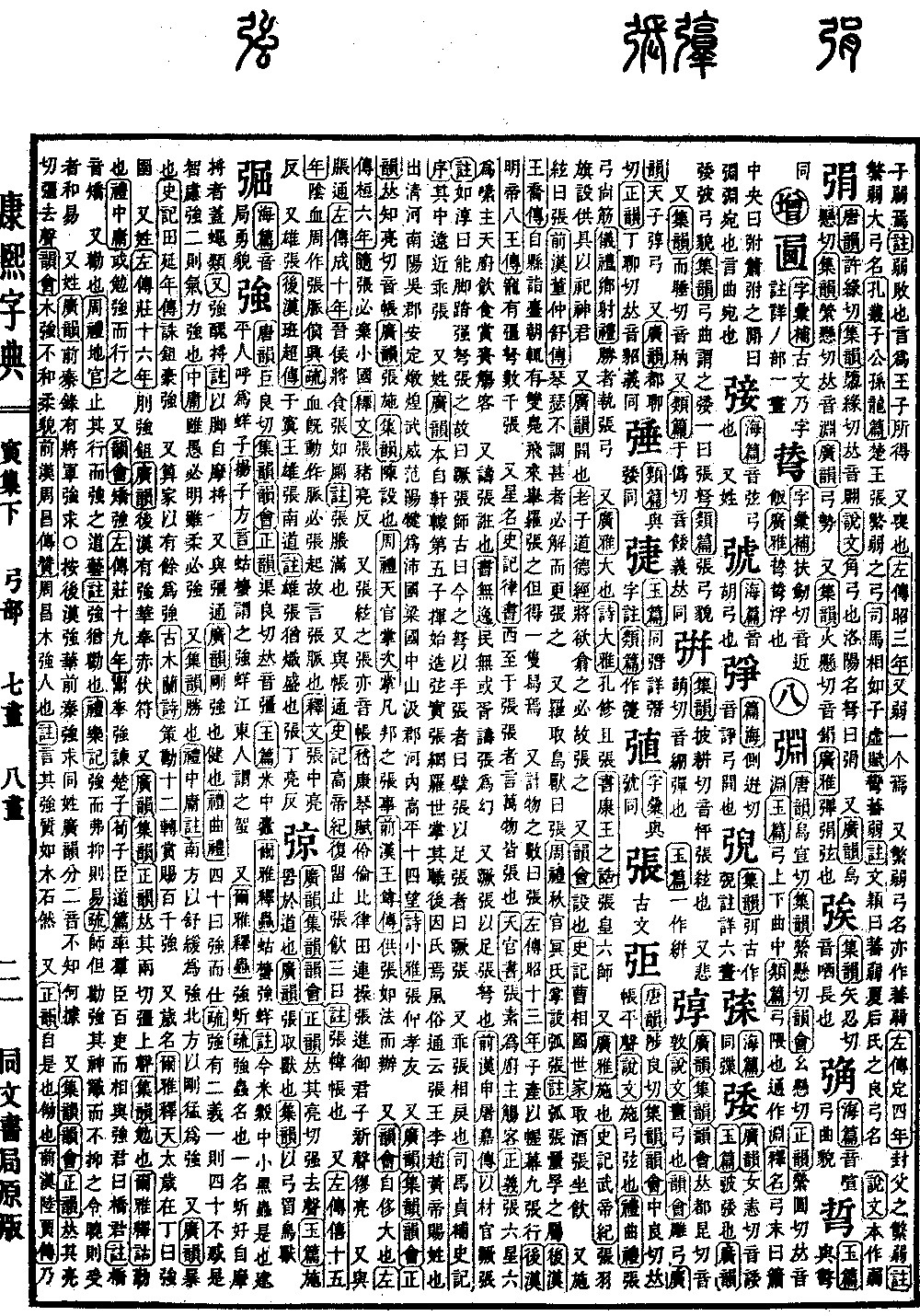
Yin Collection, Lower Volume
Radical: Bow (gōng)
Kangxi strokes: 11
Page 359, Entry 23
Pronounced qiáng.
The Yu Pian (Comprehensive Volume) defines it as a weevil found in rice.
The Erya (Approaching Elegance), section on insects, states that the gu insect is also called qiáng. The commentary notes that this refers to the small black insects found in rice and grain today; people in Jianping call them zi.
The Fangyan (Regional Speech) by Yangzi states that the gu insect is also called qiáng, which people in Jiangdong refer to as such.
Also, the Erya, section on insects, mentions the qiáng-qi insect. The commentary explains that qiáng is a type of insect also called qí, which likes to rub its body; it is likely a type of fly.
Also, the entry mentions "qiáng-chǒu-lǚ," noted as rubbing itself with its feet.
Also, it is interchangeable with the character qiáng (strong).
The Guangyun (Expanded Rhymes) defines it as meaning firm, robust, and sturdy.
The Book of Rites (Liji), section on the Summary of Propriety, states that one is called strong at the age of forty, at which point one may enter official service. The commentary explains this has two meanings: first, that at forty one is no longer confused, reflecting strong intelligence and thought; second, that one’s physical strength is robust.
The Doctrine of the Mean (Zhongyong) states: even if stupid, one will surely become enlightened; even if weak, one will surely become strong.
Also, as defined in the Jiyun (Collected Rhymes), it means to surpass.
The commentary to the Doctrine of the Mean (Zhongyong) states that the people of the South consider gentleness as strength, while the people of the North consider rigid fierceness as strength.
Also, the Guangyun (Expanded Rhymes) defines it as tyrannical or violent.
The Records of the Grand Historian (Shiji), Biography of Tian Yannian, mentions executing the powerful and violent.
Also, in mathematics, it refers to a remainder.
The ancient Poem of Mulan mentions recording honors twelve times, with hundreds and thousands remaining as surplus.
Also, the name of a Jupiter year. The Erya (Approaching Elegance), section on heaven, states that when the Great Year (Tai Sui) is in the ding position, it is called qiáng-yǔ.
Also, a surname.
The Zuo Zhuan (Commentary of Zuo), 16th year of Duke Zhuang, mentions cutting off the feet of Qiáng Chǔ.
The Guangyun (Expanded Rhymes) notes that during the Later Han Dynasty, there was a man named Qiáng Hua who presented the Red Talisman (Chifu fu).
Pronounced qiǎng.
Defined in the Jiyun (Collected Rhymes) as to exert effort.
The Erya (Approaching Elegance), section on definitions, defines it as diligence.
The Book of Rites (Liji), Doctrine of the Mean (Zhongyong), speaks of either forcing oneself to act or striving to carry something out.
Also, as noted in the Yunhui (Collection of Rhymes), it means to force oneself to feign an action.
The Zuo Zhuan (Commentary of Zuo), 19th year of Duke Zhuang, notes that Yu Quan forcibly admonished the King of Chu.
The Xunzi (Master Xun), section on the Way of the Minister, speaks of leading the officials and ministers to force the ruler to correct his errors. The commentary notes that qiao is the same as the character for to correct.
Also, to encourage or exhort.
The Rites of Zhou (Zhouli), section on the Office of Earth, speaks of correcting their behavior while exhorting them to learn arts and techniques. The commentary notes that qiáng functions like the word for to exhort.
The Book of Rites (Liji), section on the Record of Music, states that if one is exhorted rather than suppressed, it is easy to accept instruction. The commentary explains that the teacher only exhorts to increase the student’s intelligence without suppressing him, and once he understands, the recipient remains peaceful and receptive.
Also, a surname.
The Guangyun (Expanded Rhymes) mentions that the Records of the Former Qin (Qian Qin Lu) records a General Qiáng Qiú.
Note: Regarding Qiáng Hua from the History of the Later Han (Hou Hanshu) and Qiáng Qiú from the Records of the Former Qin, these are the same surname. The Guangyun splits them into two pronunciations, but the basis for this is unclear.
Pronounced qiàng.
The Yunhui (Collection of Rhymes) defines the term mù-qiáng as referring to an inflexible appearance.
The History of the Former Han (Qian Hanshu), Biography of Zhou Chang, praises Zhou Chang as a person who is mù-qiáng. The commentary explains this means his rigid, honest nature was like wood or stone.
Also, the Zheng Yun (Correct Rhymes) defines it as self-righteous or obstinate.
The History of the Former Han (Qian Hanshu), Biography of Lu Jia, mentions the attempt to use the newly established and unstable Yue state to remain obstinate and defiant. The commentary explains that qū-qiáng means to be unyielding and disobedient. The Records of the Grand Historian (Shiji) writes it with the character for qiáng (strong).
Also, it is interchangeable with the character qiǎng (swaddling clothes).
The Le Pian (Categorized Compilation) states that qiáng refers to the cloth strap used to carry an infant on one’s back.
The Records of the Grand Historian (Shiji), Annals of the Duke of Lu, mentions that King Cheng was young and still in the qiáng-bǎo. The commentary says the Suoyin (Search for Obscurities) states that qiáng-bǎo refers to swaddling clothes. The Zheng Yi (Correct Meaning) states that the qiáng was eight inches wide and eight feet long, used to wrap an infant and carry it on one’s back while walking.
Correction: The Rites of Zhou (Zhouli), Office of Earth, reads "correct their behavior" instead of "stop their behavior."