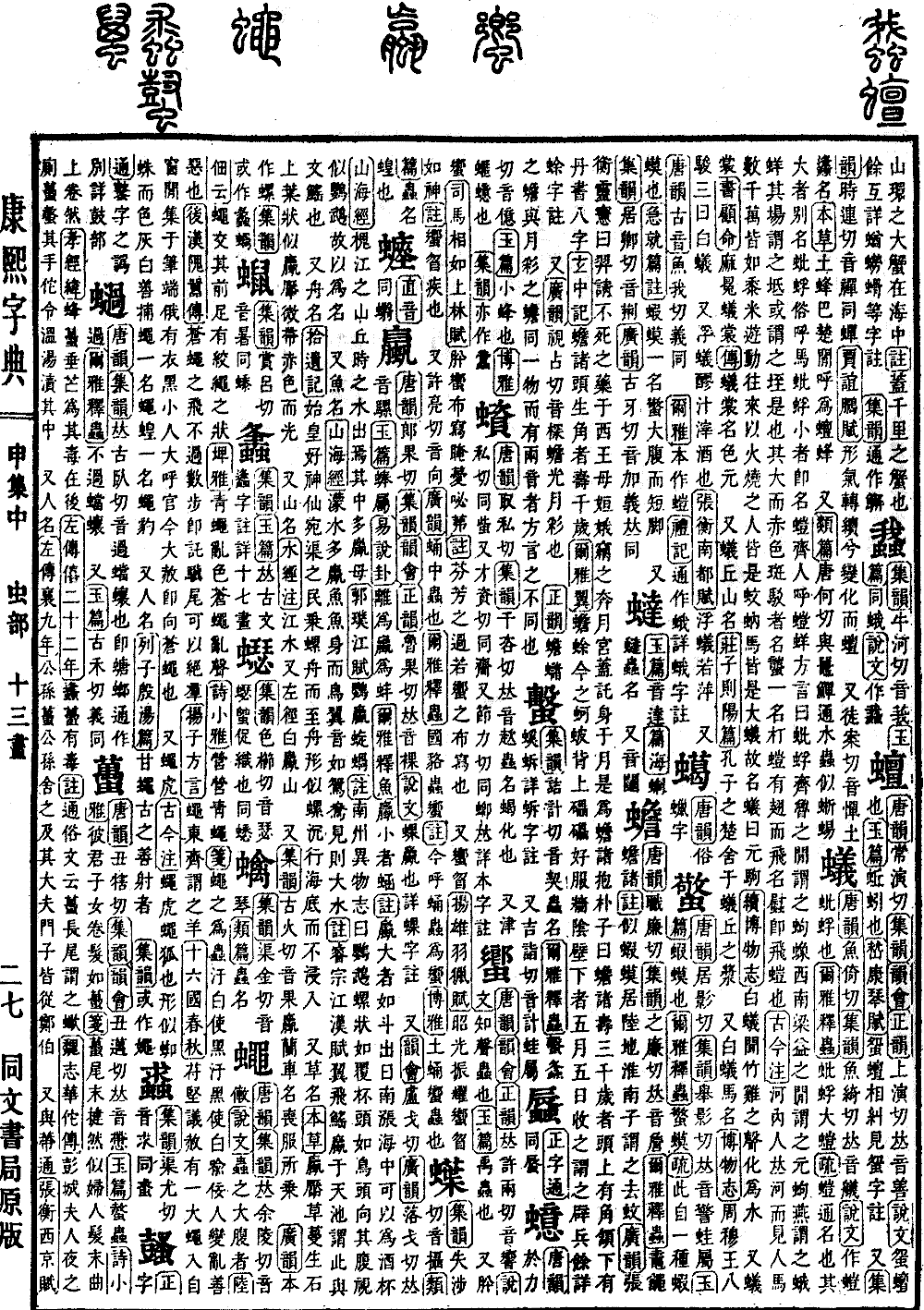
Shen Collection, Middle Volume
Radical: Insect (chóng)
Kangxi stroke count: 19
Page 1099, Entry 03
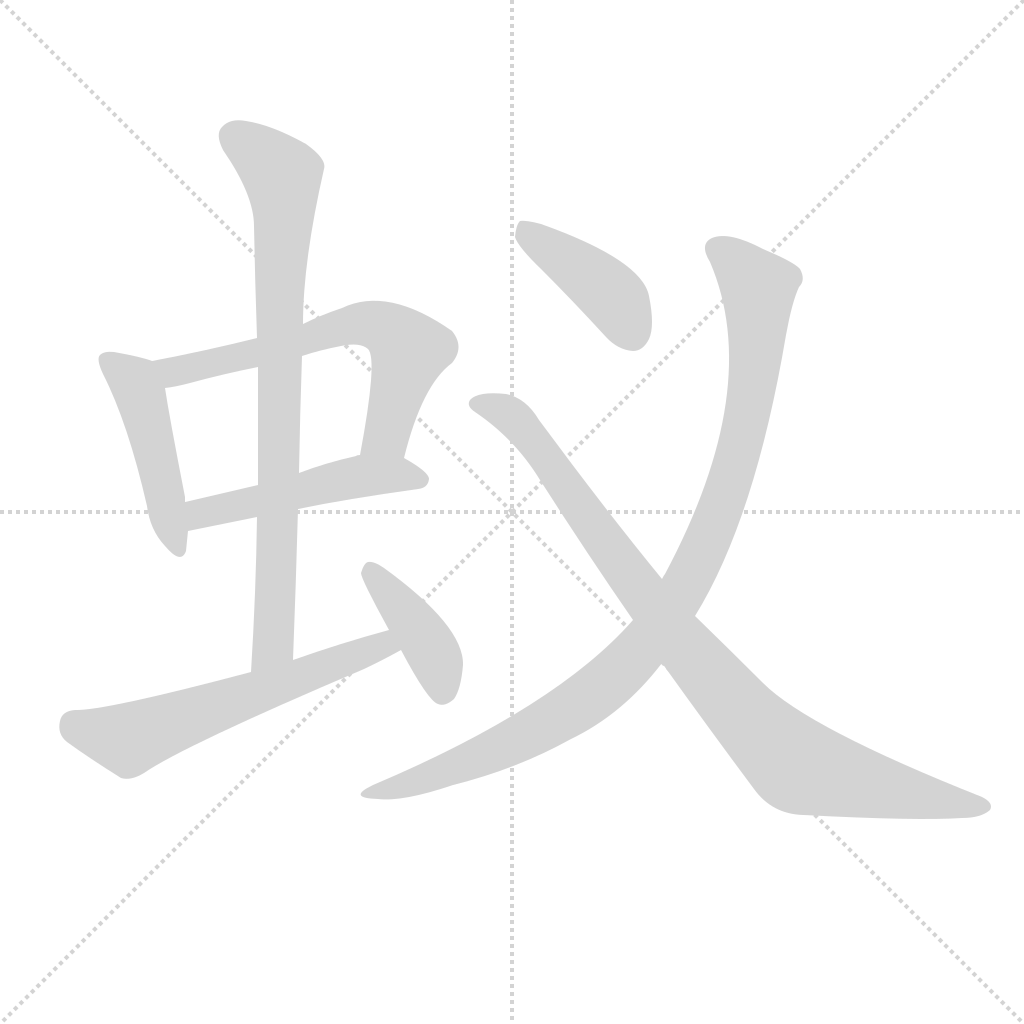
Pronounced yi (rising tone).
Shuowen Jiezi (Shuowen) records it as a variant form, referring to an ant.
Erya: Explanations of Insects (Erya) states that the pifou is a large ant. The commentary explains that ant is the general term; the large variety is specifically called pifou, commonly known as the horse-ant. The small variety is called ant. People in Qi call it yang. The Dialects (Fangyan) states that in the regions of Qi and Lu, it is called goushang. In the southwest regions of Liang and Yi, it is called yuangou. In Yan, it is called ezhang. Their nests are called di or die. The large species with red markings is called long, also known as deng-ant. Those with wings that can fly are called flying ants.
Records of Past and Present (Gujin Zhu): People in Henei once saw thousands of men and horses crossing a river, all the size of millet grains, moving back and forth. When burned, the men turned into gnats and the horses into large ants; thus, the ant is called the primal foal.
Sequel to the Treatise on Diverse Matters (Xu Bowuzhi): Termites turn into water when they hear the cry of the bamboo partridge.
There is also the ant-garment. Book of Documents (Shu): Hemp ceremonial cap and ant-colored garments. The commentary explains that ant is the name of the garment, which is black in color.
There is also Ant Hill, which is the name of a mountain. Zhuangzi: Records of Ze Yang (Zhuangzi): Confucius traveled to the State of Chu and stayed at a tavern at Ant Hill.
There is also White Ant, which is the name of a horse. Treatise on Diverse Matters (Bowuzhi): Among the eight fine horses of King Mu of Zhou, the third is named White Ant.
There is also floating ant, referring to the foam on the surface of wine. Zhang Heng: Rhapsody on the Southern Capital (Nandu Fu): The floating ants are like duckweed.
Also pronounced yi (falling tone). The meaning is the same.
Erya: Originally written as a variant form. Book of Rites (Liji): Commonly written as a variant form. See the detailed entry under the character for moth.