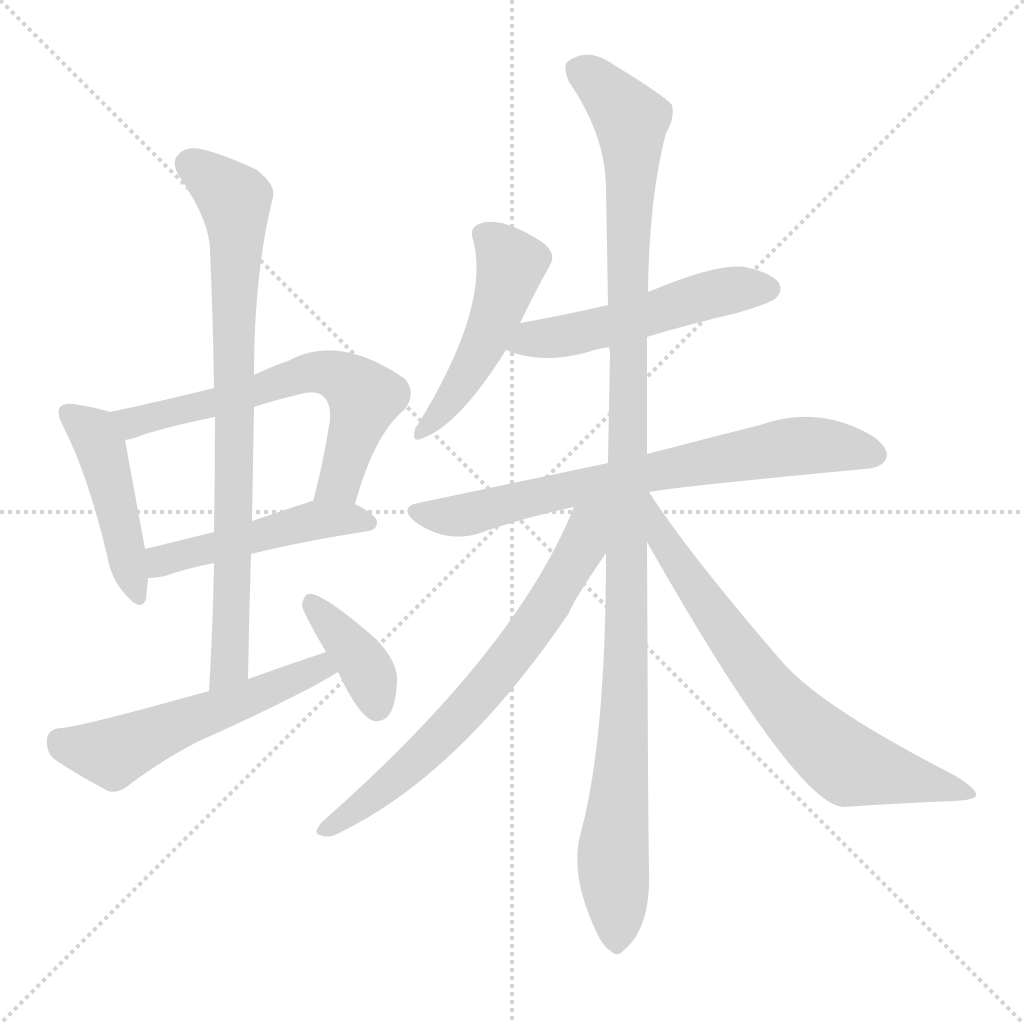
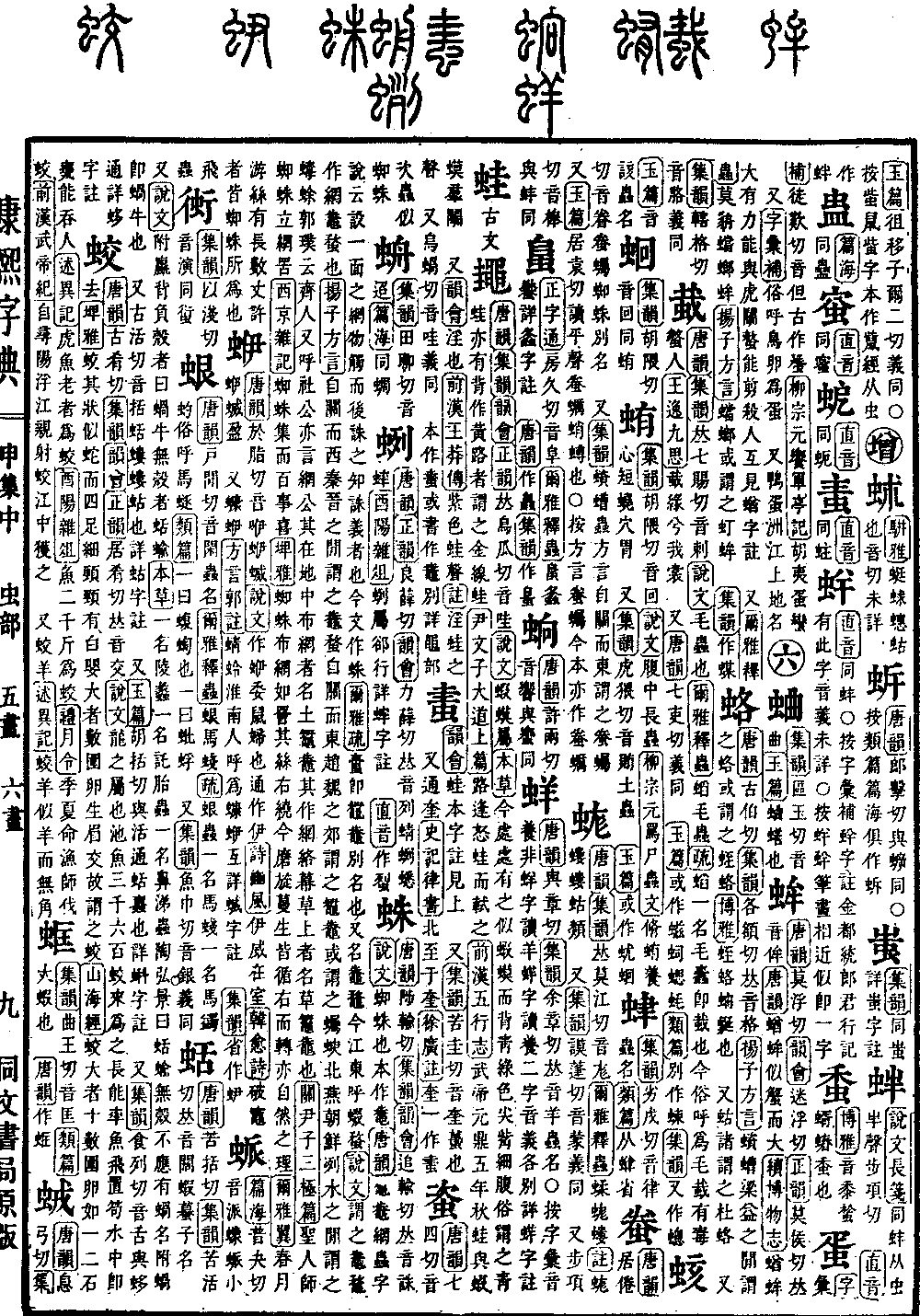
Shen Collection, Middle Volume. Radical: Insect (chóng). Kangxi strokes: 12. Page 1081, Entry 31.
Pronounced zhu.
According to the Explaining Graphs and Analyzing Characters (Shuowen Jiezi), it refers to a spider. Originally written as a variant form (zhū).
According to the Tang Rhyme (Tangyun), it is a web-spinning insect. The Book of Character Explanations (Zishuo) states: It sets up a net on one side, and when a creature touches it, it kills (zhu) it thereafter; this is why it carries the meaning of killing. In modern texts, it is written as spider (zhu).
According to the Commentary on the Erya (Erya Shu), it is another name for a spider, also known as a zhūmáo. In the region east of the Yangtze River, it is currently called dìngmáo.
According to the Explaining Graphs and Analyzing Characters (Shuowen Jiezi), it is called a zhūmáo, which creates a web.
According to the Regional Speech (Fangyan) by Yang Xiong, from the pass westward, in the regions of Qin and Jin, it is called a zhūmáo. From the pass eastward, in the outskirts of Zhao and Wei, it is called a zhū, or sometimes a zhú. In the region of Northern Yan and Korea, between the Lie River, it is called a dàichú. Guo Pu states: People of Qi also call it the lord of the shrine, and also refer to it as the lord of the net. Those that spread nets on the ground are called earth spiders. Those that create a net-like curtain over grass are called grass spiders.
According to the Three Ultimates Chapter of Guan Yinzi, the sage modeled the creation of nets and traps after the spider.
According to the Miscellaneous Records of the Western Capital (Xijing Zaji), if spiders gather, all affairs will be joyful.
According to the Piya, a spider spreads its web like a fishing net, with its silk spiraling to the right. Modern millstones and climbing vines all follow a rightward rotation, which is also a principle of nature.
According to the Erya Yi, the floating threads seen in the spring months, sometimes several fathoms long, are all produced by spiders. The character máo is written with the components for striving (wù) and toad (mǐn).