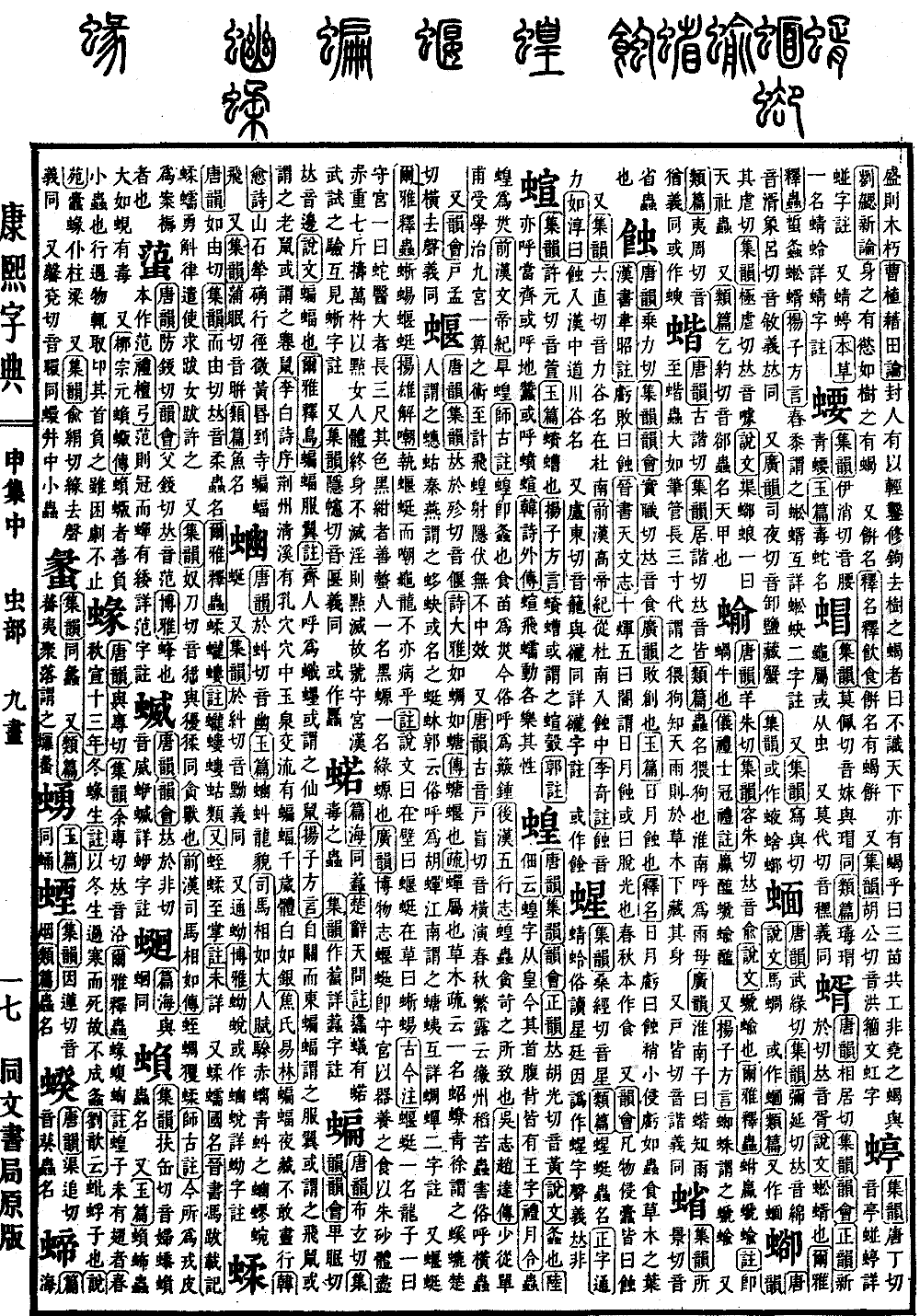
Shen Collection, Middle Volume. Radical: Insect (chóng). Character: shi. Kangxi strokes: 15. Page 1089, Entry 10.
According to Tang Rhymes (Tangyun), pronounced shi (rising tone). According to Collected Rhymes (Jiyun) and Rhyme Collection (Yunhui), pronounced shi (entering tone). In the Extensive Rhymes (Guangyun), it means a festering sore. In the Jade Chapters (Yupian), it refers to an eclipse of the sun or moon. In Explanation of Names (Shiming), it states that the sun and moon becoming obscured is called shi, implying a gradual encroachment and decay, similar to insects eating the leaves of plants and trees. In the Commentary by Wei Zhao to the History of the Han (Hanshu), it states that to decay or fail is called shi. In the Treatise on Astronomy in the History of the Jin (Jinshu), it refers to the ten radiances, the fifth of which is darkness, signifying an eclipse of the sun or moon, sometimes described as the loss of light. In the Spring and Autumn Annals (Chunqiu), the character is originally written as eat. Furthermore, according to the Rhyme Collection (Yunhui), anything eroded by insects is called shi.
Also, according to Collected Rhymes (Jiyun), pronounced li (entering tone). It is the name of a valley, located south of Du. In the Annals of Emperor Gaozu in the Former History of the Han (Qianhan shu), it mentions entering through the south of Du into the Shi valley. Li Qi’s commentary states that shi is pronounced li. Ru Chun states that shi is the name of a river valley on the road entering Hanzhong.
Also, pronounced long. Same as the variant form long. Please refer to the detailed entry for the character long. Also written in a variant form.