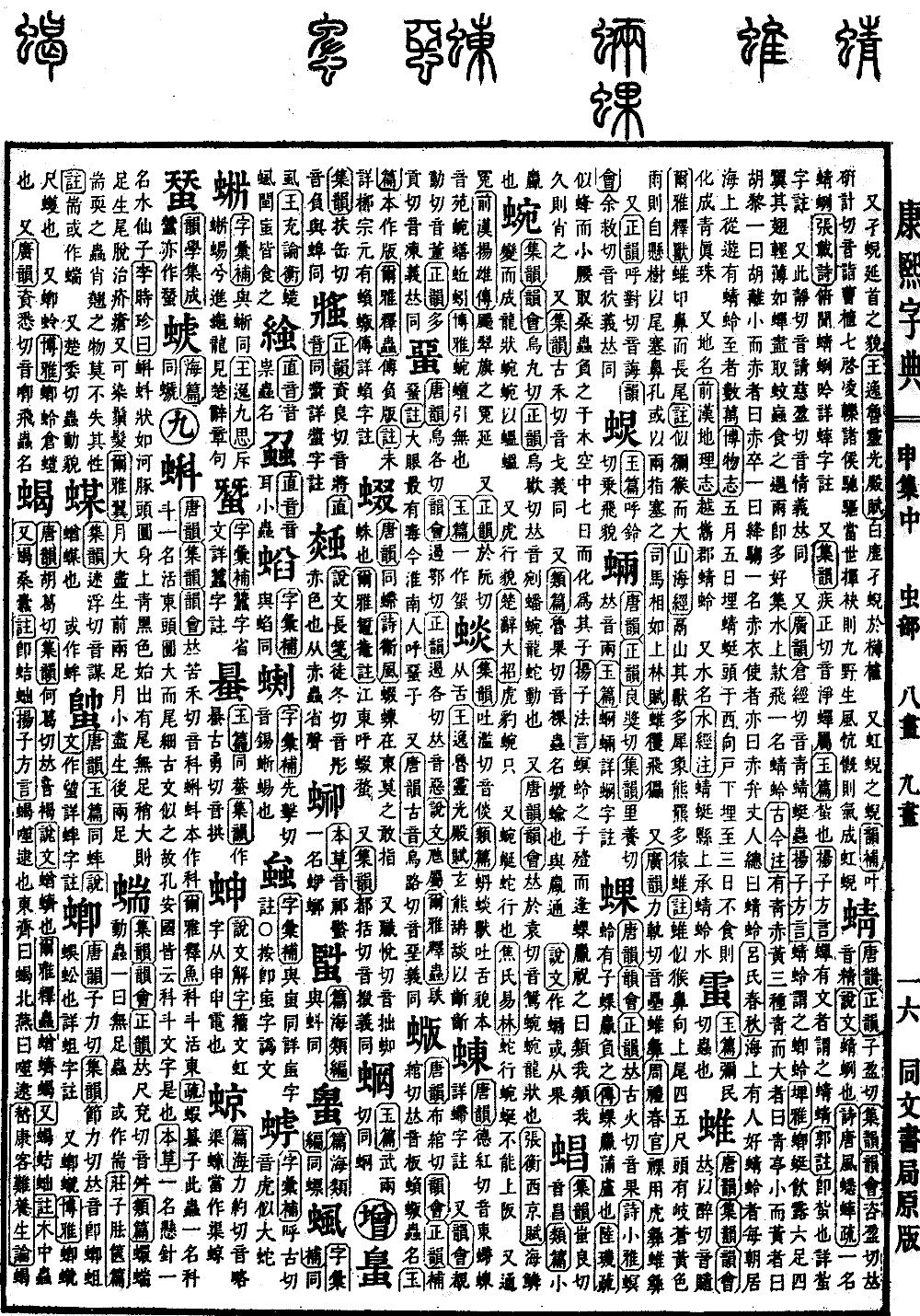
Shen Collection, Middle Volume
Radical: Insect (chóng)
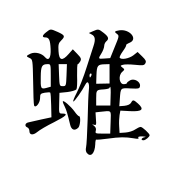
蜼
Kangxi Strokes: 14
Page 1088, Entry 03
Tang Rhymes (Tangyun), Collected Rhymes (Jiyun), Dictionary of Rhymes (Yunhui): Pronounced yi (falling tone).
Erya: Explanations of Animals (Erya Shishou): The yi has an upturned nose and a long tail.
Commentary: It resembles a macaque but is larger.
Classic of Mountains and Seas (Shanhaijing): On Mount Ge, there are many rhinoceroses, elephants, bears, and brown bears, as well as many apes and yi.
Commentary: The yi is similar to a monkey; its nose turns upward, its tail is four or five feet long, and its head has a split or fork. Its fur is a pale yellow color. When it rains, it hangs itself from a tree and uses its tail to plug its nostrils, or it uses two fingers to plug them.
Sima Xiangru: Rhapsody on the Imperial Park (Shanglin Fu): The yi and the jue leap and fly.
Also, Wide Rhymes (Guangyun): Pronounced lei (rising tone).
Yi-yi (a type of ritual vessel).
Rites of Zhou (Zhouli), Office of Spring (Chunguan): In libation ceremonies, the tiger vessel and the yi vessel are used.
Also, Correct Rhymes (Zhengyun): Pronounced hui (falling tone).
Dictionary of Rhymes (Yunhui): Pronounced you (falling tone).
The meaning is the same.