Shen Collection, Lower Volume
Radical: Insect (chóng)
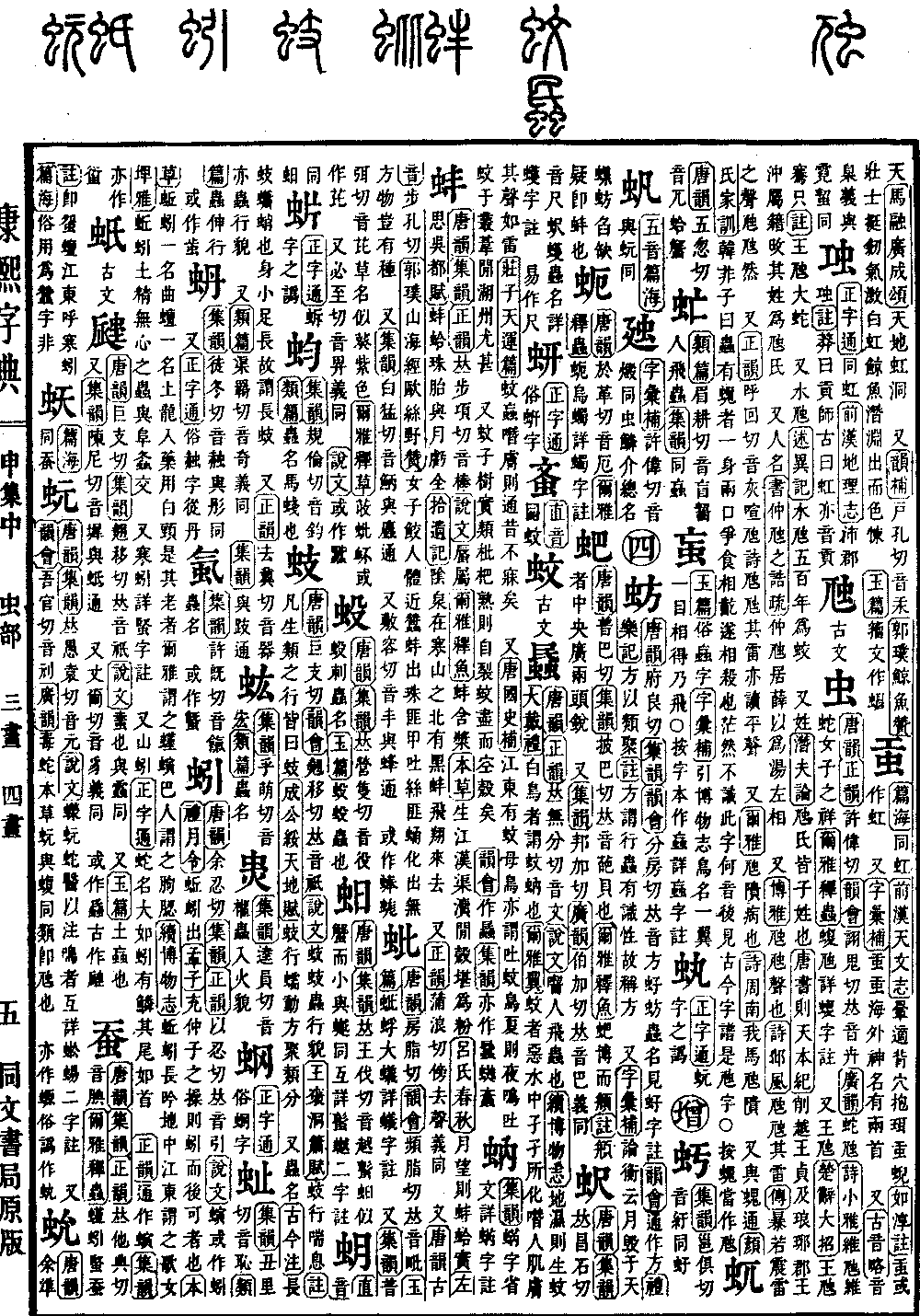
蚊
Kangxi Strokes: 10
Page 1077, Entry 18
Ancient texts write this as 蟁.
Tang Rhymes (Tangyun) and Correct Rhymes (Zhengyun) state the pronunciation is wén.
Explaining Graphs and Analyzing Characters (Shuowen Jiezi) explains: A flying insect that bites humans.
Continuation of the Records of Broad Knowledge (Xu Bowuzhi) records: Land that is damp will breed mosquitoes.
Records of the Elder Dai (Da Dai Liji) mentions: The term white bird refers to mosquitoes and gnats.
Wings of the Literary Encyclopedia (Erya Yi) describes: Mosquitoes are transformed from larvae in stagnant water; they bite human skin, and their flight sound is like thunder.
Zhuangzi, Chapter on the Mandate of Heaven (Zhuangzi Tianyun Pian) says: Mosquitoes and horseflies biting the skin can cause a person to be unable to sleep all night.
According to the Supplement to the Tang National History (Tang Guoshi Bu), there is a mosquito-mother bird in the Jiangdong region, also called the mosquito-spitting bird; it calls at night in summer and spits out mosquitoes among the reeds; this is especially common in the Huzhou region.
There is also a mosquito tree; its fruit resembles a loquat, and when it matures, it splits open on its own, the mosquitoes fly away, and only an empty shell remains.
Rhyme Collection (Yunhui) writes this as 蟁.
Collected Rhymes (Jiyun) also records it as 蟁.