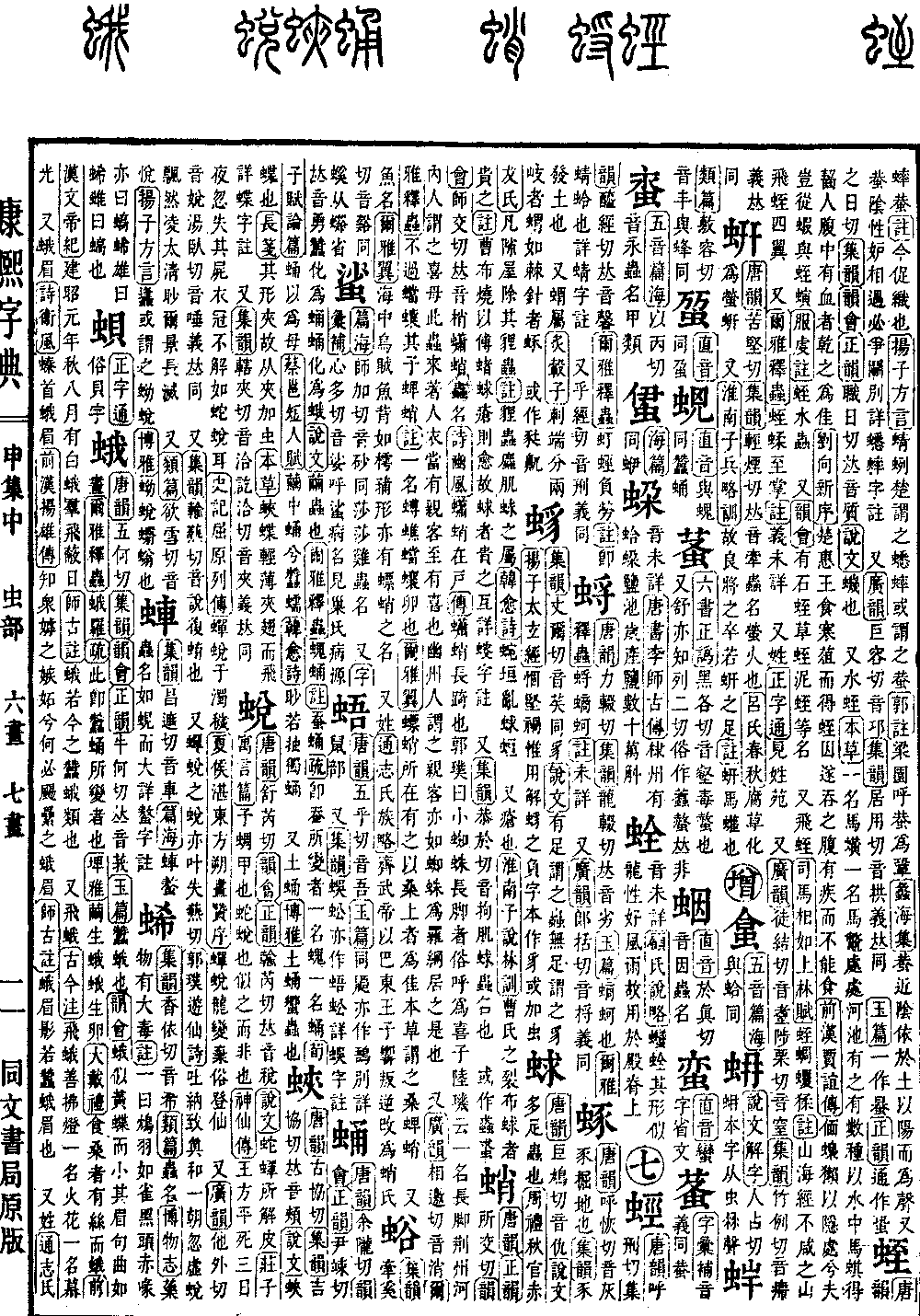
Shen Collection, Middle Volume. Radical: Insect (chóng). Kangxi strokes: 12. Page 1083, Entry 01.
Pronounced zhi.
Shuowen Jiezi (Shuowen) defines this as a louse. It also refers to the leech.
Bencao (Materia Medica) states that it is also known as the horse leech or horse turtle. They are found in rivers and ponds everywhere. There are several varieties; those found in water that attach to a person's stomach to draw blood are considered the best when dried.
Liu Xiang's New Preface (Xinxu): King Hui of Chu was eating pickled vegetables and found a leech, which he swallowed; he then suffered from a stomach ailment and could not eat.
Biography of Jia Yi in the Book of Han (Hanshu): Turning my back on water otters to hide away, how could I follow the shrimp, leeches, and earthworms?
Fu Qian's commentary: A leech is a water insect.
According to the Yunhui dictionary, there are also names such as stone leech, grass leech, and mud leech.
There is also the flying leech. Sima Xiangru's Rhapsody on the Shanglin Park (Shanglin Fu): Leeches, cicadas, and monkeys. The commentary to the Classic of Mountains and Seas (Shanhaijing) states: On the mountain of Buxian, there is a flying leech with four wings.
Erya: Interpreting Insects (Erya Shi Chong): The term zhi is also called rou, pronounced zhi zhang. The commentary notes that the meaning is not yet clear.
It is also a surname. See the Surname Garden (Xingyuan) in the Zhengzitong dictionary.
Pronounced die. Pronounced zhi. Pronounced lie. The meanings are the same.