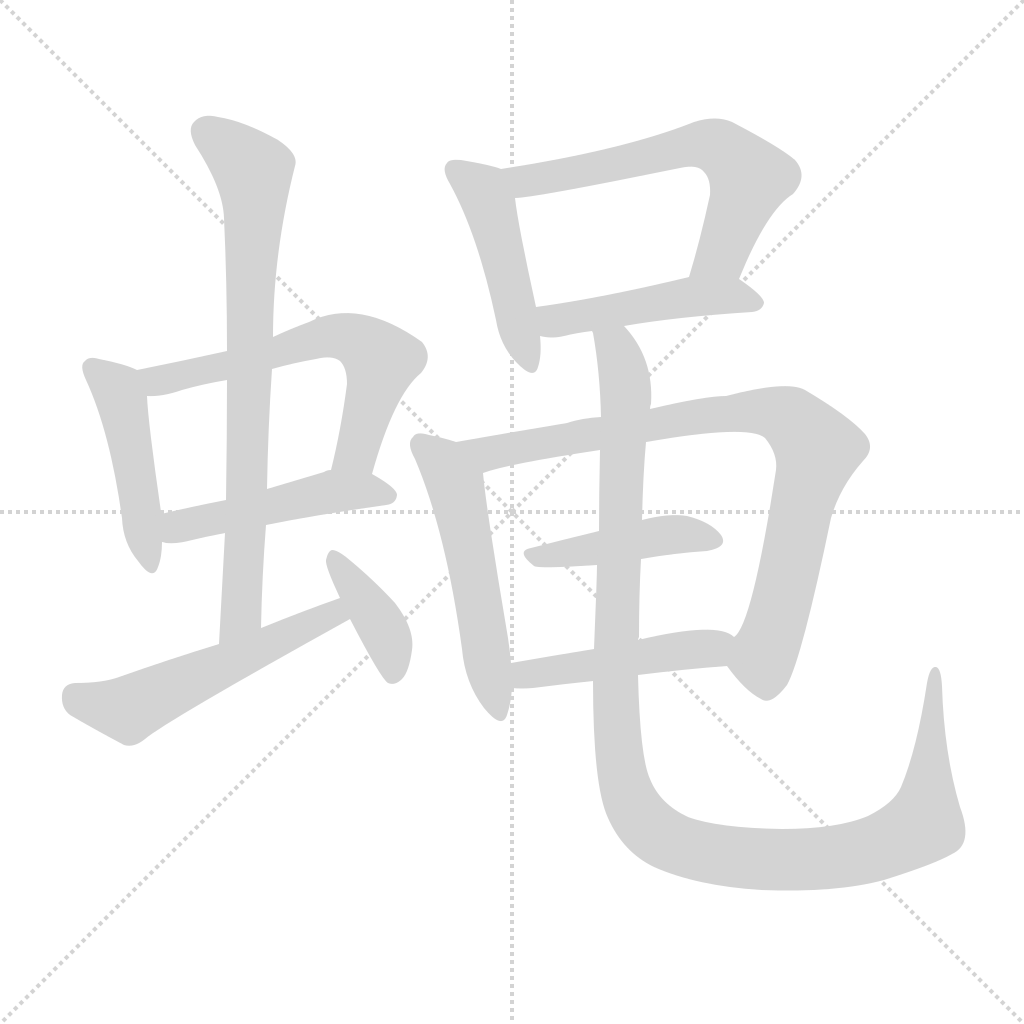
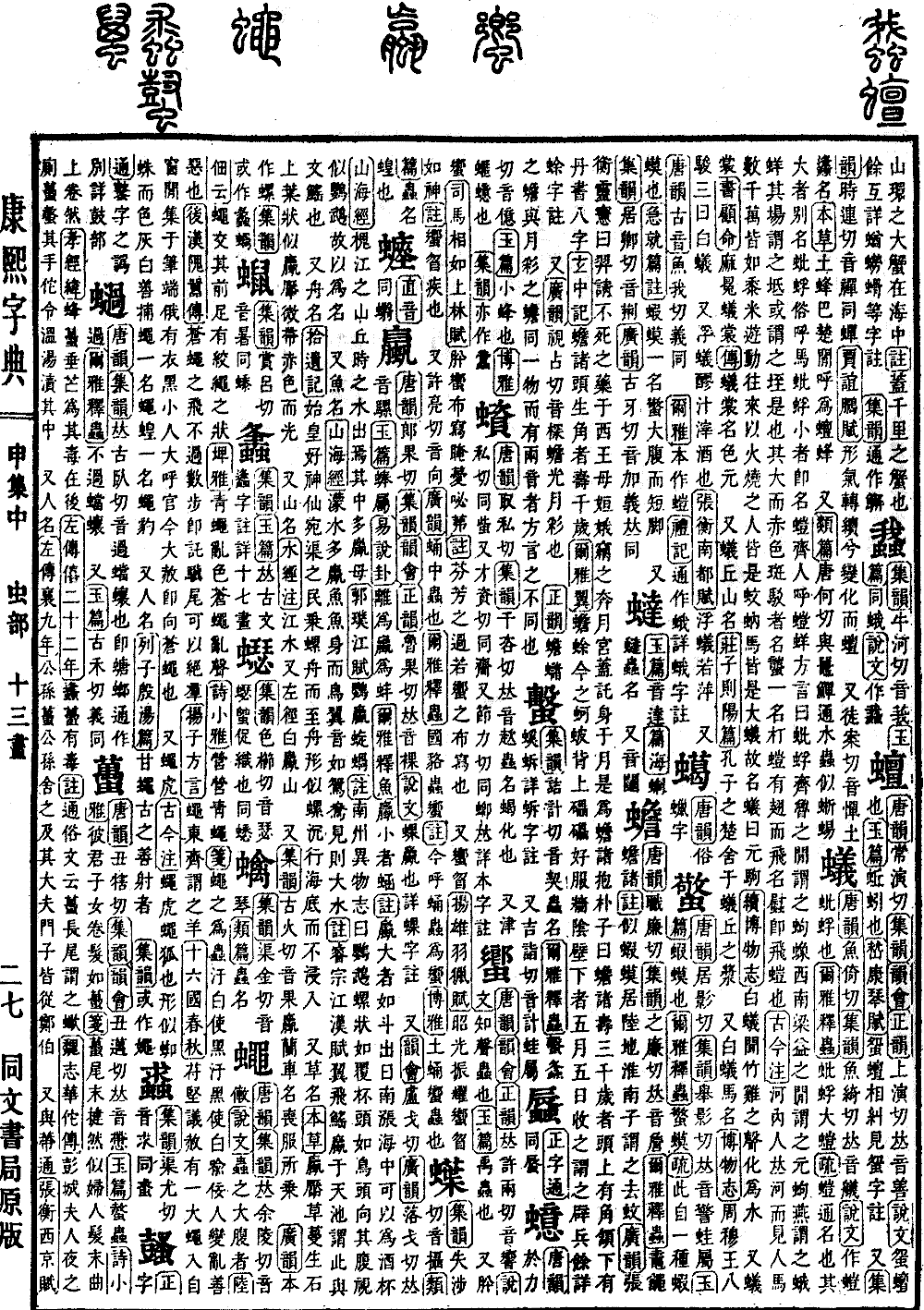
Shen Collection, Middle Volume. Radical: Insect (chóng). Kangxi stroke count: 19. Page 1099, Entry 02.
Pronounced ying.
According to the Tang Rhyme (Tangyun) and Collected Rhymes (Jiyun), the pronunciation is ying (rising tone).
According to the Explaining Graphs and Analyzing Characters (Shuowen), it is an insect with a large abdomen. Lu Dian stated that flies rub their front feet together in a manner resembling the twisting of ropes. The Piya states that green flies confuse colors, while houseflies confuse sounds.
Book of Odes (Shijing), Lesser Odes (Xiao Ya): The humming green flies. The commentary notes that the fly is an insect that makes white things black and black things white, a metaphor for sycophants who confuse good and evil.
History of the Later Han (Hou Hanshu), Biography of Wei Xiao: The flight of a housefly does not exceed a few paces, yet if it attaches itself to the tail of a thoroughbred horse, it can travel a great distance.
Yangzi's Dialects (Fangyan): The fly is called a sheep in eastern Qi.
Spring and Autumn Annals of the Sixteen Kingdoms (Shi Liu Guo Chun Qiu): When Fu Jian was debating an amnesty, a large fly entered through a window and landed on the tip of his brush. Suddenly, a small person dressed in black appeared, shouting loudly that the official was now granting a great amnesty, and then turned toward the fly.
Also known as the fly tiger. According to Records of Ancient and Modern Matters (Gujin Zhu), the fly tiger is also called the fly fox. It is shaped like a spider, is gray-white in color, and is skilled at catching flies. One name for it is the fly locust, and another is the fly leopard.
Also a personal name. Liezi, Questions of Tang (Tangwen): Gan Ying, an expert archer of antiquity.
Collected Rhymes (Jiyun): Sometimes also written in a variant form.
Textual research: In the section citing Liezi, Book of Yin Tang, it has been corrected to the Questions of Tang (Tangwen) to match the original text.