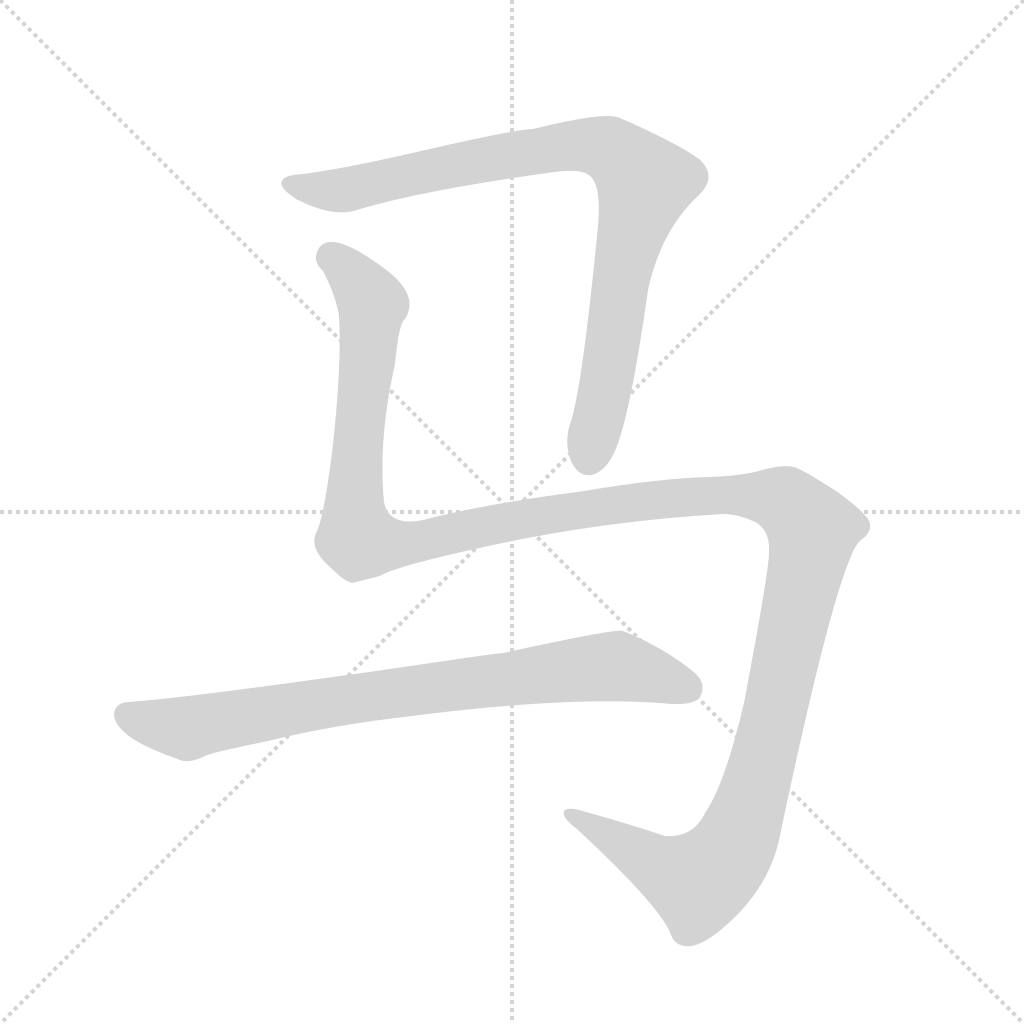
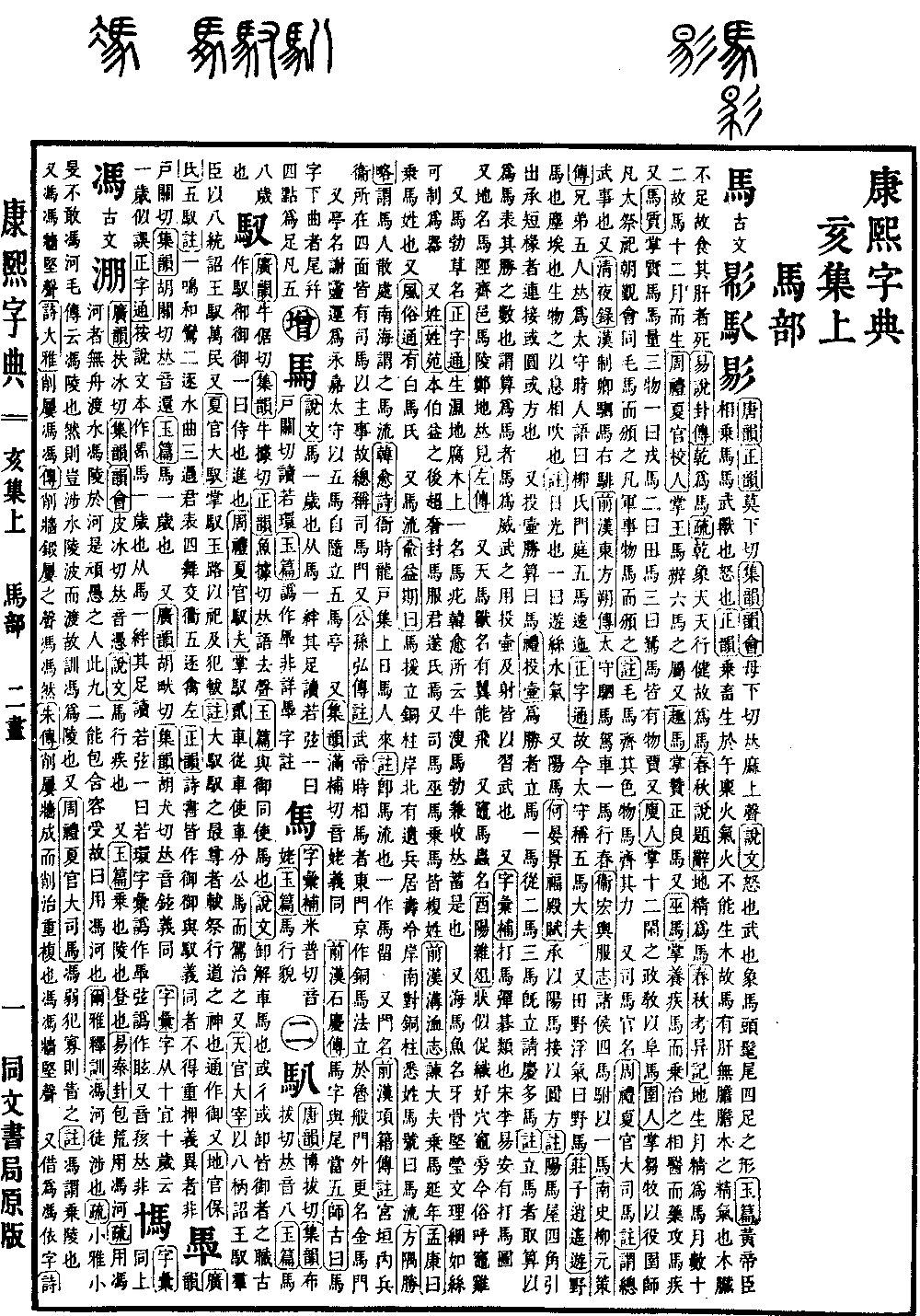
Hai Collection, Upper Volume. Radical: Horse (mǎ). Kangxi dictionary strokes: 10. Page 1433, Entry 01.
Ancient character. Pronounced ma (rising tone).
Shuowen Jiezi (Explanation of Simple and Compound Characters): Denotes anger, denotes martial strength. It resembles the form of a horse's head, mane, tail, and four legs.
Yupian (Jade Chapters): A minister of the Yellow Emperor who rode horses. The horse is a martial beast, representing anger.
Zheng Yun (Correct Rhymes): A beast for riding. It is born in the hour of the Horse and possesses the nature of fire. Fire cannot produce wood; thus, the horse has a liver but no gallbladder. The gallbladder is the refined essence of wood. Because the wood organ is insufficient, one who eats its liver will die.
Book of Changes (I Ching), Commentary on the Trigrams: The Qian trigram represents the horse.
Commentary: Qian symbolizes Heaven; Heaven’s motion is strong and vigorous, therefore it is a horse.
Chunqiu Shuotici (Apocryphal Texts on the Spring and Autumn Annals): The essence of the earth becomes the horse.
Chunqiu Kaoyiji (Records of the Examination of Anomalies in the Spring and Autumn Annals): The earth produces the essence of the moon, which becomes the horse. The moon has a cycle of twelve, therefore the horse matures in twelve months.
Rites of Zhou (Zhou Li), Ministry of Summer, Master of Horse Quality: Oversees the quality of horses. Horses are measured by three criteria: first, war horses; second, field horses; third, draft horses. All have set market prices.
Also, the Supervisor of Horses oversees the royal horses, distinguishing the categories of the six types of horses. During all great sacrifices, imperial audiences, and formal meetings, they distribute them by coat color. During military affairs, they distribute them by strength. Note: Coat color refers to matching their appearance. Strength refers to matching their physical capacity.
Also, the Assistant of Horses oversees the management of quality horses.
Also, the Shaman of Horses oversees the care of sick horses, treating them with medicine to combat equine illnesses.
Also, the Keeper of Horses oversees the twelve government pastures to increase the horse population.
The Groom oversees grazing and fodder to serve the animal keepers.
Also, Sima (Minister of War), a title of an official.
Rites of Zhou, Ministry of Summer, Commentary on the Grand Minister of War: Refers to the management of all military affairs.
Qing Ye Lu (Records of the Quiet Night): According to the Han dynasty system, a high official was accompanied by four horses, with a horse on the right side of the carriage.
History of the Former Han (Qian Han Shu), Biography of Dongfang Shuo: A governor travels by a four-horse carriage; one horse accompanies his spring inspection.
Wei Hong, Treatise on Carriages and Attire (Yufu Zhi): Feudal lords used four horses, with an additional spare horse.
History of the Southern Dynasties (Nan Shi), Biography of Liu Yuance: Five brothers were all governors. People of the time said: The Liu family gates are graced by five horses.
Zhengzitong (Standard Character Comprehensive): Therefore, today, governors are called Five-Horse Gentlemen.
Also, shimmering air over fields is called wild horse.
Zhuangzi, Free and Easy Wandering: It is the wild horse, the floating dust; living beings blow upon one another with their breath.
Note: Refers to sunlight. Another definition is gossamer or water vapor.
Also, Yangma (a structural component): He Yan, Rhapsody on the Jingfu Palace: Supported by the Yangma, connecting circles and squares.
Note: Yangma is the element at the four corners of a roof that supports short rafters, connecting circular or square shapes.
Also, a tally used in the game of pitch-pot is called a horse.
Rites of Pitch-pot (Touhu Li): For the winner, set up the horse; one horse follows two horses; once three horses are standing, request to celebrate the high count.
Note: Setting up the horse means using tally sticks as horses to represent the number of victories. They are called horses because horses are used for martial display; both pitch-pot and archery are ways to practice martial arts.
Also, Zihui Bu (Supplement to the Character Dictionary): Da Ma (hitting the horse) is a type of board game. Zhu and Li Yian (Li Qingzhao) had a manual for the game Da Ma.
Also, a place name. Maxing was a city in Qi. Maling was a place in Zheng. Both appear in the Zuo Zhuan (Commentary of Zuo).
Also, Celestial Horse, a creature with wings that can fly.
Also, Zao Ma (stove horse), a name for an insect. Youyang Zazu (Miscellaneous Morsels from Youyang): It resembles a cricket and likes to dwell by the stove. Today, commoners call it the stove chicken.
Also, Mabo (puffball), a name for a plant. Zhengzitong: It grows on damp, rotting wood. Also known as Ma Pi. As Han Yu said, gathering both cow urine and puffballs means collecting everything.
Also, Seahorse, a fish name. Its bones and teeth are hard and glossy, with fine, thread-like markings; it can be crafted into implements.
Also, a surname. Xingyuan (Garden of Surnames): Originally descendants of Boyi. Zhao She was enfeoffed as the Lord of Mafu, and thus the surname was adopted.
Also, Sima, Wuma, and Chengma are all double-character surnames.
History of the Former Han, Treatise on Irrigation: The Remonstrance Grandee Chengma Yannian.
Meng Kang states: Chengma is a surname.
Also, Fengsu Tong (Comprehensive Meaning of Customs): There is the Baima (White Horse) clan.
Also, Ma Liu. Yu Yiqi says: When General Ma Yuan erected the copper pillar, there were leftover troops north of the river living on the Shou-leng shore, south facing the copper pillar. All were surnamed Ma, and they were called Ma Liu. Fangyu Shenglue (Summary of Territories) states that the Ma people scattered in the South Seas are called Ma Liu.
Han Yu's poems: When the dragon-gate officials assemble at the office, the Ma people come on the sun-day.
Note: This refers to the Ma Liu. One version writes it as Ma Liu (alternative characters).
Also, a gate name. History of the Former Han, Annotation to the Biography of Xiang Ji: Within the palace walls where the guards were stationed, all four sides had Sima gates to manage affairs, hence the general term Sima Gate.
Also, Annotation to the Biography of Gongsun Hong: During the reign of Emperor Wu, the horse judge Dongmen Jing created a bronze horse model, which was placed outside the Luban Gate, and it was renamed the Golden Horse Gate.
Also, a pavilion name. Xie Lingyun was the governor of Yongjia and was accompanied by five horses, so he established the Five-Horse Pavilion.
Also, Jiyun (Collection of Rhymes): Pronounced mu (rising tone). Same meaning.
History of the Former Han, Biography of Shi Qing: The character for horse and the tail should be five.
Shigu says: In the character for horse, the lower curved part is the tail, together with the four dots representing the feet, it is five.