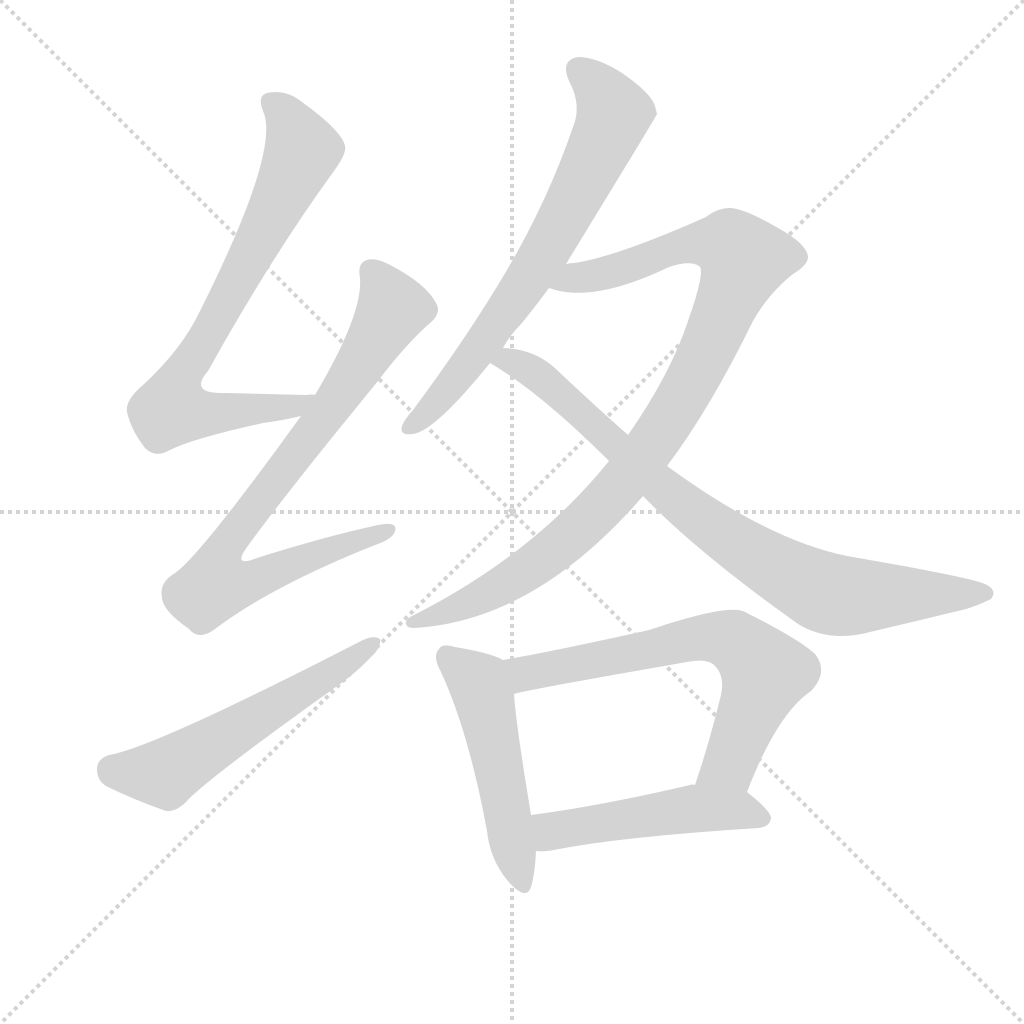
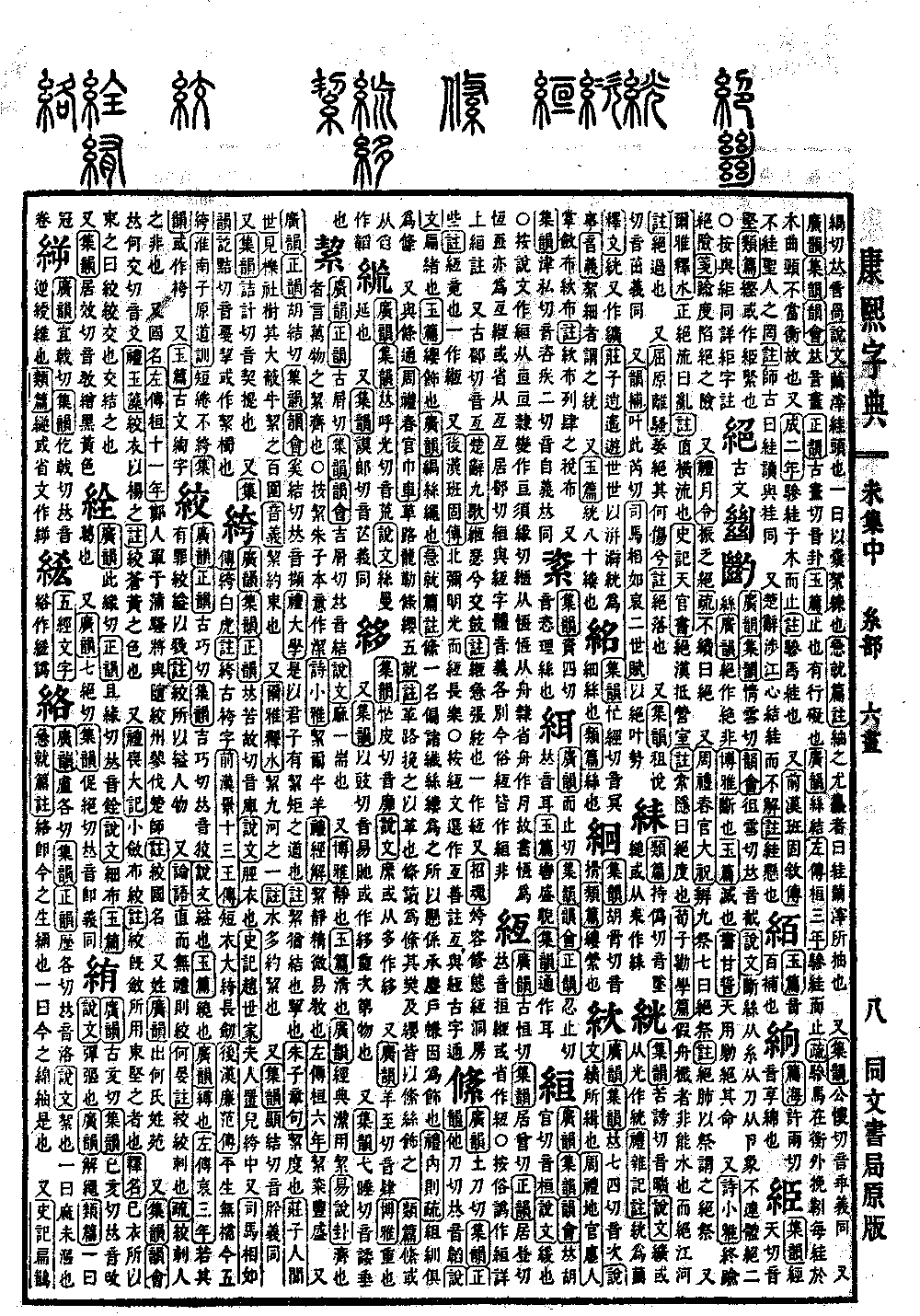
Wei Collection, Middle Volume
Radical: Silk (mì)
Kangxi Strokes: 12
Page 922, Entry 14
Pronounced luo. According to the Analytical Dictionary of Characters (Shuowen Jiezi), it refers to silk floss. Another definition states it is hemp that has not yet been soaked. The commentary to the Quick Guide to Literacy (Jijiupian) states that this is what is now known as raw silk. Another definition holds that it is what is now known as cotton pongee.
Also, in the Records of the Grand Historian (Shiji), biography of Bian Que, it is mentioned in relation to the main channels and network vessels. The commentary notes that this refers to the twelve meridian channels and the twelve network vessels.
Also, in the History of the Former Han (Qianhanshu), biography of Yang Xiong, it is used to describe the wrapping of heaven and earth. The commentary notes this refers to encompassing or wrapping.
Also, in the Songs of Chu (Chuci), Summoning of the Soul, it is used in the sense of binding. The commentary notes that this means to tie up.
Also, in the Western Capital Rhapsody (Xidu Fu) by Ban Gu, it is used in the sense of enclosing mountains and surrounding the wilds. The commentary notes this means to coil around.
Also, in the Eastern Capital Rhapsody (Dongdu Fu) by Ban Gu, it is used in the sense of spreading across the earth. The commentary notes this means a net.
Also, in the Dialect (Fangyan) by Yang Xiong, it is noted that a rope for drawing water may be called by this name.
Also, in the Dialect (Fangyan) by Yang Xiong, it is noted that this term is sometimes referred to as a frame. The commentary notes this is the mechanism used to turn a winding reel for silk.
Also, as a surname.
Also, pronounced ke. The meaning is the same.
Also, in rhyme supplementation, it is rhymed as lu. In the Songs of Chu (Chuci), Summoning of the Soul, it appears in the line regarding the Qin brazier and Qi cords.