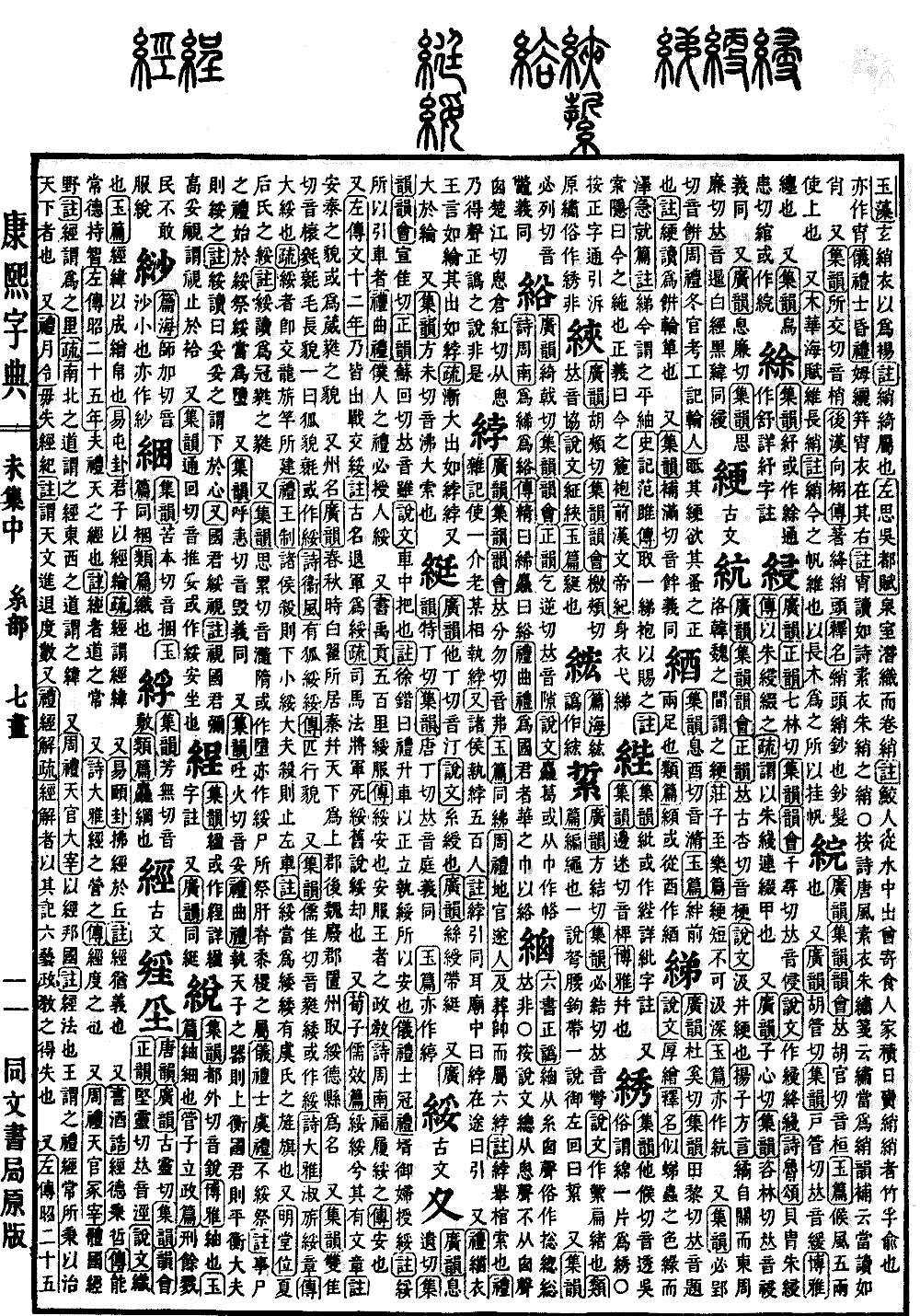
Wei Collection, Middle Volume
Radical: Silk (mì)
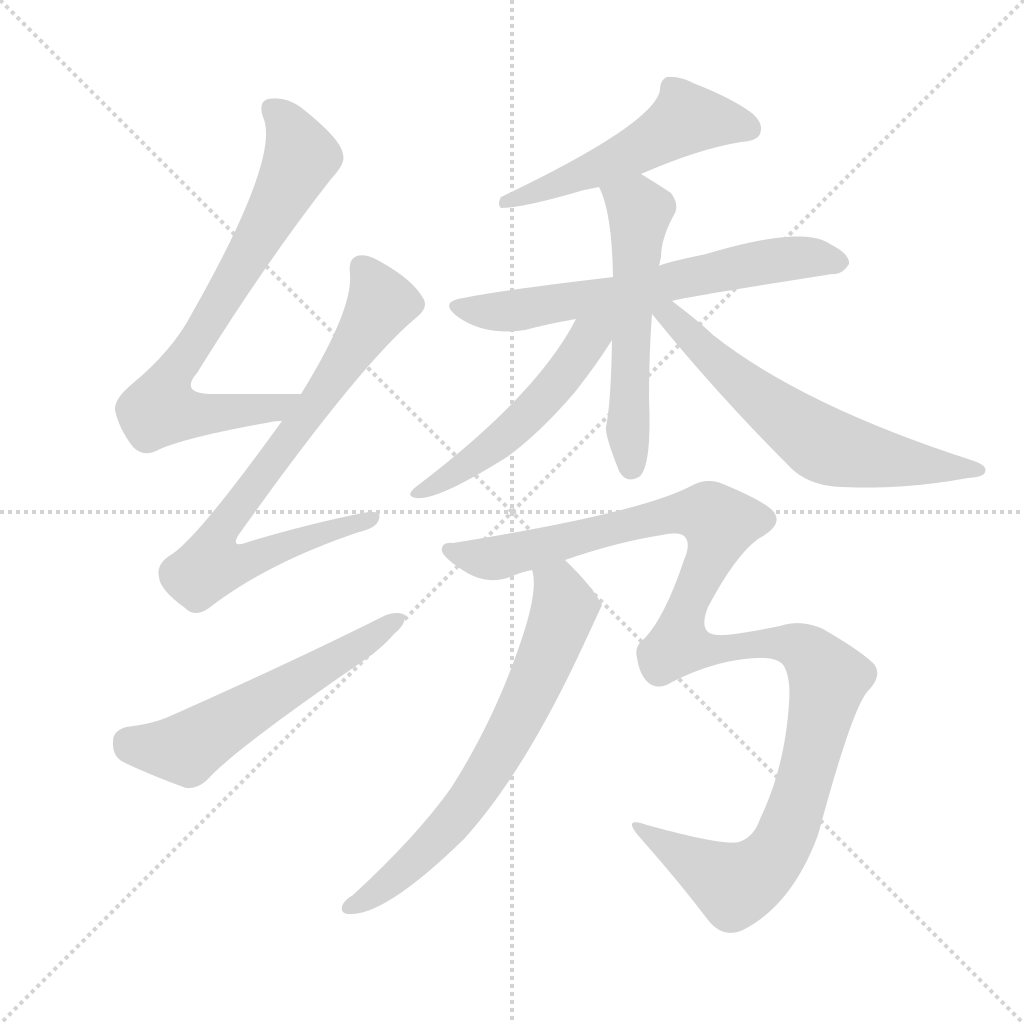
繡
Kangxi strokes: 18
Page 925, Entry 01
Guangyun (Guangyun), Jiyun (Jiyun), Yunhui (Yunhui), Zhengyun (Zhengyun): Pronounced xiu (falling tone), same pronunciation as xiu.
Shuowen (Shuowen): Refers to the completion of five colors.
Shiming (Shiming): Xiu is synonymous with the meaning of xiū (to cultivate/embellish), referring to the appearance of patterns that are long, refined, and orderly.
Book of Documents (Shujing), Yi Ji chapter: Refers to fine hemp cloth garments embroidered with black and white axe-shaped patterns and interweaving black and azure patterns.
Rites of Zhou (Zhouli), Winter Official, Artificers' Record (Kaogongji): The work of painting and embroidery, when possessing all five colors, is called xiu.
Also functions as a surname.
Quick Study of Surnames (Xingshi Jijiupian): In the Han dynasty, there was Xiu Junshi.
Also, Jiyun (Jiyun): Pronounced xiao (level tone), same pronunciation as xiao.
Leipian (Leipian): Refers to silk fabrics with patterns.
Book of Odes (Shijing), Tang Feng: On simple-colored garments, there are red embroidered patterns.
Jian (Jian): Xiu should be written as xiao.
Yunbu (Yunbu): Should be pronounced xiao.
Verification: Rites of Zhou, Winter Official, Artificers' Record: The work of painting and embroidery, possessing all five colors, is called xiu. Following the original text, the expression has been corrected to read as "is called" rather than "for."