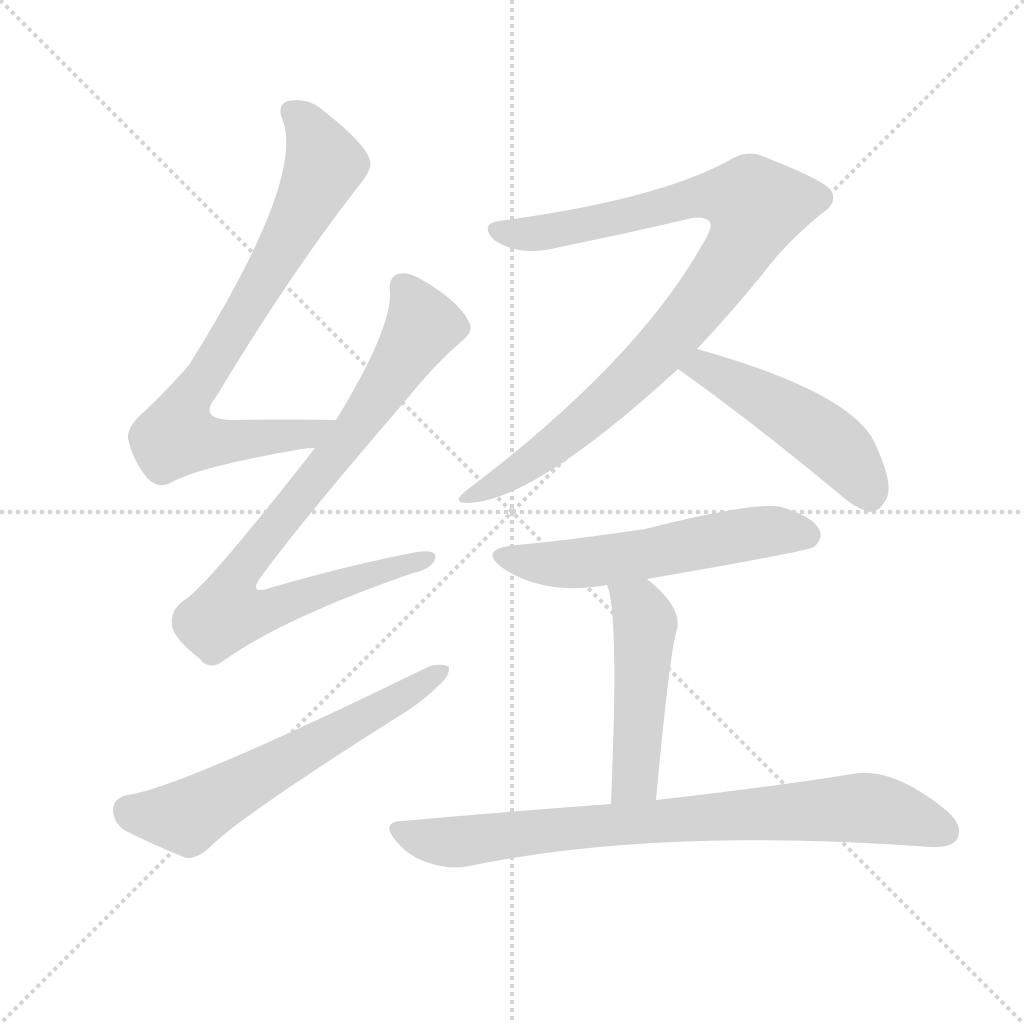
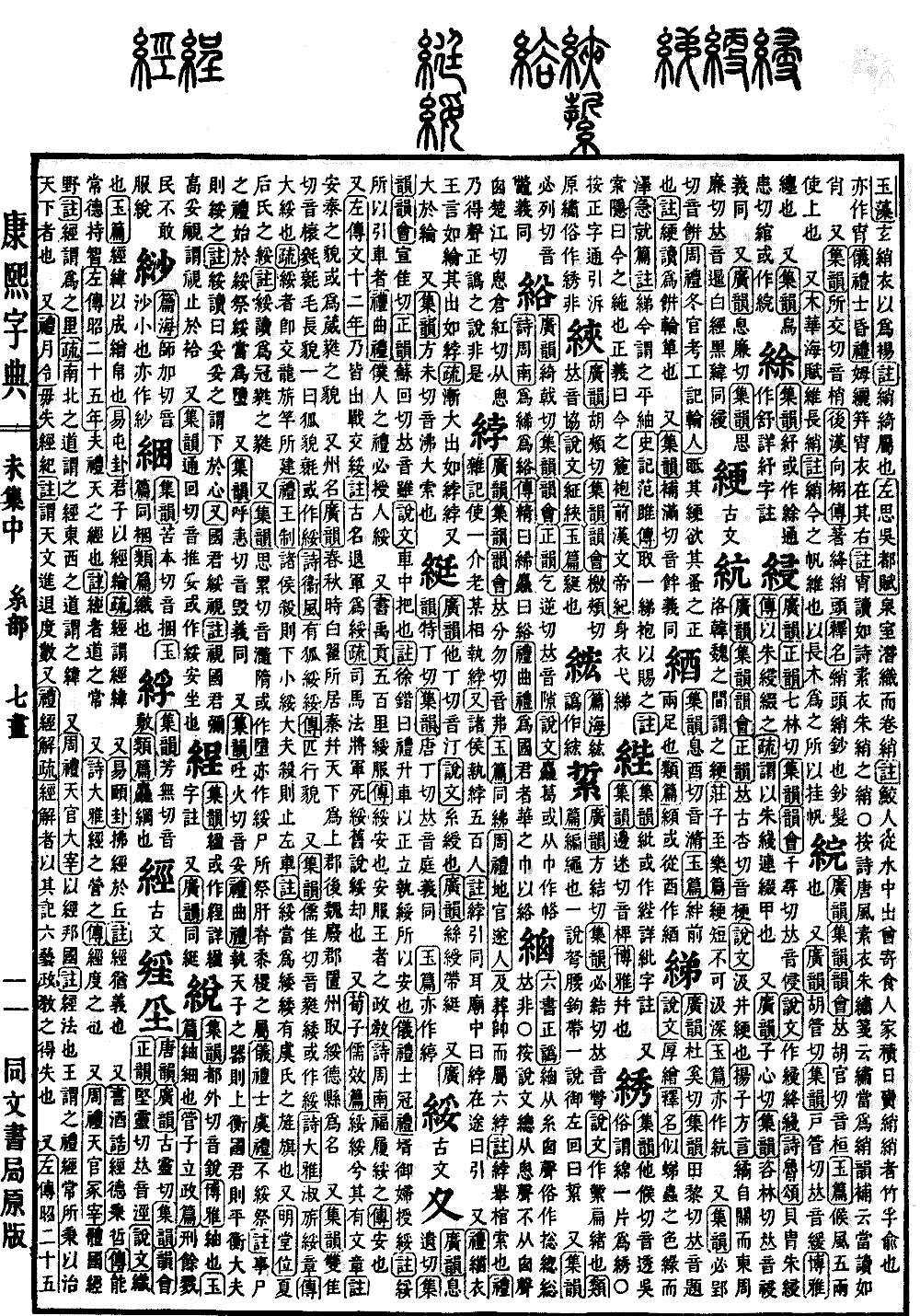
Wei Collection, Middle Volume
Radical: Silk (mì)
Kangxi stroke count: 13
Page 925, Entry 01
Ancient script form: 坕
According to Tang Rhymes (Tangyun) and Extensive Rhymes (Guangyun), pronounced jing; according to Collected Rhymes (Jiyun), Rhyme Meetings (Yunhui), and Orthodox Rhymes (Zhengyun), pronounced jing, pronounced like jing.
Explaining Graphs and Analyzing Characters (Shuowen Jiezi): To weave.
Jade Chapters (Yupian): The warp and woof of fabric used to create silk textiles.
Book of Changes (Yijing), Tun Hexagram: The superior man uses this to regulate and organize. Commentary: To regulate means the warp and the woof.
Also, Book of Changes (Yijing), Yi Hexagram: To brush past the warp at the hill. Commentary: Warp here means principles.
Also, Book of Documents (Shangshu), Announcement on Wine (Jiugao): To regulate virtue and hold fast to wisdom. Commentary: To be able to maintain constant virtue and uphold wisdom.
Zuo Commentary (Zuo Zhuan), 25th Year of Duke Zhao: Propriety is the warp of heaven. Commentary: Warp means the constants of the Way.
Also, Book of Odes (Shijing), Greater Odes (Daya): To plan it and to build it. Commentary: Warp means to measure or plan.
Also, Rites of Zhou (Zhouli), Offices of Heaven, Prime Minister: To structure the state and measure the wilderness. Commentary: Warp refers to establishing boundaries within them. Commentary: Paths running north-south are called warp; paths running east-west are called woof.
Also, Rites of Zhou (Zhouli), Offices of Heaven, Grand Minister: To organize the states and countries. Commentary: Warp means law. The king refers to those rituals and constants upheld to govern the world.
Also, Book of Rites (Liji), Monthly Ordinances (Yueling): Do not neglect the warp and the management. Commentary: Refers to the orbital degrees of the celestial bodies.
Also, Book of Rites (Liji), Commentary on the Explication of the Classics (Jingjie Shu): Explication of the classics refers to the recording of the merits and flaws of the Six Arts and political education.
Also, Zuo Commentary (Zuo Zhuan), 25th Year of Duke Zhao: Establishing the roles of husband and wife, internal and external, to manage the two spheres. Commentary: The husband manages the external, the wife manages the internal, each managing their own domain.
Also, Analects (Lunyu): To hang oneself in a ditch, yet no one knows of it. He Yan Commentary: To hang oneself dead in the middle of a ditch.
Stories of the States (Jin Yu): To hang oneself like a pheasant at the temple of Xincheng. Explanation of Names (Shiming): To bend the neck and stop the breath is called hanging like a pheasant, as a pheasant does.
Also, Extensive Rhymes (Guangyun), pronounced jing: To regulate the warp and woof. Also, to weave.
Also, Chu Ci (Lisao), Wang Yi Commentary: Warp means path. Explanation of Names (Shiming): Warp means path. Like a path, it is unobstructed everywhere and can be used constantly.
Also, Rhyme Supplements (Yunbu), rhyming with liang. Han Yu, Poem on the Regret of This Day: Closing the door to read history books, the cool breeze blows through the window. Every day I miss your visit; do you know my feelings? We have not been separated long, yet I have endured much hardship. Qing is pronounced xiang.
Five Classics Text (Wujing Wenzi): The author wrote this incorrectly.