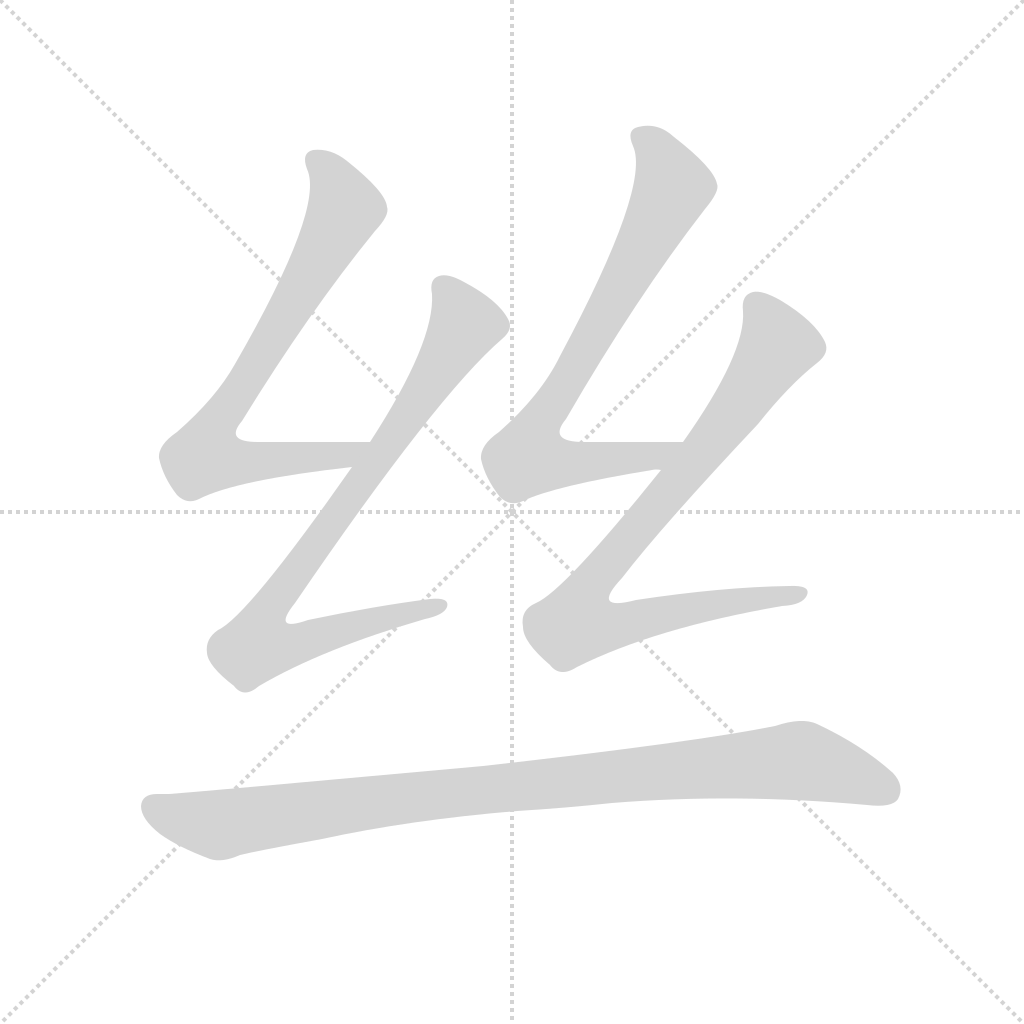
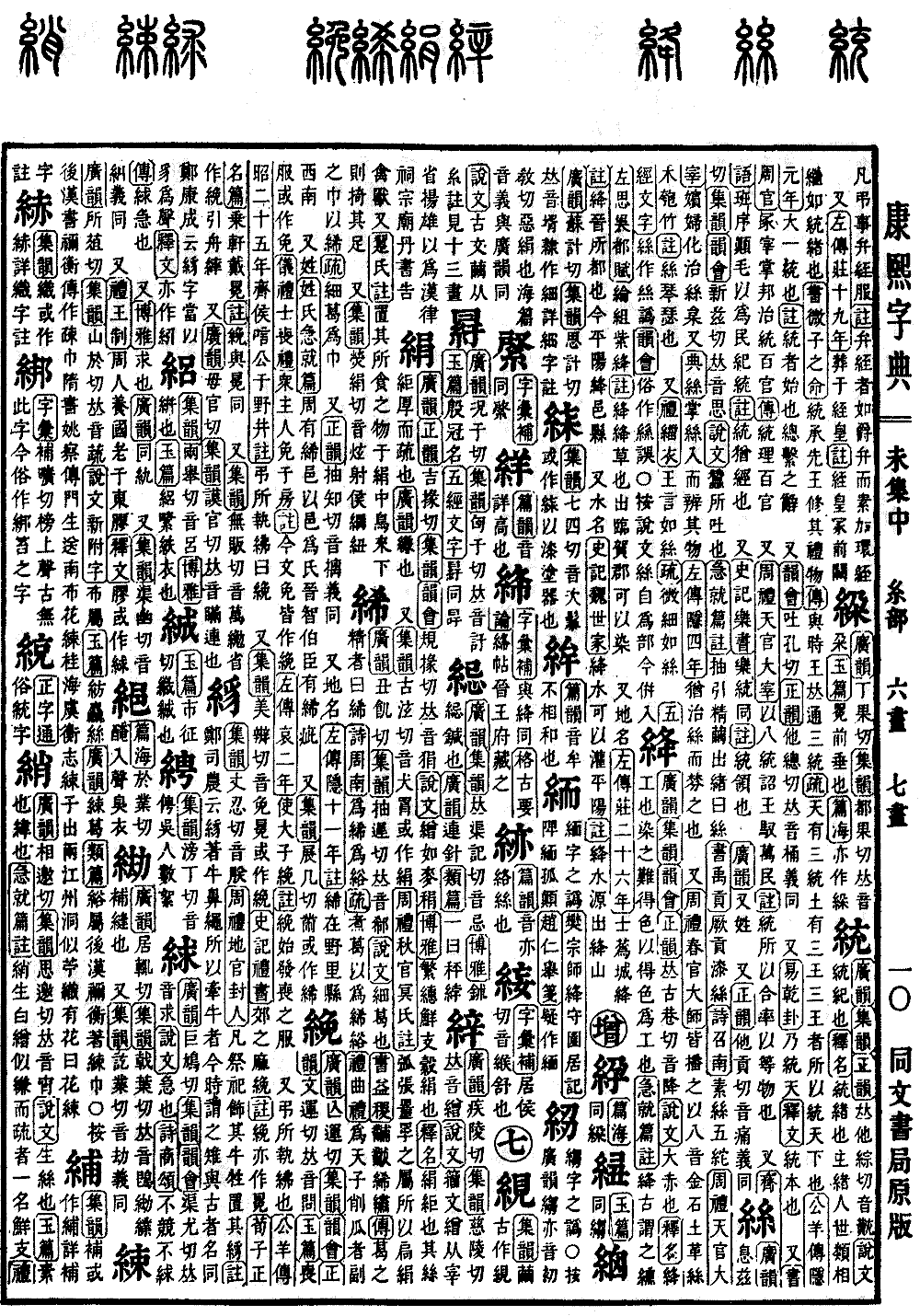
Wei Collection, Middle Volume
Radical: Silk (mì)
Kangxi Strokes: 12
Page 924
According to the Broad Rhymes (Guangyun), the Collected Rhymes (Jiyun), and the Rhyme Assembly (Yunhui), the pronunciation is formed by the fanqie (a traditional method of phonetic notation) of xi and zi, sounding like si.
The Explaining Graphs and Analyzing Characters (Shuowen Jiezi) defines it as that which is produced by silkworms.
The Commentary on the Primer for Quick Learning (Jijiu Pian) states that drawing out the fine threads from cocoons is called silk.
The Book of Documents (Shangshu) in the Tribute of Yu (Yu Gong) section mentions that their tribute consisted of lacquer and silk.
The Book of Odes (Shijing) in the Odes of Shao and the South (Shaonan) section mentions five hanks of white silk.
The Rites of Zhou (Zhouli) in the Offices of Heaven (Tianguan), Grand Administrator (Dazai) section states that women transform and process silk and hemp.
Furthermore, the Master of Silk (Diansi) section notes that they are in charge of receiving silk and distinguishing its types.
The Zuo Commentary (Zuo Zhuan) in the Fourth Year of Duke Yin compares a situation to trying to organize silk but only tangling it further.
Also, the Rites of Zhou in the Offices of Spring (Chunguan), Grand Master of Music (Dashi) section states that all musical performances are broadcast using the eight sounds: metal, stone, clay, skin, silk, wood, gourd, and bamboo.
The Commentary explains that silk refers to stringed instruments like the zither and the lute.
The Book of Rites (Liji) in the Black Robes (Ziyi) section states that the King's words are like silk.
The Sub-commentary explains this as being as fine and subtle as a thread of silk.
The Characters in the Five Classics (Wujing Wenzi) notes that writing the character in a certain variant form is a corruption.
The Rhyme Assembly states that the common way of writing it with specific components is an error.
Note: According to the Explaining Graphs and Analyzing Characters, silk originally constituted its own radical section, but it is now merged into this one.