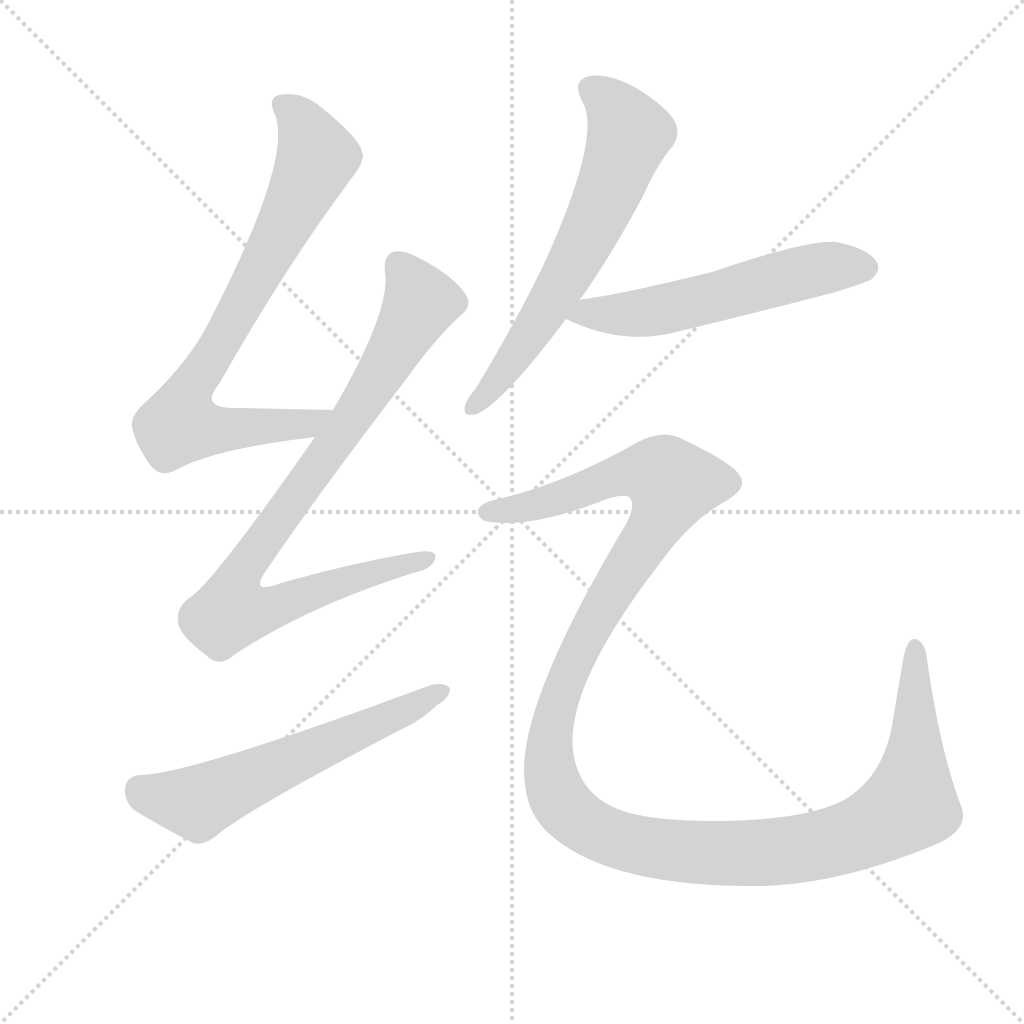
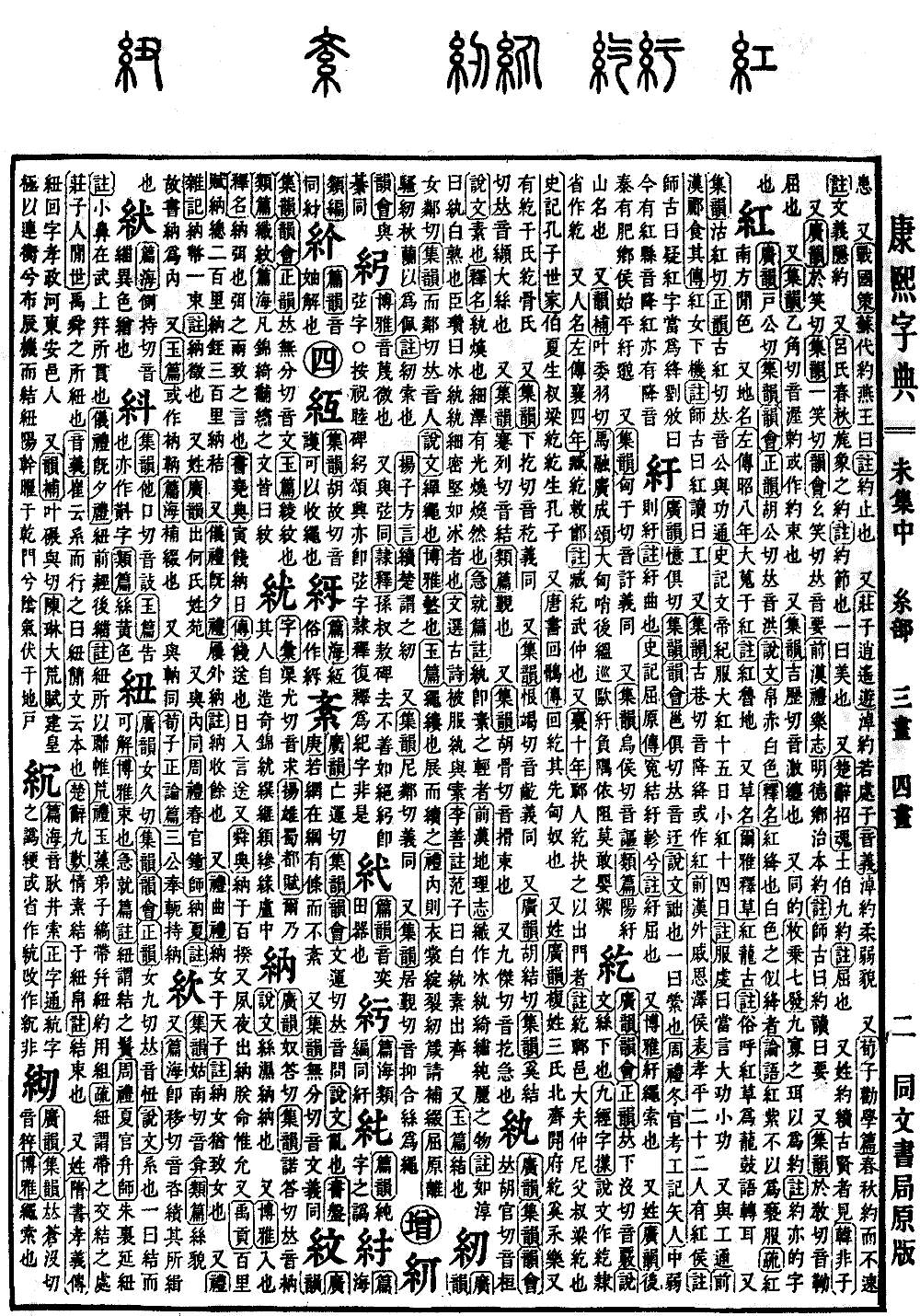
Wei Collection, Middle Volume. Radical: Silk (mì). Kangxi stroke count: 9. Page 916, Entry 01.
According to the Guangyun (Guangyun), Yunhui (Yunhui), and Zhengyun (Zhengyun), pronounced he (rising tone). According to the Shuowen Jiezi (Shuowen), it refers to the lower part of a thread. According to the Jiujing Ziyang (Jiujing Ziyang), the Shuowen uses a different form, and the clerical script simplified form is written as he.
Also a personal name. According to the Zuo Commentary (Zuozhuan), in the fourth year of Duke Xiang: Zang He came to the rescue of Zeng. The commentary notes that Zang He is Wuzhong.
Also, in the tenth year of Duke Xiang: The man from Zou, He, pried it open and exited through the gate. The commentary notes that He refers to Shuliang He, the father of Confucius and a grandee of the Zou city. According to the Records of the Grand Historian (Shiji), the chapter on the House of Confucius: Boxia fathered Shuliang He, and He fathered Confucius.
Also, according to the Book of Tang (Tangshu), in the biography of the Uyghurs: The ancestors of the Huihe were the Xiongnu.
Also a surname. According to the Guangyun, there are three compound surnames: in the Northern Qi dynasty, there was the Governor He-Xi Yongle, as well as the Hegan clan and the Hegul clan.
According to the Jiyun (Jiyun), pronounced he (rising tone). The meaning is the same.
According to the Jiyun, pronounced he (entering tone). The meaning is the same.
According to the Guangyun and the Jiyun, pronounced xie (entering tone). It refers to thick silk.
According to the Jiyun, pronounced jie (entering tone). According to the Leipian (Leipian), it means to see or appear.
According to the Jiyun, pronounced hu (entering tone). It means to bind.
According to the Jiyun, pronounced ge (entering tone). It means urgent.