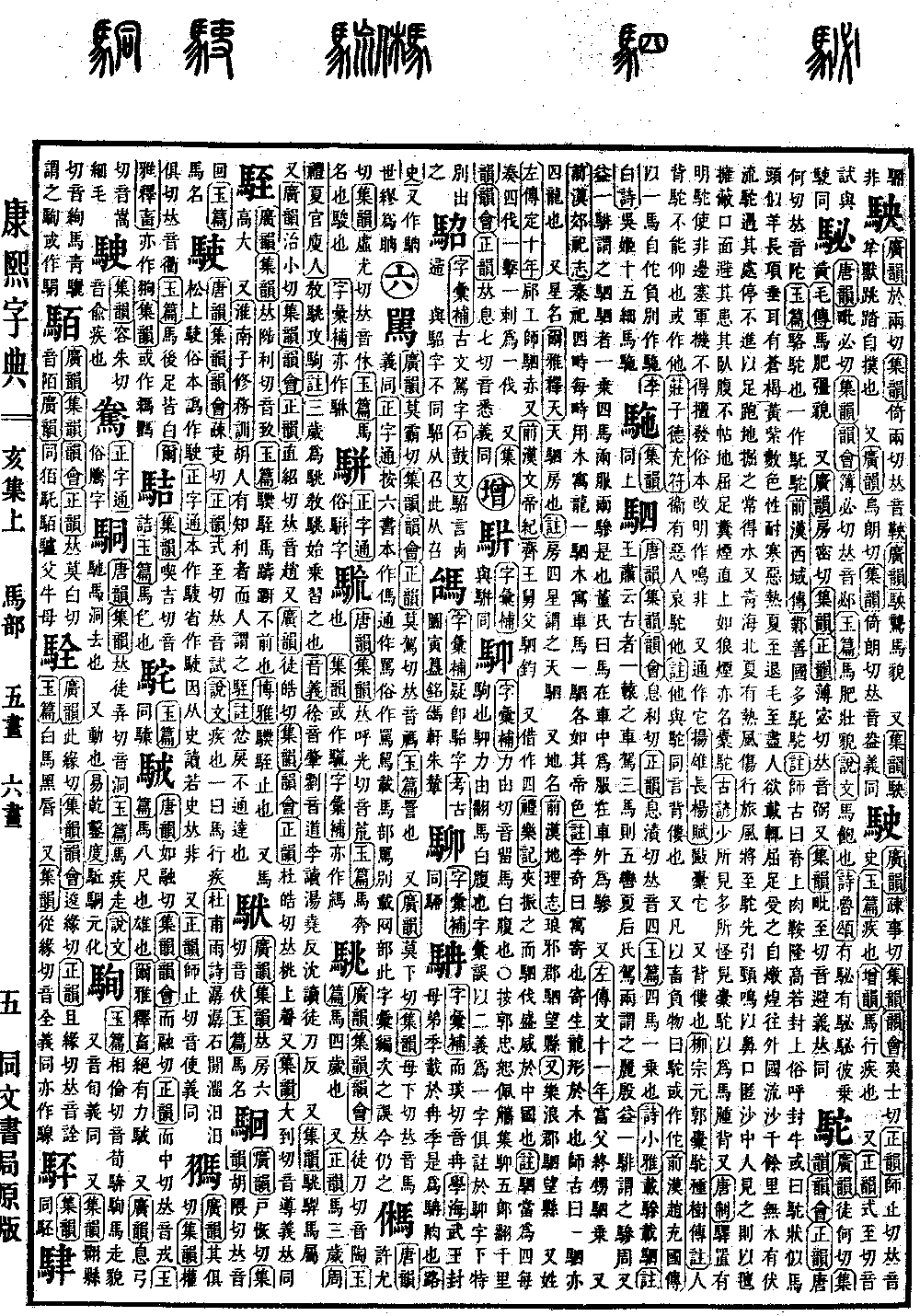
Hai Collection, Upper Volume
Radical: Horse (mǎ)
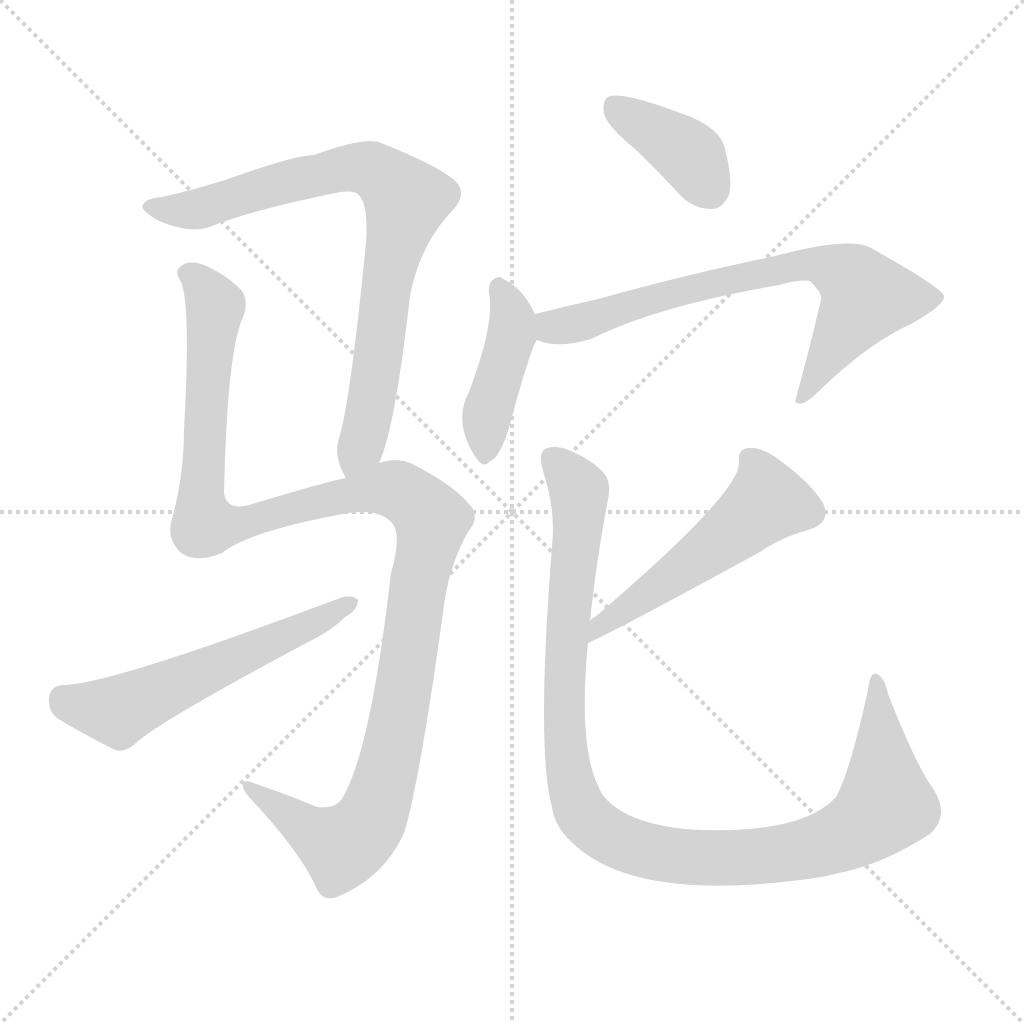
Camel
Kangxi Strokes: 15
Page 1437, Entry 01
Pronounced tuo
Jade Chapters (Yupian): Refers to the camel. Also written as a variant form (luótú).
History of the Former Han (Qianhan): The Shanshan Kingdom has many camels. Commentary by Yan Shigu: The flesh on the back forms a saddle-like protrusion, high and raised, which common people call a hump. Others say the camel looks like a horse, with a head like a sheep, a long neck, and drooping ears. There are colors such as grey, brown, yellow, and purple. Its nature is cold-resistant and heat-averse; at the summer solstice, it sheds its hair completely. When people wish to load it, it kneels down to receive the burden. From Dunhuang toward foreign lands, there are over a thousand li of shifting sands with no water, but there are underground streams; when a camel encounters such a spot, it stops and refuses to move, then paws the ground and digs, and is always able to find water.
Also, north of the Qinghai Lake, there are winds in summer that harm travelers. When the wind is about to arrive, the camel first stretches its neck and calls out, hiding its nose and mouth in the sand. When people see this, they wrap felt around their mouths and faces to avoid the calamity. When it lies down, its belly does not touch the ground; it bends its legs, and its dung smoke rises straight up like a beacon fire. It is also called tuotuo.
Ancient Proverb: He who sees little finds much to wonder at; seeing a camel, he thinks it is a horse with a swollen back.
Also, according to the Tang Dynasty regulations, the postal system had messengers known as Mingtuo (bright camels); they were not to be dispatched without authorization unless for urgent military matters on the frontier. Vulgar editions change Ming to Ming (singing), which is incorrect.
Also used interchangeably with the character (tuo).
Yang Xiong: Changyang Rhapsody (Changyang fu): Driving camels.
Also refers to a hunchback.
Liu Zongyuan: Biography of Guo Tuotuo the Tree Planter, Commentary: A person with a hunched back cannot look upward.
Also written as a variant form (tuo).
Zhuangzi: The Sign of Virtue Complete (Dechongfu): In the State of Wei, there was an ugly man named Ai Tai-tuo. Commentary: The character used here is the same as camel, referring to a hunchback.
Also, any animal that carries goods is called tuuo.
Also written as a variant form (tuo).
History of the Former Han (Qianhan): Using one horse to carry its own burden.
Separately written as a variant form (tuo).
Li Bai: Poetry: A maiden of Wu, aged fifteen, riding a fine camel.