Hai Collection, Upper Volume
Radical: Carriage (mǎ)
Entry: jia
Kangxi dictionary strokes: 15
Page 1436, Entry 01
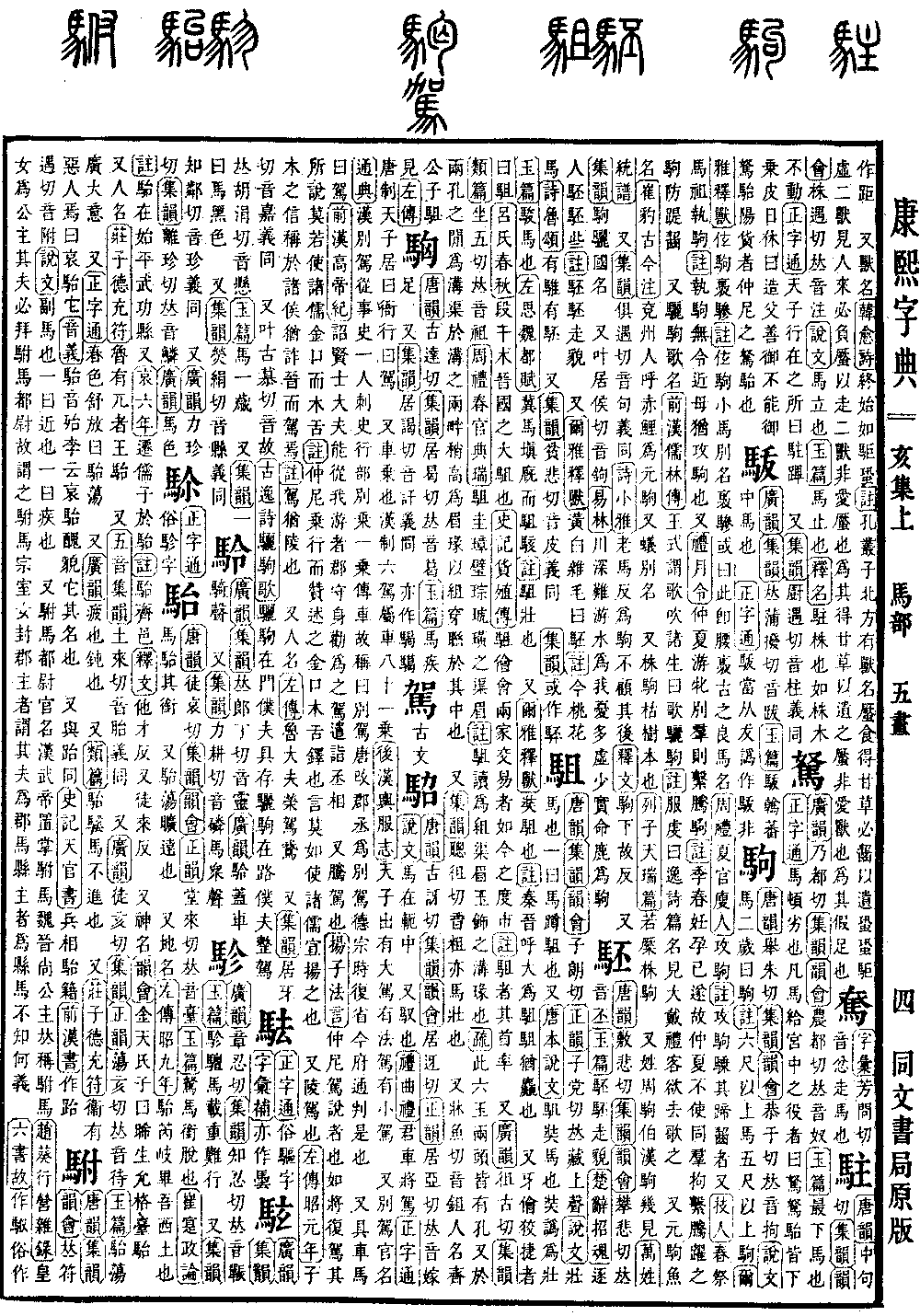
Pronounced jia. According to the Shuowen Jiezi, it refers to a horse in the yoke. It also means to drive. In the Book of Rites (Liji), it is said, The ruler's carriage is about to be harnessed. According to the Zhengzitong, in the Tang dynasty, the place where the Emperor resided was called the yamen, and when traveling, it was called a carriage (jia). It also refers to a carriage or vehicle. According to the Han dynasty system, there were six types of imperial carriages and eighty-one accompanying carriages. The Book of the Later Han (Hou Hanshu) records that when the Emperor went out, there were the Great Carriage, the Standard Carriage, and the Small Carriage. It also refers to the Biejia, a government title. According to the Tongdian, in the Han dynasty, the Biejia was an assistant official who traveled in a separate carriage when the provincial inspector was on inspection duty, hence the name Biejia. The Tang dynasty changed the title of the commandery vice-administrator to Biejia, which was abolished during the reign of Emperor Dezong; the current office of the prefectural assistant magistrate is its successor. It also means to prepare a carriage and horses. The Book of Han (Hanshu) records, An edict was issued to worthy scholars and officials capable of accompanying me; commandery governors were to personally encourage them and provide carriages to send them to the Prime Minister. It also means to mount or ride. The Model Sayings (Fayan) by Yang Xiong states, Confucius was one who drove his doctrines. If one intends to drive them again, it would be better to have the scholars use metal mouths and wooden tongues. The commentary notes that Confucius traveled and promoted his teachings; metal mouths and wooden tongues refer to a bell with a wooden clapper, meaning it would be better to have scholars proclaim them. It also means to insult or override. In the Zuo Tradition (Zuozhuan), it is written, Although the integrity of Zimu was renowned among the feudal lords, he still deceived the state of Jin and overrode it. The commentary notes that overriding is synonymous with insulting. It is also used in personal names; the Zuo Tradition (Zuozhuan) mentions Rong Jia'e, a grand officer of the state of Lu. According to the Jiyun, it is also pronounced jia, with the same meaning. It also rhymes with gu. In the lost Poem of the Black Colt (Li Ju Ge), it is written, The black colt is at the door, the servant is waiting there. The black colt is on the road, the servant readies the carriage.