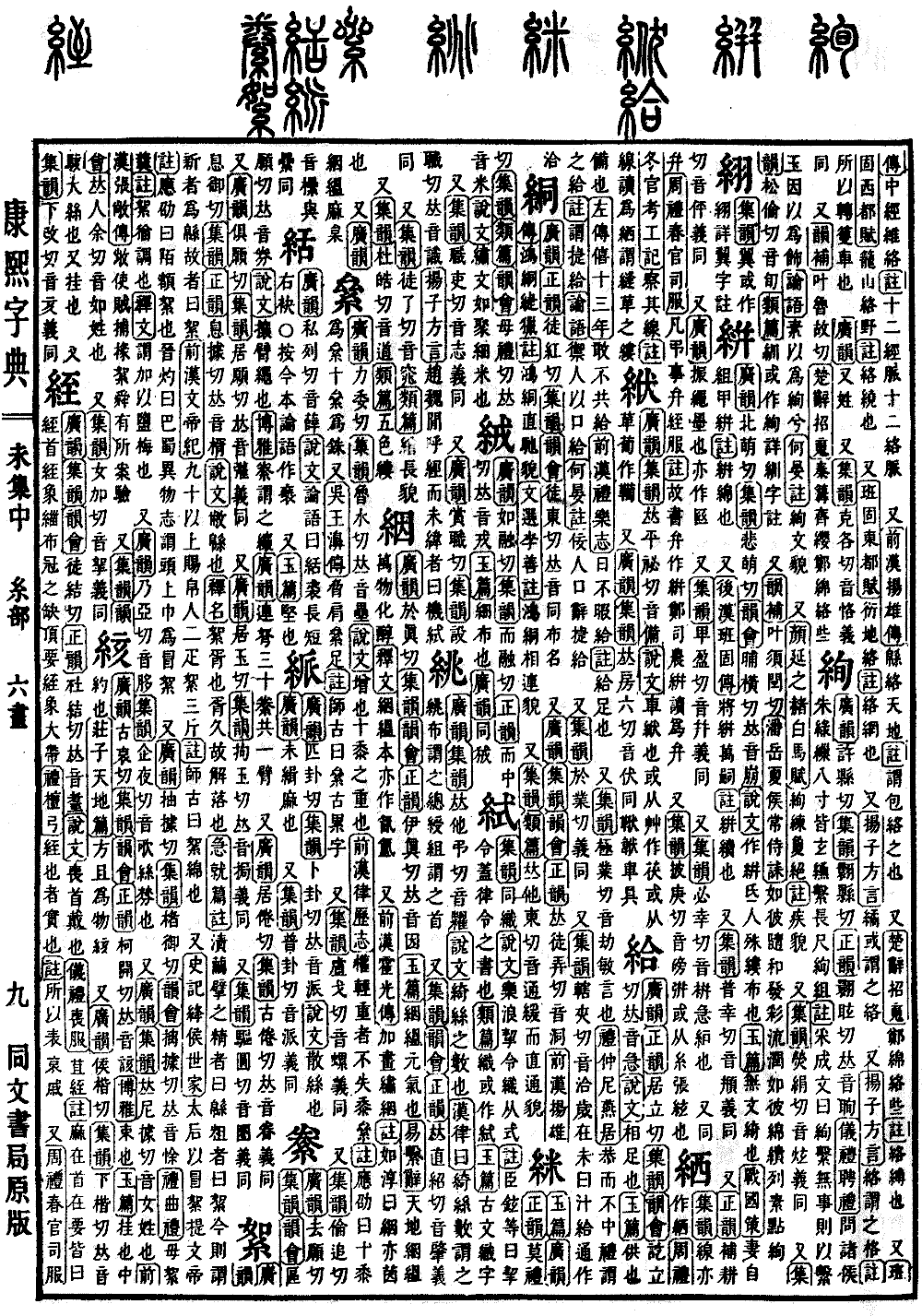
Wei Collection, Middle Volume
Radical: Silk (mì)
Kangxi Strokes: 12
Page 923, Entry 01
Pronounced ji (falling tone).
Shuowen Jiezi (Shuowen): To be mutually sufficient.
Yupian: To supply, to prepare.
Zuo Zhuan (Zuo Zhuan): How could one dare not provide supplies.
History of the Former Han (Qian Hanshu), Treatise on Rites and Music: One does not have time to provide sufficiency.
Commentary: To provide is to be sufficient.
Also pronounced jie (entering tone). To be quick of speech.
Book of Rites (Liji), Zhongni Yanju: Being respectful but not according to the rites is called being glib.
Commentary: This refers to being glib.
Analects of Confucius (Lunyu): Defending oneself against others with glib speech.
He Yan Commentary: The eloquent speech of a sycophant.
Also pronounced ye (entering tone). Meaning is the same.
Also pronounced qia (entering tone). When the year is in the earthly branch of Wei, it is called Zhi-qia. Commonly written as qia.