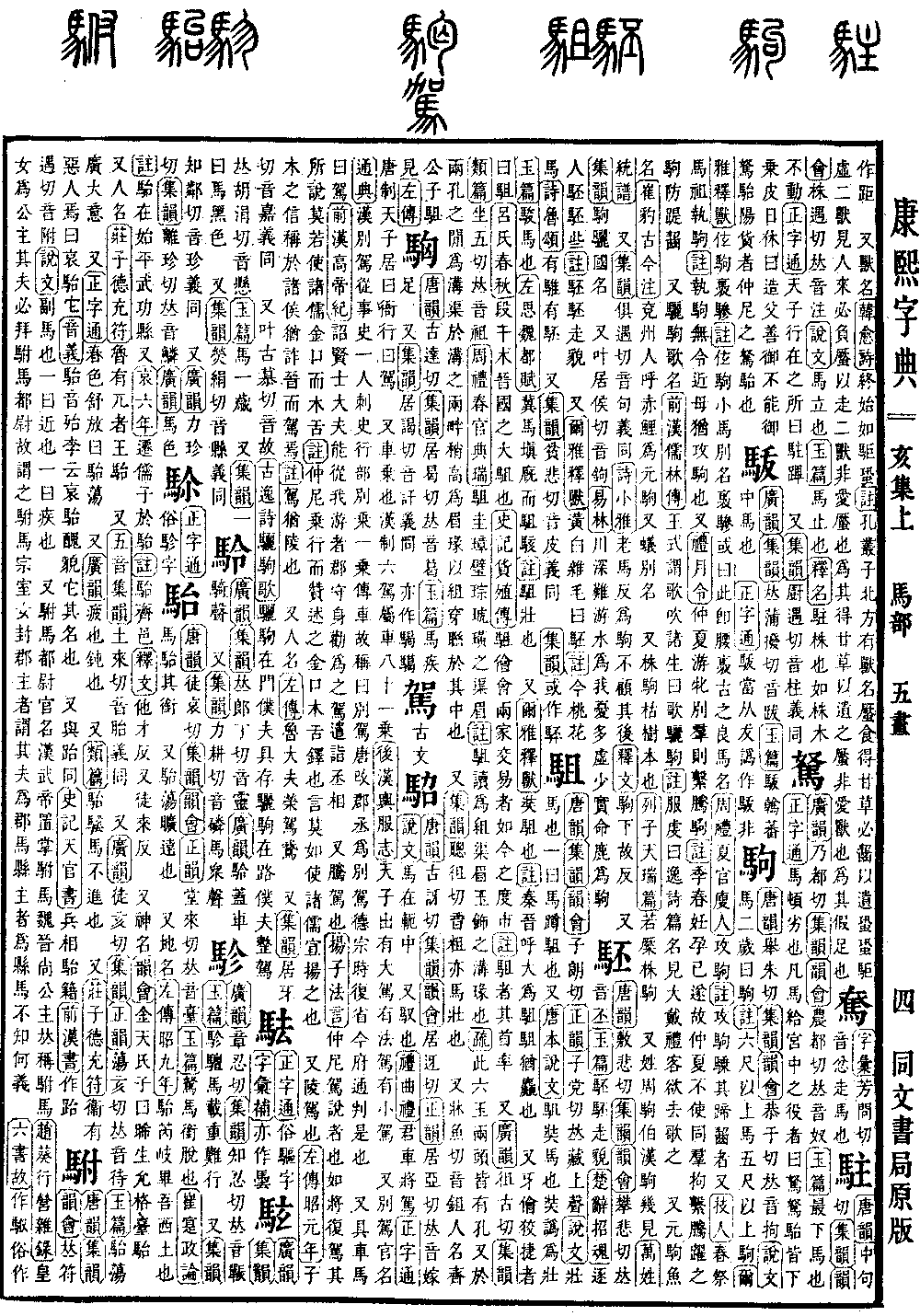
Hai Collection, Upper Volume
Radical: Horse (mǎ)
Entry: zǎng
Kangxi Dictionary strokes: 15
Page 1436, Entry 01
According to the Tang Dynasty Rhyme Dictionary (Tangyun), the Collected Rhymes (Jiyun), and the Rhyme Compendium (Yunhui), pronounced zǎng (rising tone); according to the Corrected Rhymes (Zhengyun), pronounced zǎng (rising tone).
Explaining Writing (Shuowen): A strong horse. Another interpretation is the appearance of a horse crouching. According to the Tang version of the Explaining Writing (Shuowen), this is a large horse, with the word large having been mistakenly written as strong.
Jade Chapters (Yupian): A fine horse.
Wei Capital Rhapsody (Wei Du Fu) by Zuo Si: The horses of the Ji region fill the stables, all of them strong and fine horses.
Commentary: Strong, meaning powerful and robust.
Erya (Erya): A large size is called zǎng.
Commentary: In the region east of the Yangtze River, large is referred to as zǎng, implying a coarse or bulky size.
Also refers to cunning and agile individuals among merchant intermediaries.
Spring and Autumn Annals of Mr. Lu (Lüshi Chunqiu): Duan Ganmu was a prominent intermediary of the Jin State.
Records of the Grand Historian (Shiji), Biographies of Money-makers (Huozhi Zhuan): Merchants and intermediaries are those who facilitate trade between two parties, similar to modern market brokers.
Commentary: These are the leaders among such brokers.
According to the Broad Rhymes (Guangyun), pronounced zǔ; according to the Collected Rhymes (Jiyun) and the Categorized Compendium (Leipian), pronounced zǔ.
Rites of Zhou (Zhouli), Spring Officials, Records of Auspices: Used to describe the carved grooves on jade objects such as the gui, zhang, bi, cong, hu, and huang, which are threaded with silk cords.
Commentary: Pronounced zǔ; the term refers to the decorative carved grooves on jade.
Sub-commentary: These six types of jade objects have holes at both ends, with grooves carved between the holes and raised ridges along the sides, allowing silk cords to be threaded through the center.
According to the Collected Rhymes (Jiyun), pronounced cū. Also means a horse that is strong and robust.
Also pronounced chú. A personal name, Prince Zǎng of the Qi State, mentioned in the Zuo Commentary (Zuozhuan).
Textual verification: In the Wei Capital Rhapsody (Wei Du Fu) by Zuo Si, the original text contained an error; it has been corrected from startled to fine. In the Erya (Erya), section on beasts, the text was corrected from talk to beasts, and the regional reference from Jiangdong to Qin and Jin.