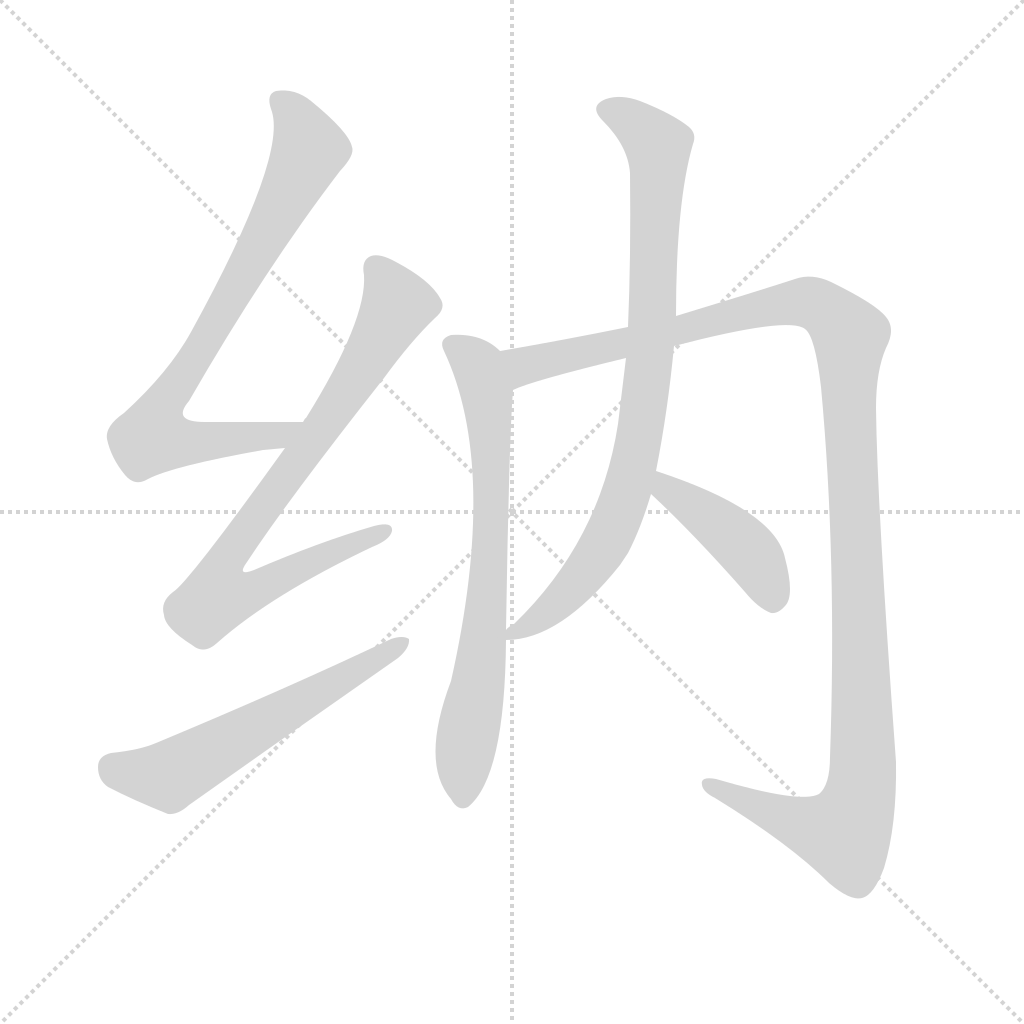
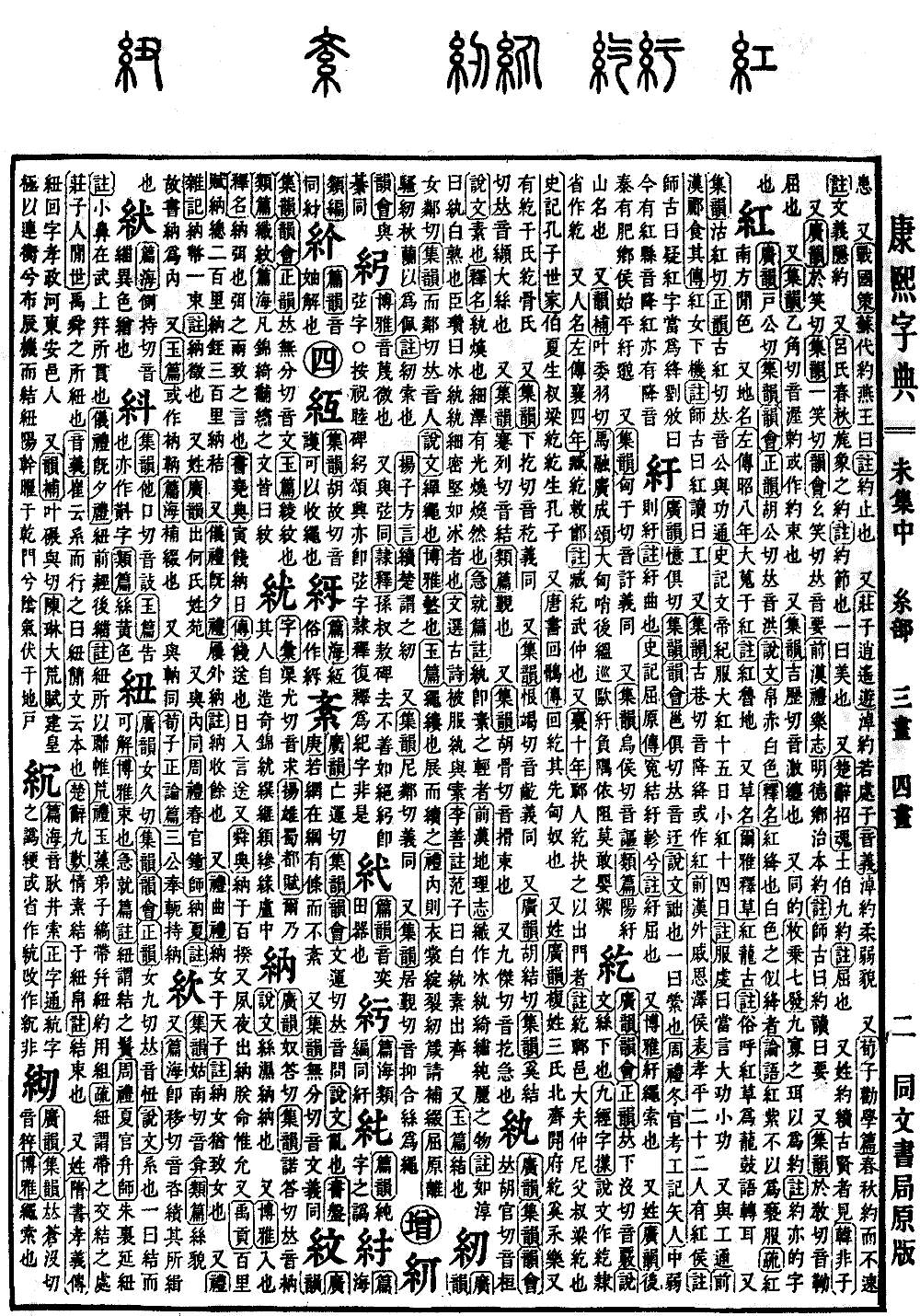
Wei Collection, Middle Volume
Radical: Silk (mì)
Kangxi Strokes: 10
Page 916, Entry 01
Pronounced na.
According to the Explaining Graphs and Analyzing Characters (Shuowen), it refers to the state of silk being moist and dense.
Also means to enter.
According to Explaining Names (Shiming), na means to suppress; it refers to the act of bringing two things together.
Book of Documents (Shangshu), Canon of Yao: To respectfully send off the setting sun. Commentary: Qian means to send off; sending off refers to the sun setting.
Also in the Canon of Shun: To enter into the hundred offices.
Also: From early morning until night, sending out and bringing in; my commands are truthful.
Also in the Tribute of Yu (Yugong): Within one hundred li, the tax paid is grain in the sheaf; within two hundred li, it is grain with the stalk; within three hundred li, it is grain stalks.
Also in the Ceremonial Rites (Yili), Rites of the Deceased: To put the shoes on. Commentary: Na means to receive or retract.
Also in the Book of Rites (Liji), Summary of the Rules of Propriety: To present a woman to the Son of Heaven. Commentary: Presenting a woman is the same as conveying a woman.
Also in the Book of Rites (Liji), Miscellaneous Records: To present a bundle of silk as a betrothal gift. Commentary: Na means to levy or demand.
Also a surname. According to the Broad Rhymes (Guangyun), it appears in the He Family Register of Surnames (He Shi Xingyuan).
Also the same as the character for inside. In the Rites of Zhou (Zhouli), Spring Offices, Bell Master: To play the Xia music. Commentary: In the old text, the character na was written as the character for inside.
According to the Jade Chapters (Yupian), it is also written in the variant forms na or na.
According to the Collection of Characters (Pianhai), it means to mend or patch.
Also the same as the character for a carriage pole yoke strap. In the Xunzi, Rectification of Terms: The Three Excellencies hold the yoke and grasp the strap.