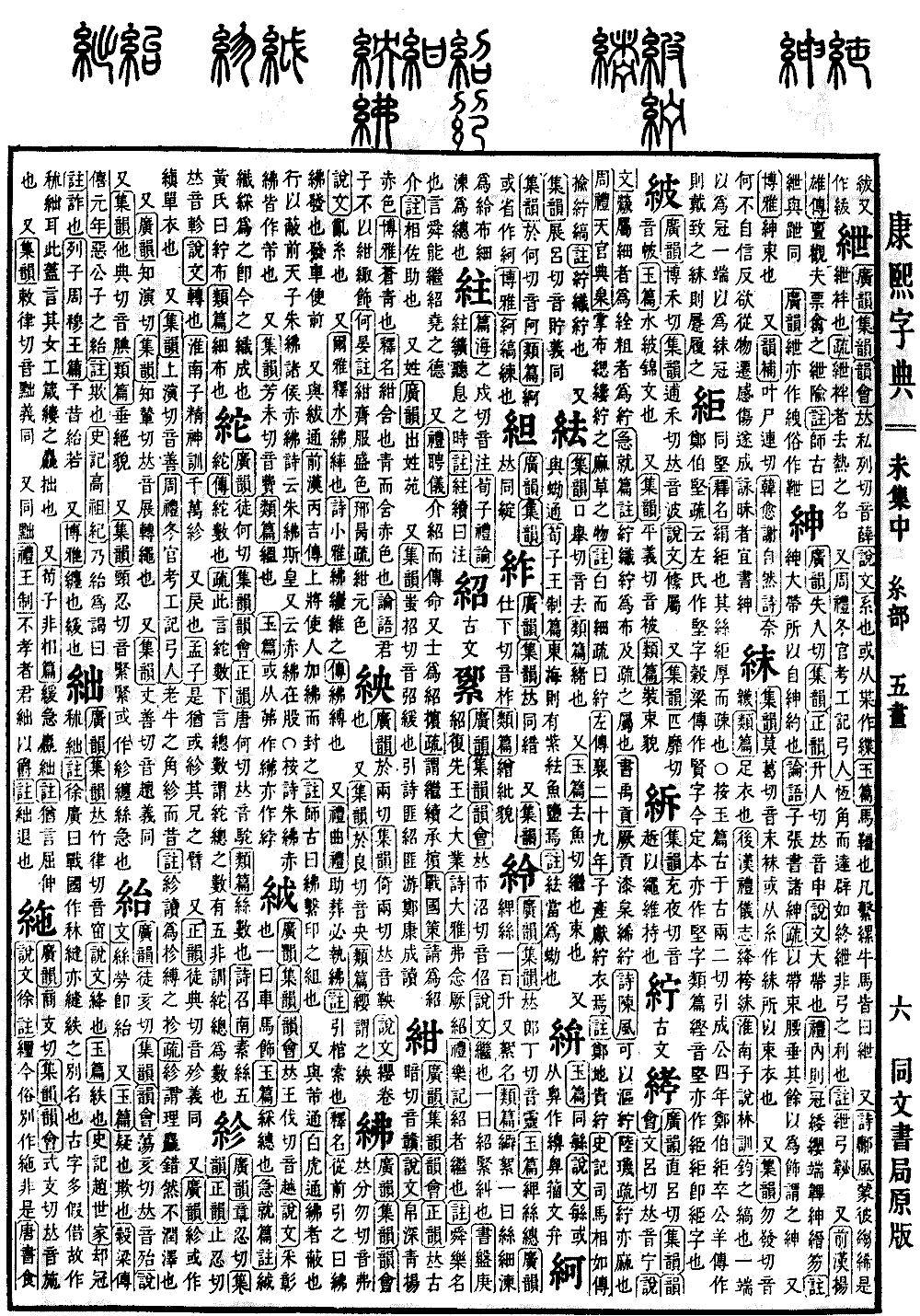
Wei Collection, Middle Volume
Radical: Silk (mì)
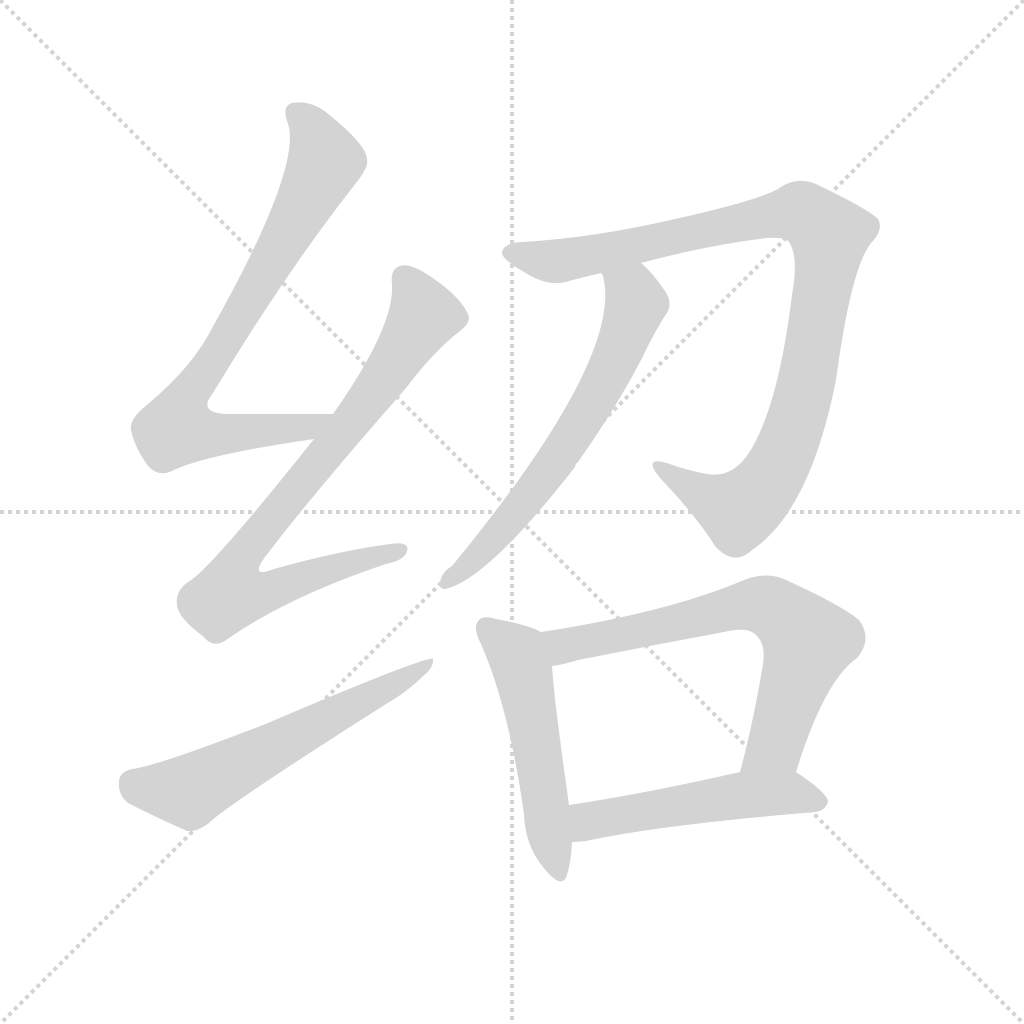
Shao
Kangxi stroke count: 11
Page 920, Entry 18
Ancient form: the character consisting of silk and the sound component indicating a variant form (chuo)
Broad Rhymes (Guangyun), Collected Rhymes (Jiyun), and Rhyme Meeting (Yunhui) define it as pronounced shao (falling tone).
In Explaining Simple and Compounding Characters (Shuowen Jiezi), it means to continue. Another definition is to bind or twist tightly.
In the Book of Documents (Shujing), specifically the Pan Geng chapter: To continue and restore the great achievements of the former kings.
In the Book of Odes (Shijing), specifically the Greater Odes section: Not thinking of their succession.
In the Book of Rites (Liji), specifically the Record of Music (Yueji): Shao means to continue. The commentary states this refers to the name of the music of Emperor Shun, meaning Shun was able to continue and carry on the virtues of Emperor Yao.
Also in the Book of Rites (Liji), specifically the Rites of Envoys (Pinyi): To act as an intermediary to convey an order. Also, a scholar acts as a continuator. The sub-commentary states this refers to continuing and succeeding.
In the Strategies of the Warring States (Zhanguoce): Please allow me to act as an intermediary. The commentary explains this as assisting and helping.
Also a surname. According to the Record of Surnames (Xingyuan).
Also, according to the Collected Rhymes (Jiyun), it is pronounced chao. It means to be slow or lax. This cites the Book of Odes (Shijing): Neither slack nor wandering. This is the reading used by Zheng Kangcheng.
Textual research: In the Book of Rites (Liji), Record of Music (Yueji), the entry says Shao means to continue. Following the original text, this has been corrected to say Shao means to continue.