Wei Collection, Middle Volume
Radical: Silk (mì)
Kangxi Strokes: 15
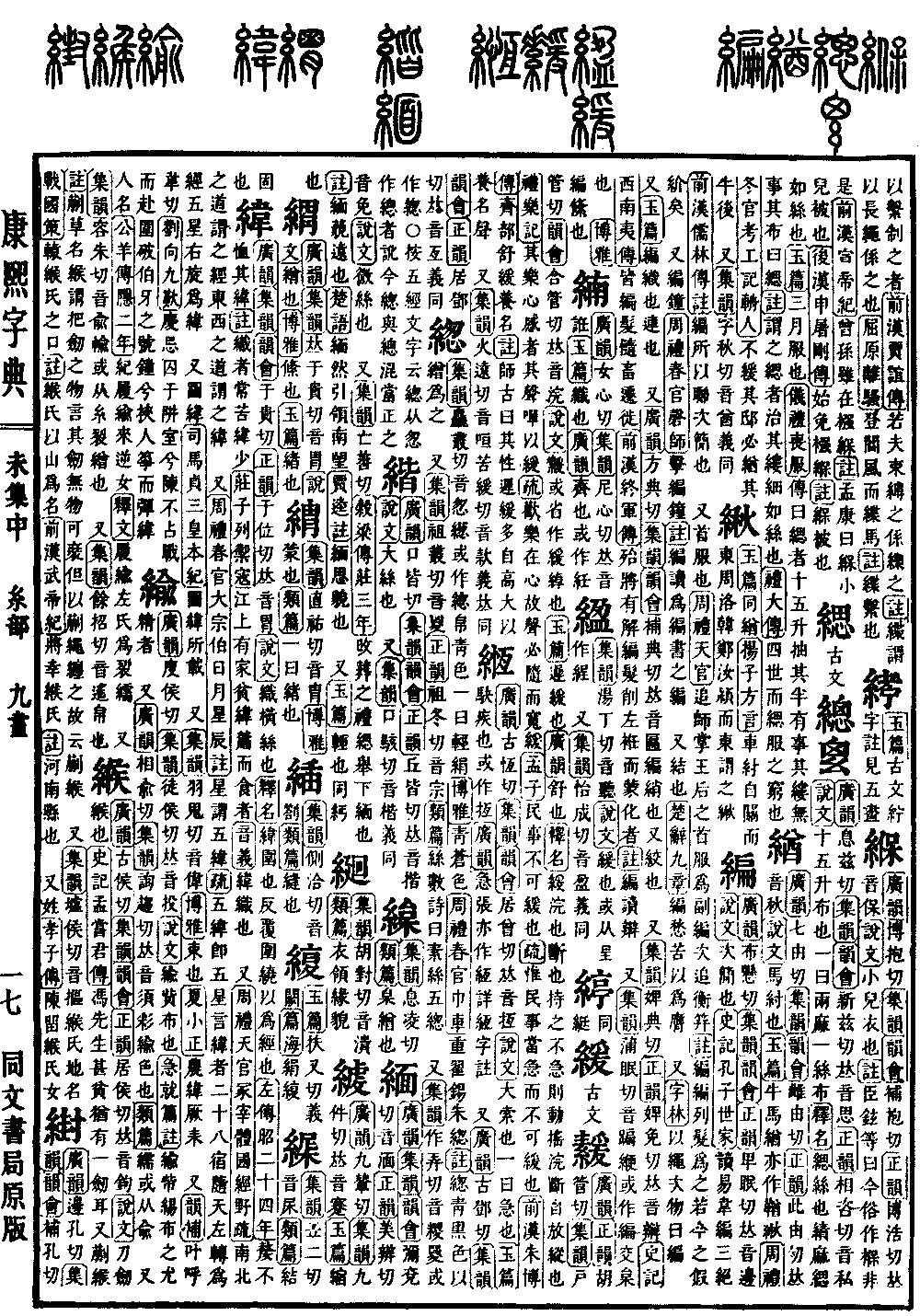
Page 931, Entry 01
Guangyun: Pronounced bian. Jiyun, Yunhui, and Zhengyun: Pronounced bian.
Shuowen Jiezi: To arrange in order.
Records of the Grand Historian (Shiji), Biography of Confucius: When reading the Book of Changes (Yijing), the leather cords binding the bamboo strips broke three times.
Commentary to the History of the Former Han (Qianhan), Biographies of Confucian Scholars: Bian refers to things used to connect items in sequence.
Also refers to hair ornaments.
Rites of Zhou (Zhouli), Offices of Heaven: The Master of Ornaments manages the Queen’s headwear, creating fu, bian, and ci, as well as zhui, heng, and ji.
Commentary: Bian refers to hair arranged into a style, similar to modern wigs.
Also refers to a set of bells.
Rites of Zhou, Offices of Spring, Master of Musical Stones: Striking the bells.
Commentary: Bian is pronounced the same as the bian in books.
Also refers to weaving or connecting.
Songs of Chu (Chuci), Nine Declarations (Jiuzhang): Weaving sorrow into a chest ornament.
Zilin: To string items together in order using a rope is called bian.
Yupian: Bian means to weave or to connect.
Guangyun: Pronounced bian. Jiyun and Yunhui: Pronounced bian.
Bian refers to thin silk fabric made from raw silk. Also refers to twisting or knotting.
Jiyun: Pronounced bian. Zhengyun: Pronounced bian.
Records of the Grand Historian, Biographies of the Southwestern Barbarians: All knot their hair and migrate following their livestock.
History of the Former Han, Biography of Zhong Jun: Likely there will be those who untie their knotted hair, change their left-lapping garments, and accept moral transformation.
Commentary: Bian is pronounced the same as the word for braid.
Jiyun: Pronounced pian.
Also written as the variant form bian. Refers to intertwining and joining hemp threads.
Guangya: Bian refers to a silk ribbon.