Chou Collection, Upper Volume
Radical: Enclosure (wéi)
Kangxi Strokes: 11
Page 219, Entry 07
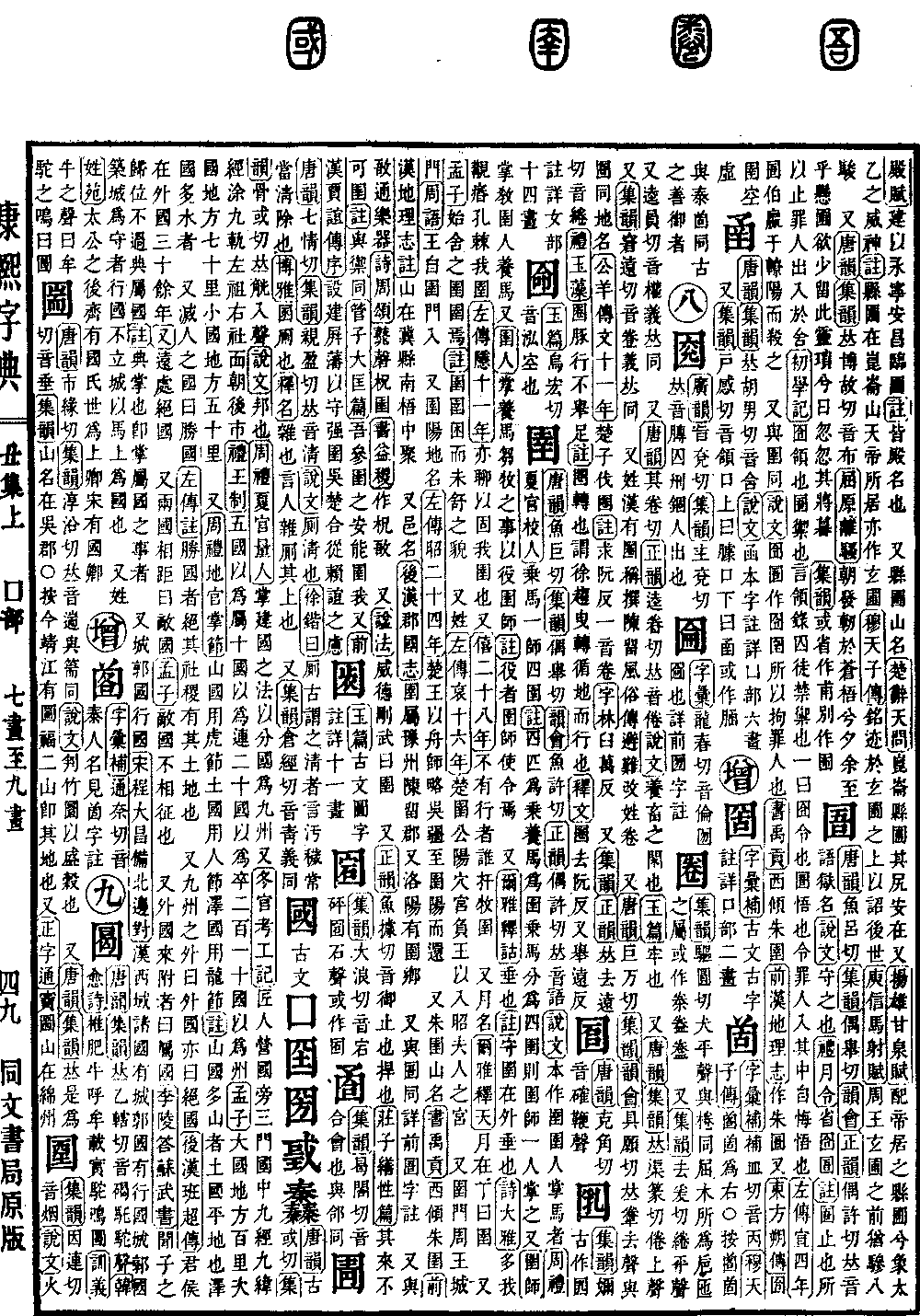
Collected Rimes (Jiyun): Pronounced quan (level tone). Same as the character for a bent wooden vessel, belonging to the category of goblets or basins. Sometimes written as a variant form (juan). Also, according to Collected Rimes (Jiyun): Pronounced quan (level tone). Also pronounced quan (level tone). The meaning is the same.
Also, according to Tang Rhymes (Tangyun): Pronounced juan (falling tone); according to Correct Rimes (Zhengyun): Pronounced juan (falling tone). Analytical Dictionary of Characters (Shuowen): An enclosure for raising animals. Jade Chapters (Yupian): A pen or fold.
Also, according to Tang Rhymes (Tangyun) and Collected Rimes (Jiyun): Pronounced juan (rising tone). Also, according to Collected Rimes (Jiyun): Pronounced jiong (rising tone). The meaning is the same.
Also a surname. In the Han dynasty, there was a person named Quan Cheng, who wrote the Record of Customs (Liufengsutong); he changed his surname to Juan to avoid disaster.
Also, according to Tang Rhymes (Tangyun): Pronounced juan (falling tone); according to Collected Rimes (Jiyun) and Rhyme Collection (Yunhui): Pronounced juan (falling tone). Same as the character for a city. A place name. Commentary on the Spring and Autumn Annals (Gongyang Zhuan), 11th Year of Duke Wen: The Viscount of Chu attacked Quan. Commentary: Pronounced juan (rising tone), also pronounced juan (falling tone). Dictionary of Characters (Zilin): Pronounced juan (falling tone).
Also, according to Collected Rimes (Jiyun) and Correct Rimes (Zhengyun): Pronounced quan (rising tone). Book of Rites (Liji), Jade Beads (Yuzao): Pen a pig, walk without lifting the feet. Commentary: Quan means to turn; it refers to moving slowly, dragging the feet, and following the ground while walking. Explanation of Texts (Shiwen): Pronounced juan (rising tone), also pronounced juan (rising tone).