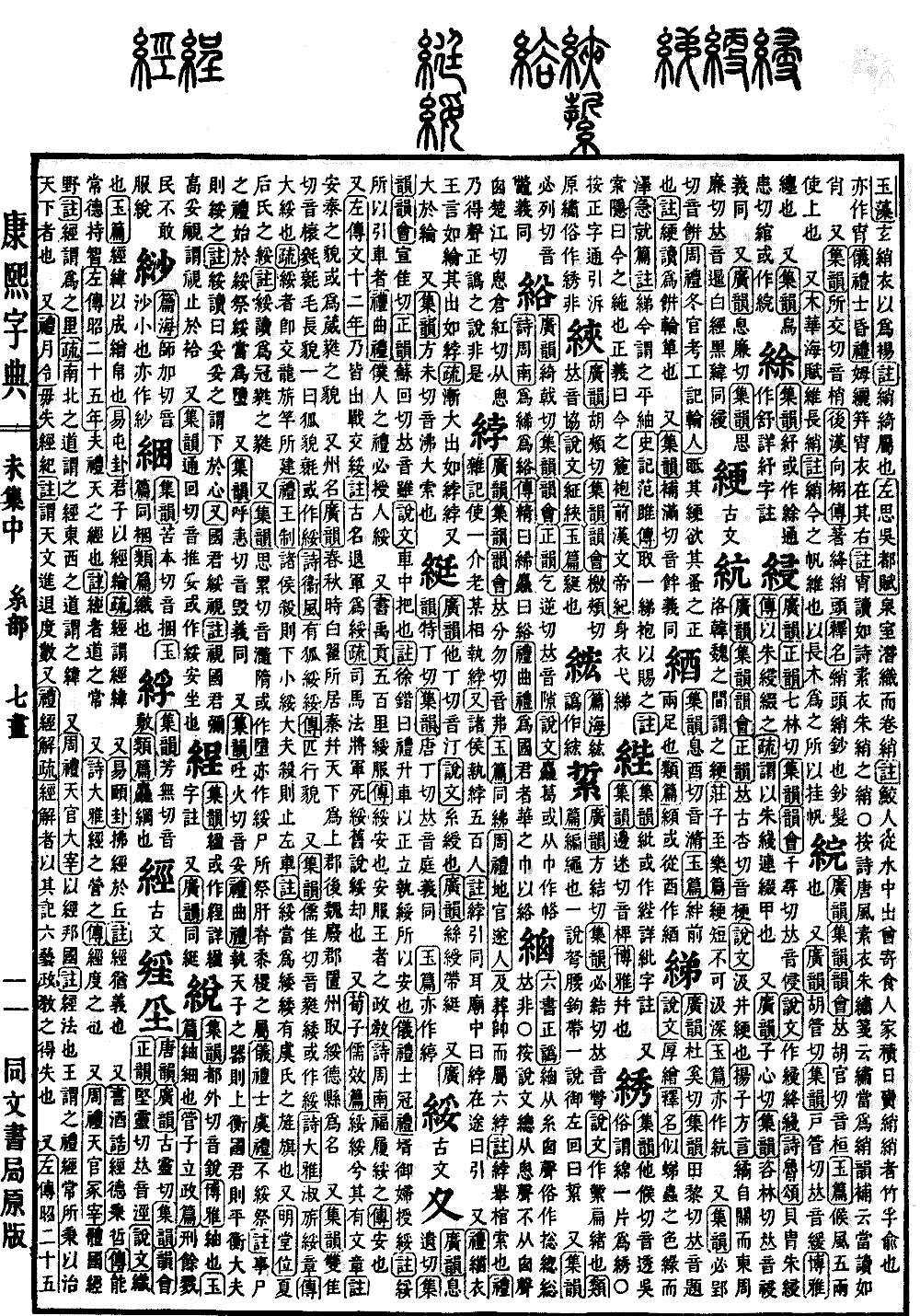
Wei Collection, Upper Volume
Radical: Silk (mì)
Kangxi Strokes: 13
Page 925, Entry 03
Ancient form is 夊. Pronounced sui (level tone).
Shuowen Jiezi (Shuowen): A strap held by a person inside a carriage. Annotation: Xu Kai stated: According to the Book of Rites (Liji), when boarding a carriage, one must stand straight and hold the strap, which provides stability.
Book of Etiquette and Ceremonial (Yili), Gentleman’s Capping Ceremony: The groom drives the bride’s carriage and hands her the strap. Annotation: The strap is that by which one pulls oneself into the carriage.
Book of Rites (Liji), Songs of Propriety: The etiquette of a charioteer requires that he always hand the strap to the person entering.
Also, Book of Documents (Shangshu), Tribute of Yu (Yu Gong): Within five hundred li, they were pacified (sui) and subjected. Commentary: Sui means to bring peace. To bring peace and submit to the administrative and educational policies of the King.
Book of Odes (Shijing), Zhou Nan: May blessings and longevity bring him peace. Commentary: Peace.
Also, Zuo Tradition (Zuo Zhuan), 12th Year of Duke Wen: Then they all went out to battle and engaged in a strategic withdrawal (sui). Annotation: In ancient times, withdrawing an army was called sui. Commentary: In the Sima Law (Sima Fa), it is written that a general who dies in a strategic withdrawal is punished. According to traditional explanations, sui means to retreat.
Also, Xunzi, Chapter on the Efficacy of the Confucians (Ru Xiao Pian): Peaceful and calm (sui sui), it possesses literary adornment. Annotation: An appearance of peace and tranquility. Or, perhaps the appearance of luxuriant growth.
Also, the name of a prefecture. Guangyun: During the Spring and Autumn period, it was inhabited by the White Di. The Qin dynasty unified the world and established it as Shang Commandery; the Later Wei dynasty abolished the commandery and established a prefecture, taking the name from Suide County.
Also, pronounced cui (level tone). San, the appearance of long hair. Another meaning is the appearance of a fox. Sometimes written as sui.
Book of Odes (Shijing), Wei Feng: A fox moving in a slow, wandering manner (sui sui). Commentary: The appearance of walking in pairs.
Also, pronounced rui (level tone). Rui (a hat tassel), sometimes written as sui.
Book of Odes (Shijing), Da Ya: Virtuous banners and tassels (sui) as symbols. Commentary: A large tassel. Commentary: The sui is the ornament erected on the pole of a dragon-adorned banner.
Book of Rites (Liji), Royal Regulations (Wangzhi): When a feudal lord slaughters an animal, he lowers the small tassel; when a great officer slaughters an animal, he stops the assistant carriage. Annotation: Sui here should be written as rui. Rui is a banner used by the clan of You Yu.
Also, Mingtang Wei: The tassel (sui) of the Xia dynasty. Annotation: Sui is read as the rui of a hat tassel.
Also, pronounced sui (rising tone). Sui, sometimes written as duo. Also written as sui. The offerings of liver, spine, and grains provided to the impersonator of the deceased.
Book of Etiquette and Ceremonial (Yili), Gentleman’s Post-Funeral Ceremony (Shi Yu Li): Do not offer the ceremonial food (sui ji). Annotation: The etiquette of serving the impersonator begins with the offering of food. Sui here should be written as duo.
Also, pronounced hui (rising tone). Meaning same as above.
Also, pronounced tuo (rising tone).
Book of Rites (Liji), Songs of Propriety: When holding the ritual vessels of the Son of Heaven, one holds them level with the chest; for the ruler of a state, one holds them level with the balance; for a great officer, one holds them downward (sui). Annotation: Sui is read as tuo. To make it level with the heart.
Also, the ruler of a state gazes downward (sui). Annotation: To gaze at the ruler from a higher position. To gaze downward means to look no further than the lapel.
Also, pronounced tui (level tone). Tuo, sometimes written as sui, meaning to sit in a peaceful posture.