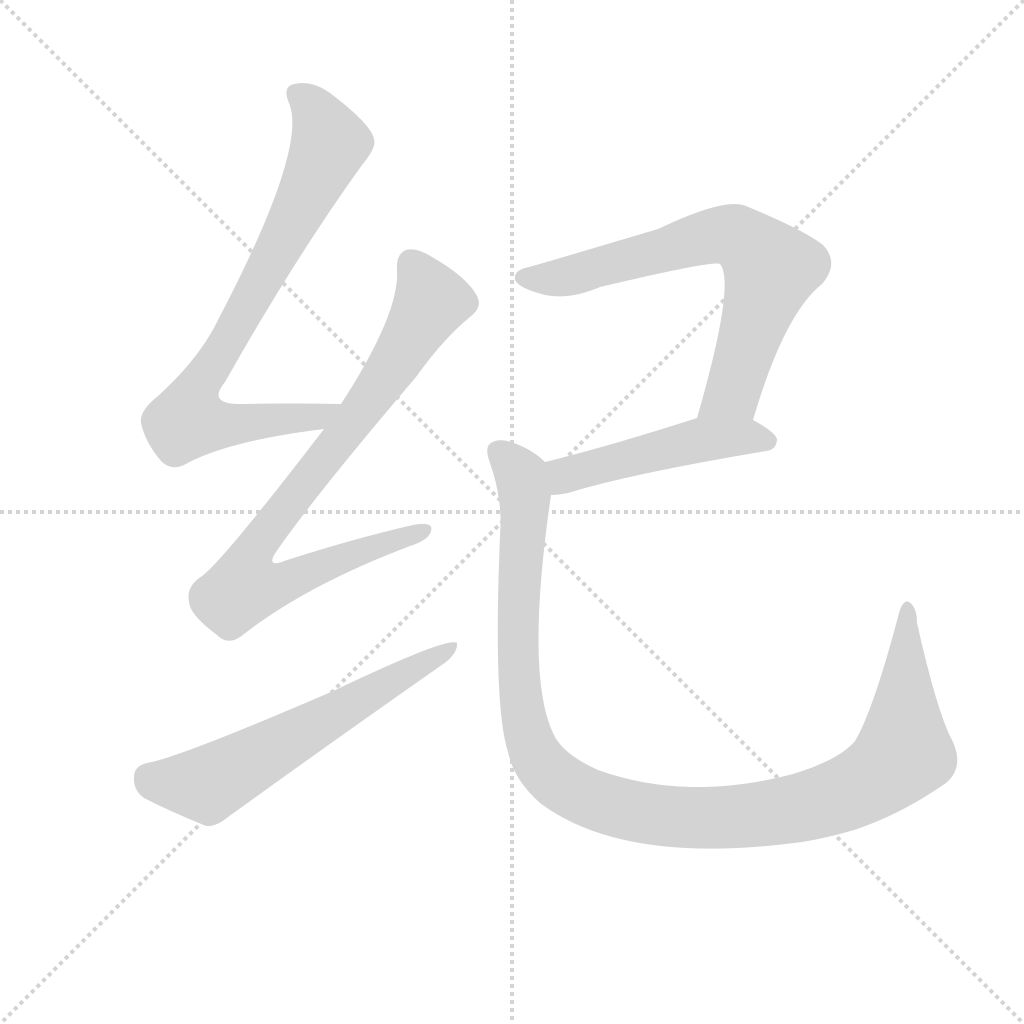
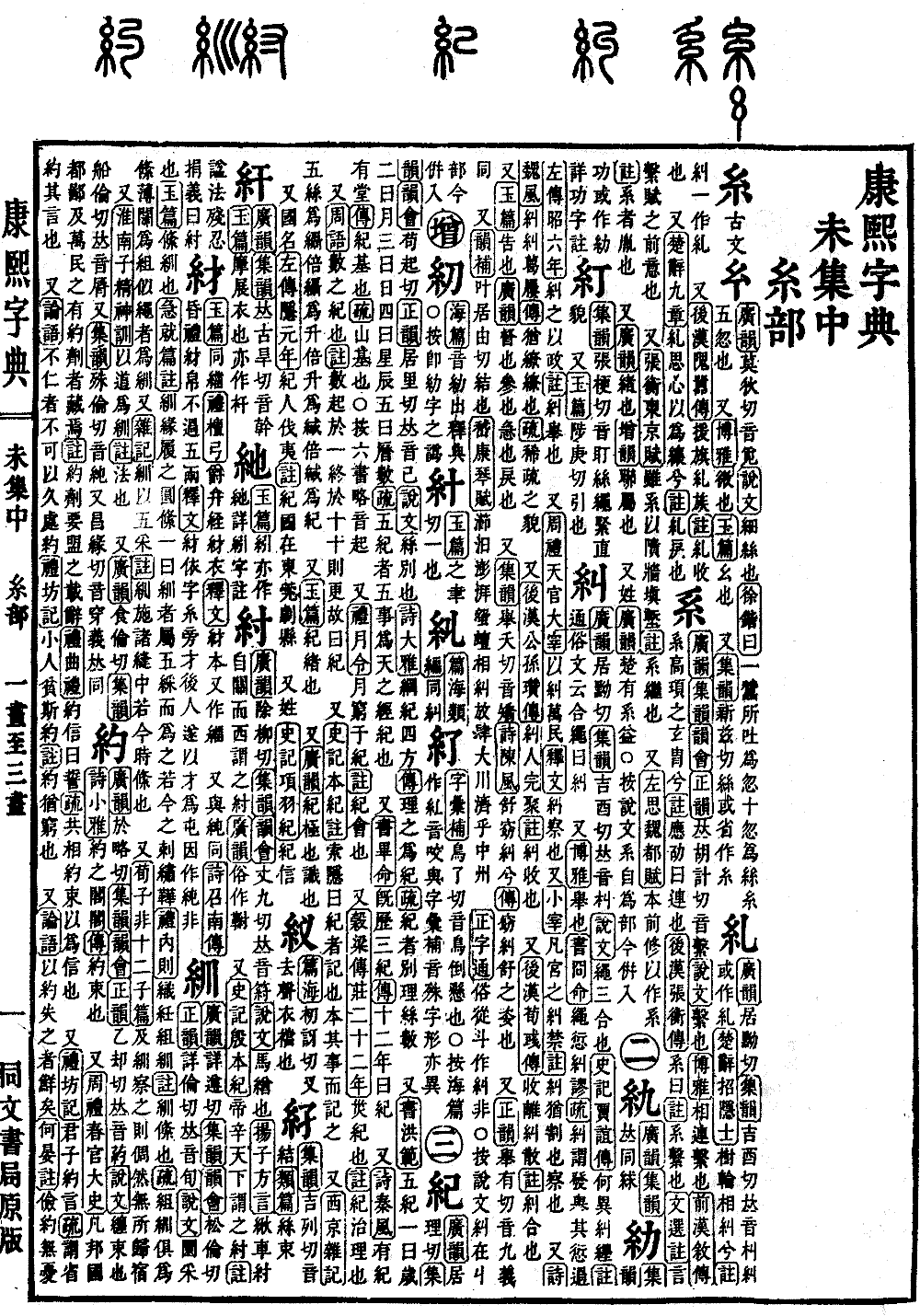
Wei Collection, Middle Volume. Radical: Silk (mì). Kangxi stroke count: 9. Page 915, Entry 03.
Pronounced ji (third tone).
According to the Explaining Graphs and Analyzing Characters (Shuowen Jiezi), it refers to the separation of silk threads. In the Book of Odes (Shijing): To govern the four directions as if managing threads. The commentary states: To manage is to organize into threads. The sub-commentary explains: Ji refers to distinguishing and ordering the threads.
In the Book of Documents (Shangshu): The five regulators (wuji): first, the year; second, the month; third, the day; fourth, the stars; fifth, the calendar calculations. The sub-commentary explains: The five regulators are the five affairs that serve as the governing threads for the heavens.
Also, in the Book of Documents (Shangshu): After passing through three cycles. The commentary states: Twelve years is called one cycle (ji).
Also, in the Book of Odes (Shijing): There are foundations, there are halls. The commentary states: Ji means a foundation. The sub-commentary explains: A mountain foundation. Note that according to the Six Writings (Liushu) approach, the sound is qi (third tone).
Also, in the Book of Rites (Liji): The month ends at the meeting point. The annotation states: Ji means a meeting.
Also, in the Guliang Commentary (Guliang Zhuan): A disaster is a governing event. The annotation states: Ji means to govern or regulate.
Also, in the Discourses of the States (Guoyu): The principles of numbers. The annotation states: Numbers begin at one and end at ten. At ten, one starts over, hence it is called a cycle (ji).
Also, in the Records of the Grand Historian (Shiji): The commentary on the Basic Annals notes: Ji means to record. It is to root out the events and write them down.
Also, in the Miscellaneous Records of the Western Capital (Xijing Zaji): Five threads make a bundle, doubling the bundle makes a small skein, doubling the small skein makes a large skein, and doubling the large skein makes a cycle (ji).
Also, in the Jade Treatise (Yupian): Ji means a beginning or an end of a thread.
Also, in the Broad Rhymes (Guangyun): Ji means a limit or to recognize.
Also, the name of a state. In the Zuo Commentary (Zuo Zhuan): The people of Ji attacked Yi. The annotation states: The State of Ji was located in Ju County, Dongguan.
Also, a surname. In the Records of the Grand Historian (Shiji): Ji Xin.