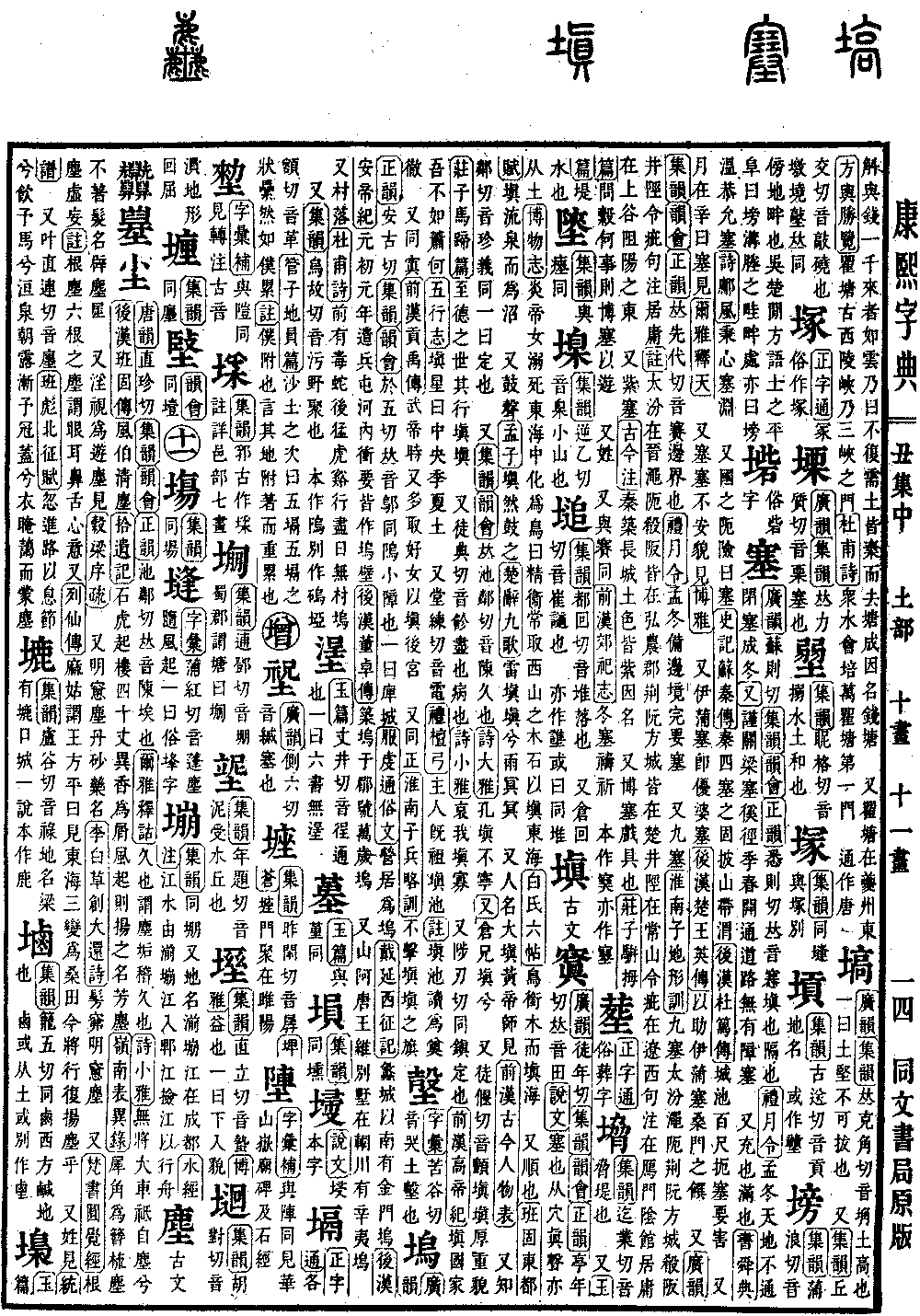
Chou Collection, Middle Volume
Radical: Earth (tǔ)
Entry: Wu
Kangxi stroke count: 13
Page 236, Entry 03
Pronounced wu. Same as the character for a small defensive fortification (wu). Refers to a small defensive work. One source suggests it refers to a low city wall.
According to the Common Words (Tongsu Wen) by Fu Qian, a place where barracks are built and occupied is called a wu.
According to the Western Records (Xizheng Ji) by Dai Yan, south of Li City there is a place called Jinmen Wu.
According to the Book of the Later Han (Hou Hanshu), in the first year of the Yuanchu era, troops were sent to garrison important transportation routes in the Henei region, all of which had defensive walls (wu bi) built.
According to the Book of the Later Han (Hou Hanshu), in the Biography of Dong Zhuo, a fortified dwelling was built in Mei County, known as the Wansui Wu.
It also refers to a low-lying area between mountains. During the Tang dynasty, Wang Wei had a villa in Wangchuan, which included the Magnolia Hollow (Xinyi Wu).
It also refers to a village. In a poem by Du Fu, it is written: There are poisonous snakes in front and fierce tigers behind; walking along the stream all day, one does not see a village.
Also, pronounced wu. Refers to a place where people live in the wilderness. The original form of the character is written as wu. It is also written as ya.