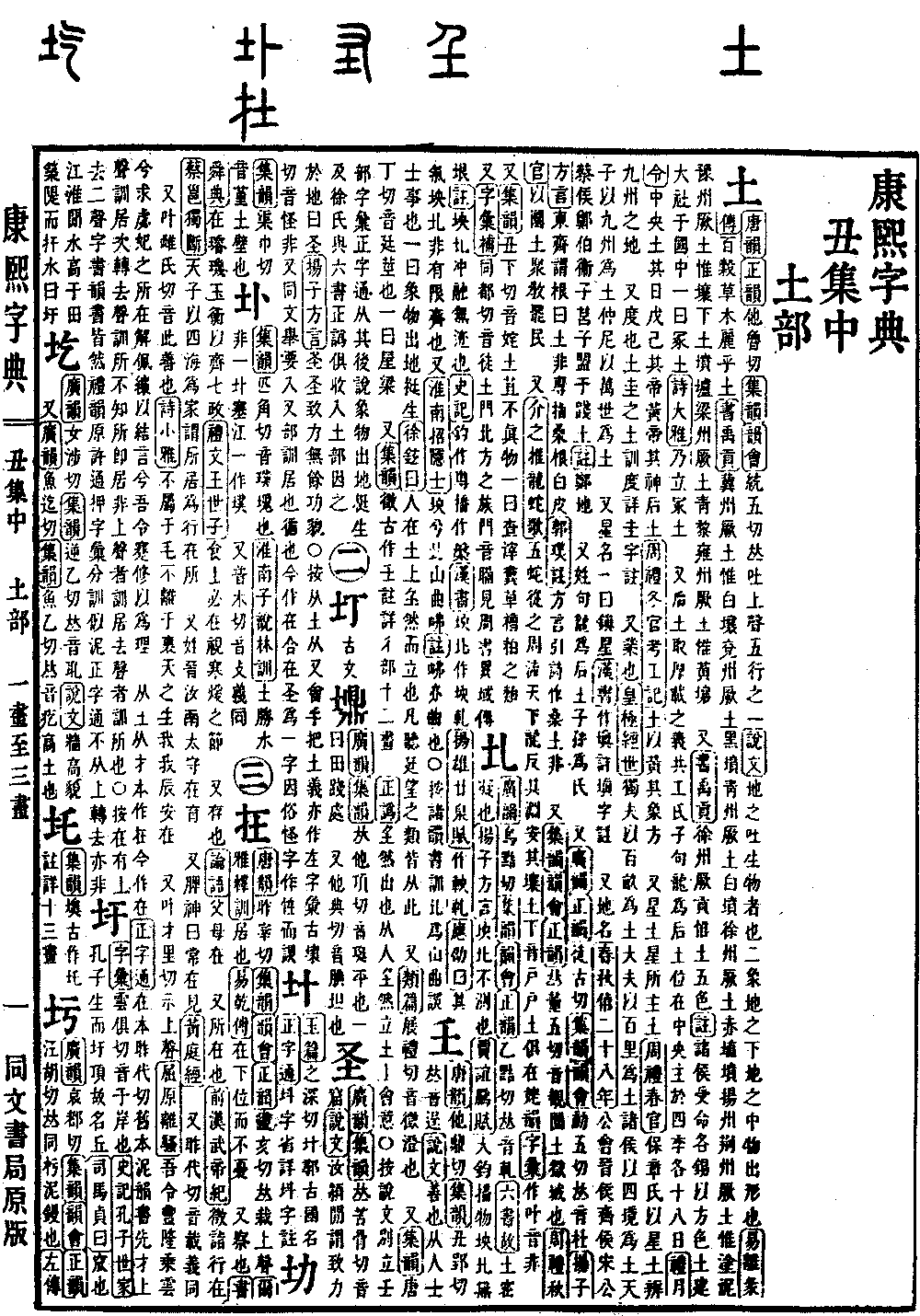
Chou Collection, Middle Volume
Radical: Earth (tǔ)
Kangxi Strokes: 3
Page 223, Entry 01
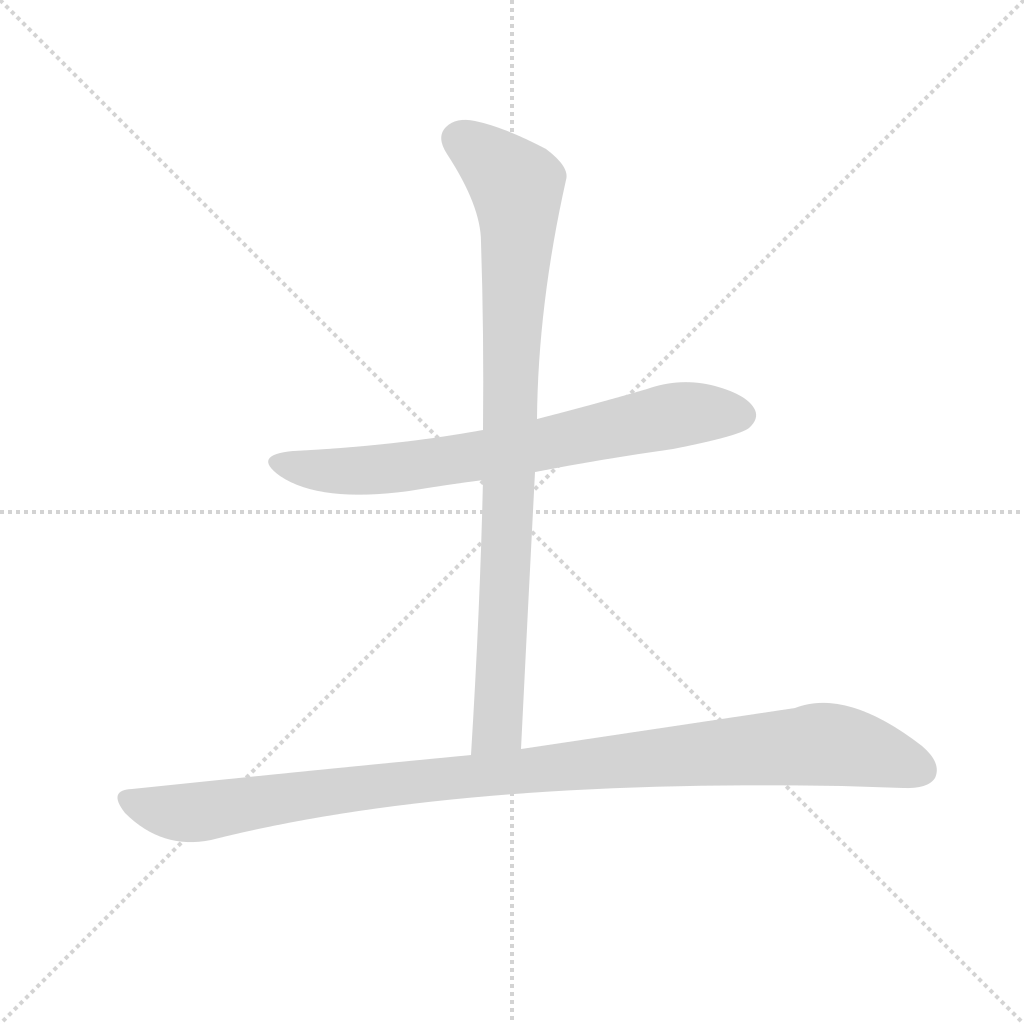
Pronounced tu (rising tone). One of the Five Elements. According to the Explaining Graphs and Analyzing Characters (Shuowen Jiezi), it is the earth that emits and produces living things. The two horizontal lines represent the underside and the center of the earth, where earthy matter emerges and takes form. According to the Commentary on the Judgments of the Book of Changes (Yijing), all grains, grasses, and trees adhere to the earth. According to the Tribute of Yu (Yu Gong) section of the Book of Documents (Shushang), the soil of Jizhou is white loam, the soil of Yanzhou is black and rich, the soil of Qingzhou is white and rich, the soil of Xuzhou is red and clayey, the soil of Yangzhou and Jingzhou is muddy, the soil of Yuzhou is loam, the soil of Liangzhou is blue and black, and the soil of Yongzhou is yellow loam. Also, according to the Tribute of Yu section of the Book of Documents, the tribute from Xuzhou consisted of soil of five colors. The commentary notes that when feudal lords were granted their domains, they were bestowed with soil of their respective cardinal colors to establish a grand altar in their capitals, also known as a mound of earth. According to the Book of Odes (Shijing), one establishes a mound of earth. Also refers to Houtu (Lord of the Earth), signifying the virtue of thick support. Goulong, son of Gonggong, became Houtu; his position is in the center, presiding over eighteen days of each of the four seasons. According to the Monthly Ordinances (Yueling) of the Book of Rites (Liji), the center corresponds to earth, its days are Wu and Ji, its emperor is the Yellow Emperor, and its deity is Houtu. According to the Records of Trades (Kaogongji) in the Rites of Zhou (Zhouli), earth is associated with the color yellow and the shape of a square. Also refers to star-earth, the regions governed by specific stars. According to the Office of Spring (Chunguan) in the Rites of Zhou, the Keeper of Celestial Records used star-earth to distinguish the lands of the nine provinces. Also means to measure. The earth of the earth-gnomon serves to measure. See the entry for gnomon for details. Also refers to one's occupation or territory. According to the Supreme Principles Governing the World (Huangji Jingshi), a commoner considers one hundred mu as their territory, a high official considers one hundred li, a feudal lord considers their four borders, the Son of Heaven considers the nine provinces, and Confucius considers the myriad generations. Also the name of a star, also called the Quelling Star (Zhenxing). In the Book of Han (Hanshu), it is written as the Quelling Star (Tianxing). See the entry for filling for details. Also a place name. According to the Spring and Autumn Annals (Chunqiu), in the twenty-eighth year of Duke Xi, the Duke met with the Marquises of Jin and Qi, the Duke of Song, the Marquis of Cai, the Earl of Zheng, the Viscount of Wei, and the Viscount of Ju to form an alliance at Jiantu, a territory of Zheng. Also a surname. Descendants of Goulong, who served as Houtu, adopted this as their clan name.
Pronounced du. According to the Dialects (Fangyan) by Yang Xiong, people in eastern Qi call roots "tu," though this does not refer exclusively to the white bark of mulberry roots. Guo Pu notes that the citation of mulberry roots in the Book of Odes within the Dialects is incorrect.
Pronounced du. Round earth refers to a prison. According to the Office of Autumn (Qiuguan) in the Rites of Zhou, round earth was used to gather and instruct those who had ceased to do good. Also, in the Song of the Dragon and Snake by Jie Zhitui, the lines refer to the earth and soil, where the final character is pronounced hu, rhyming with the character for earth in the lao rhyme group. The collection of characters (Zihui) incorrectly identifies this as a phonetic loan.
Pronounced cha. Refers to something not genuine, dross, or compost.
Pronounced tu. Refers to the Tumen, a tribe of the north. This is found in the Records of the Foreign Regions in the Book of Zhou (Zhoushu).