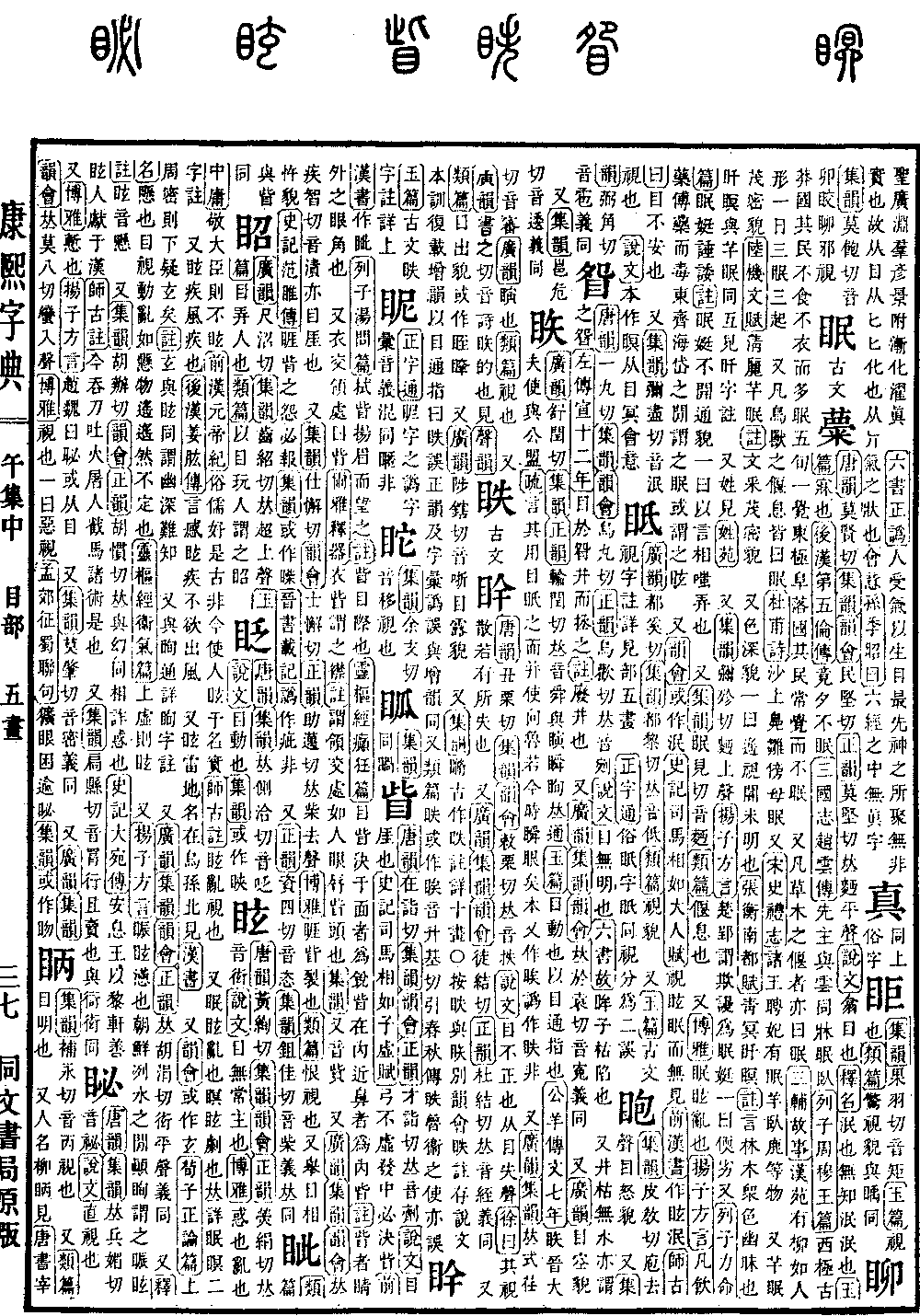
Wu Collection, Middle Volume
Radical: Eye (mù)
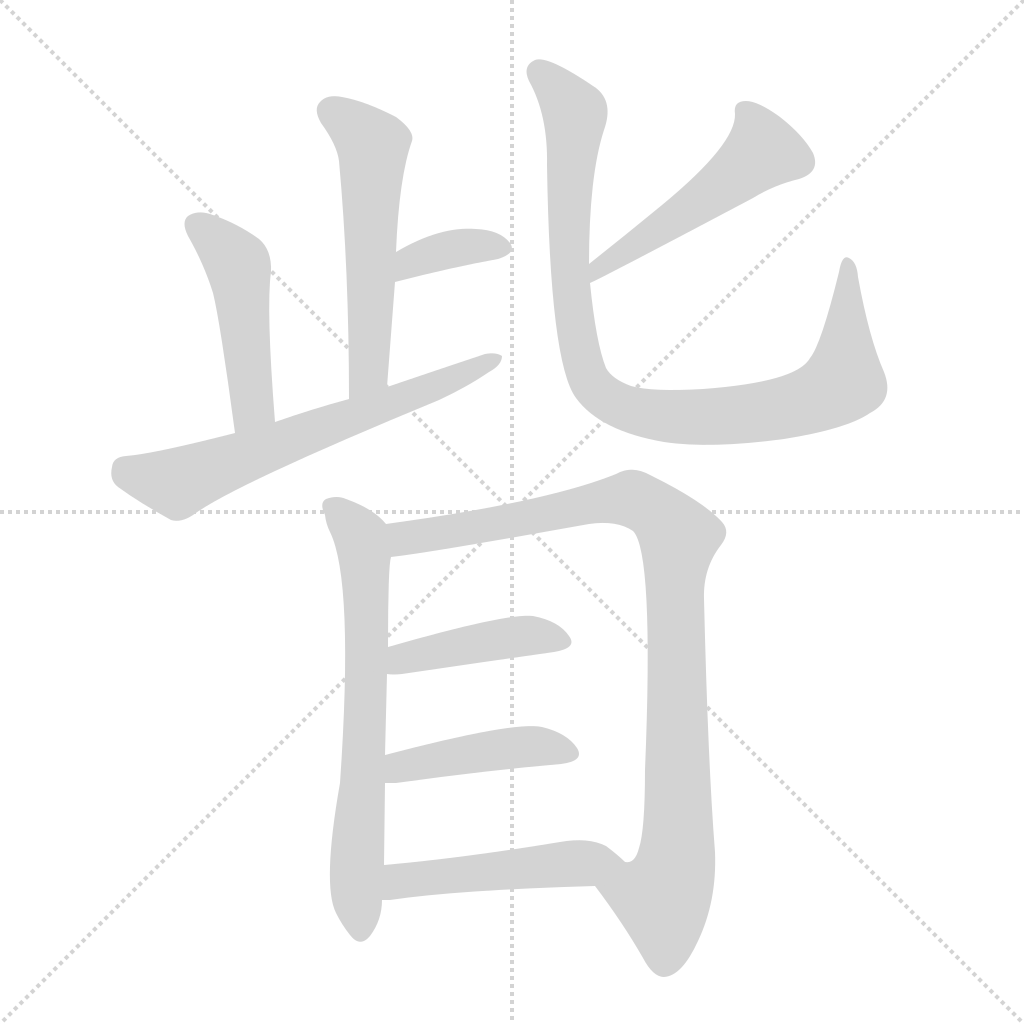
Character: Zì
Kangxi Stroke Count: 10
Page 805, Entry 16
Pronounced jì.
According to the Explaining Graphs and Analyzing Characters (Shuowen Jiezi), it refers to the edge of the eye. In the Records of the Grand Historian (Shiji), specifically the Rhapsody on Sir Vacuous by Sima Xiangru, it states, The bow does not fire in vain, and if it hits, it must pierce the eye socket. The History of the Former Han (Qian Hanshu) writes this as a variant form. In the Book of Master Lie (Liezi), in the Tang Question chapter, it says, Wiping the eye sockets and lifting the brows to gaze at it. The commentary notes that this refers to the corners of the eyes. In the Miraculous Pivot (Lingshu Jing), in the chapter on Epilepsy and Madness, it states, Where the eye socket splits at the face, it is the sharp corner; that which is inside near the nose is the inner corner. The commentary notes that this refers to the corners of the eye outside the pupil. It also refers to the area of a garment where the collar crosses. In the Erya (Erya), in the Explaining Utensils chapter, it states, The edge of a garment is called the collar. The commentary notes that this refers to the place where the collar crosses, resembling the human eye, lips, corners of the eyes, or head.
Pronounced zī.
Pronounced zì. It also refers to the edge of the eye.
Pronounced chái (falling tone). According to the Guangya (Boya), it refers to the splitting of the corners of the eyes when glaring. According to the Classified Chapters (Leipian), it refers to a hateful glare. It also describes the appearance of raising the eyes in mutual defiance. In the Records of the Grand Historian (Shiji), in the Biography of Fan Ju, it states, A grievance involving even a hateful glare must be avenged. It is sometimes written in a variant form. In the Book of Jin (Jinshu), it is incorrectly written as a variant form.
Pronounced zì.
Pronounced chái. The meaning is the same.