Wu Collection, Middle Volume
Radical: Eye (mù)
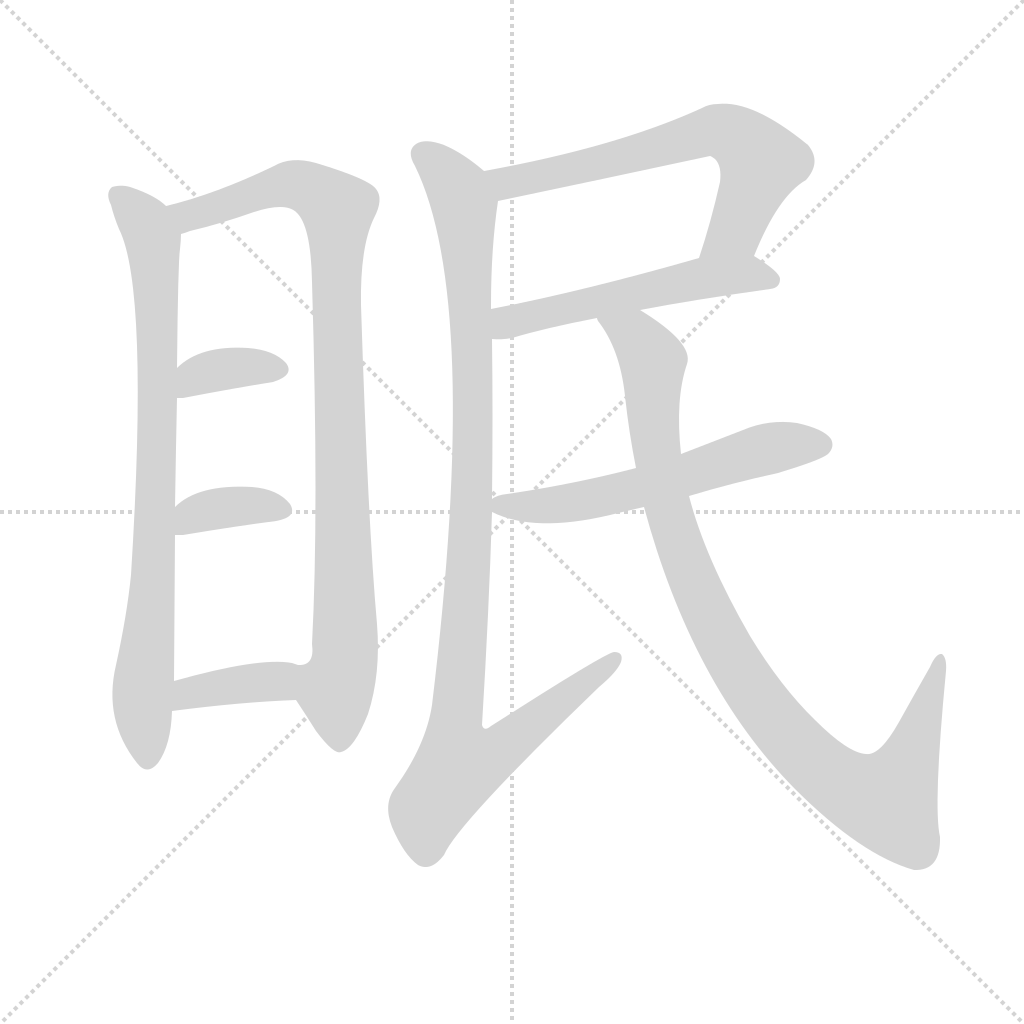
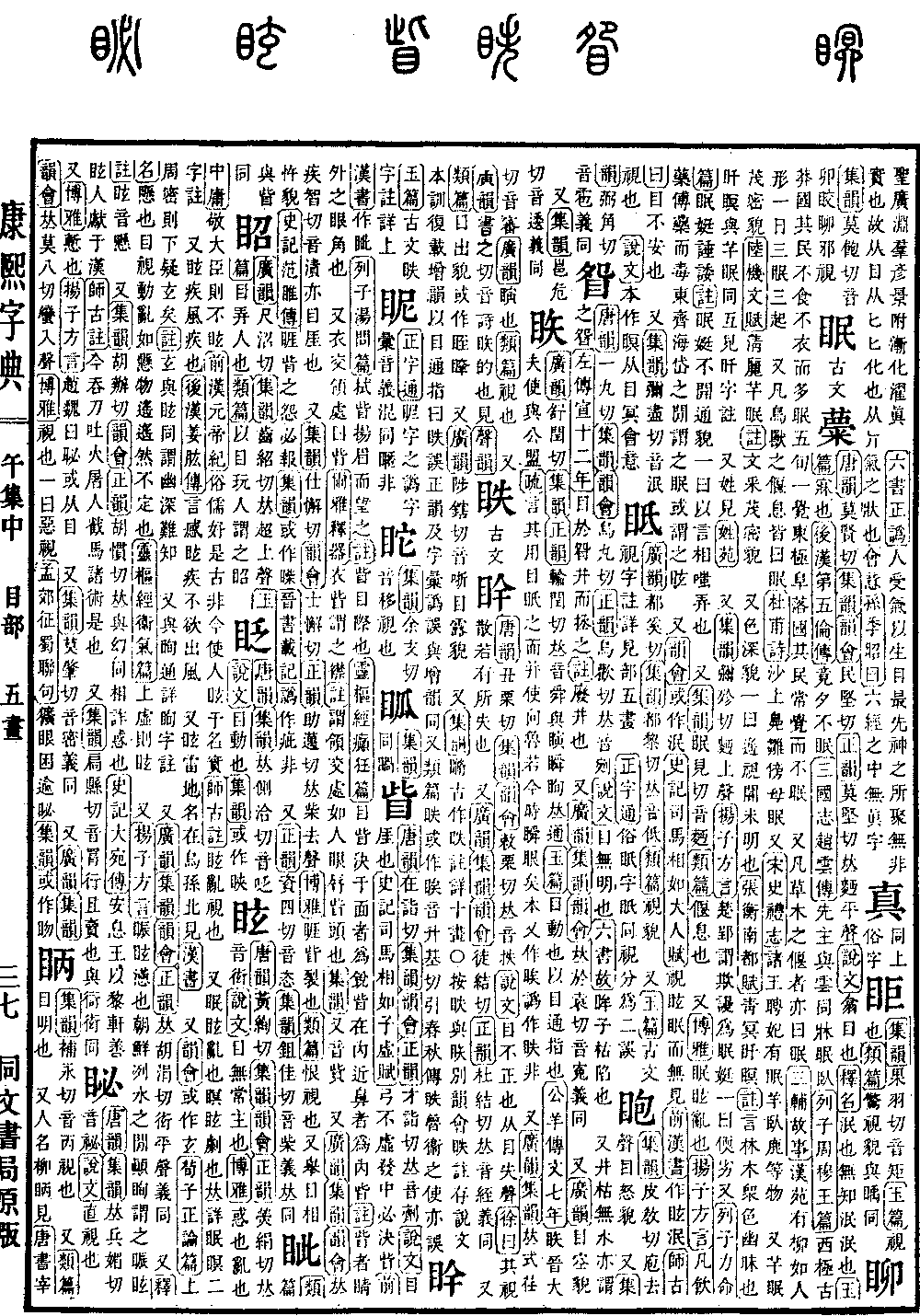
眠
Kangxi Strokes: 10
Page 805, Entry 04
Ancient literary records:
According to Tang Rhymes (Tangyun), pronounced mian (level tone). According to Collected Rhymes (Jiyun) and Rhyme Treasury (Yunhui), pronounced mian (level tone). According to Correct Rhymes (Zhengyun), pronounced mian (level tone). The pronunciation is similar to the level tone of the character mian.
Explanation in Explanation of Script and Elucidation of Characters (Shuowen Jiezi): To close the eyes.
Explanation in Explanation of Names (Shiming): It means to be extinguished or destroyed, referring to a state of being unaware or insensate.
Explanation in Jade Chapters (Yupian): To sleep.
Book of the Later Han (Hou Hanshu), Biography of Diwu Lun: Did not sleep all night.
Records of the Three Kingdoms (Sanguozhi), Biography of Zhao Yun: Liu Bei and Zhao Yun rested together on the same bed.
Book of Master Lie (Liezi), Chapter on King Mu of Zhou: In the extremely distant ancient Mang Kingdom of the west, the people there do not eat or clothe themselves and sleep a great deal, waking up only once every fifty days. In the extremely distant Fuluo Kingdom of the east, the people there are often awake and do not sleep.
Also, whenever grass or trees fall prostrate, it is also called mian.
Tales of the Three Assistant Capitals (Sanfu Gushi): There were willow trees in the Han dynasty palace gardens shaped like humans; it is said they fell and stood up three times in one day.
Also, whenever birds and beasts lie down to rest, it is called mian.
Poetry of Du Fu (Du Fu shi): Small wild ducks on the sandbank nestle against the mother duck to sleep.
Also, History of Song (Songshi), Treatise on Rites: Among the items used when princes took wives were sleeping sheep and lying deer.
Also, qianmian, describes a lush and dense appearance.
Lu Ji, Rhapsody on Literature (Wenfu): Fresh, beautiful, and flourishing.
Commentary: Refers to literary style that is rich, dense, and lush.
Also refers to a dark and deep color. One theory suggests it refers to an appearance that is dark and unclear when viewed from a distance.
Zhang Heng, Rhapsody on the Southern Capital (Nandu fu): Green, secluded, and dim.
Commentary: Describes forests and trees that are numerous, with colors that are secluded, dark, and unclear.
Ming and qianmian have the same meaning. See related characters for further notes.
Also a surname. Found in Register of Surnames (Xingyuan).
Also, according to Collected Rhymes (Jiyun), pronounced mian (rising tone).
Yang Xiong, Regional Speech (Fangyan): In the area of Ying, the capital of Chu, deceiving and hoodwinking is called miantian. Another theory suggests it refers to being weak and incompetent.
Also, Book of Master Lie (Liezi), Chapter on Power and Fate (Liming pian): Miantian, zhuìwěi.
Commentary: Miantian refers to being narrow-minded or not understanding principles. One theory suggests it refers to using words to mock and ridicule one another.
Also, according to Collected Rhymes (Jiyun), pronounced mian.
Categorized Texts (Leipian): Explains it as lying down to rest.
Also, Extensive Eulogies (Boya): Mianxuan refers to mental confusion or dizziness.
Yang Xiong, Regional Speech (Fangyan): Whenever one is poisoned by medicine or a topical application, in the East Qi and Haidai regions it is called mian. It is also called xuan.
Also, according to Rhyme Treasury (Yunhui), sometimes written in a variant form (min).
Records of the Grand Historian (Shiji), Sima Xiangru, Rhapsody on the Great Man (Daren fu): Seeing things as dim and blurred, unable to see anything clearly.
Book of the Former Han (Qian Hanshu): Written as xuanmin.
Yan Shigu says: Refers to eye discomfort and unclear vision.
Also, according to Collected Rhymes (Jiyun), pronounced min. It means to look.
Explanation of Script and Elucidation of Characters (Shuowen Jiezi): The original character is written as ming. It is a compound ideograph formed from eye and darkness.