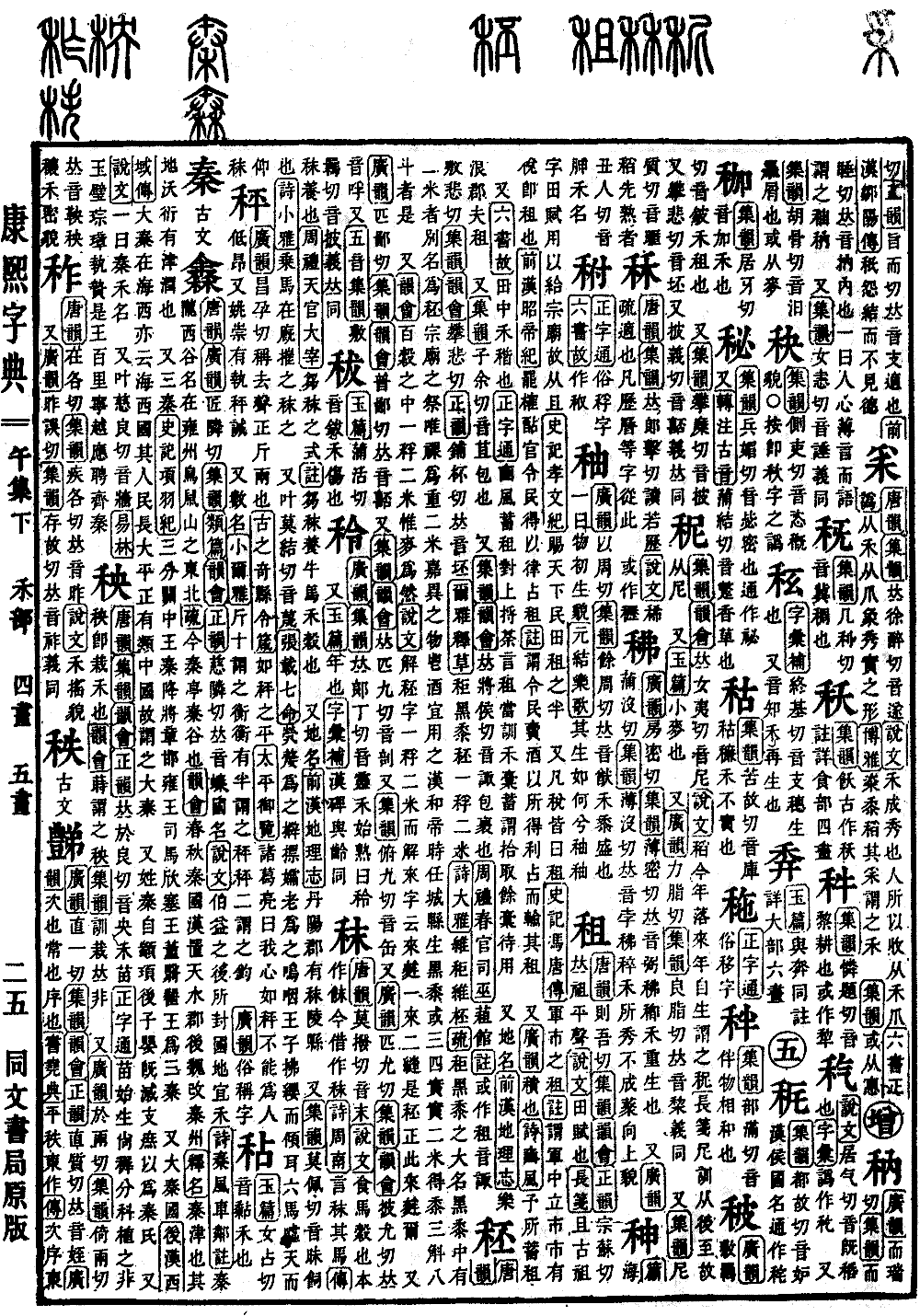
Wu Collection, Lower Volume
Radical: Grain (hé)
Kangxi Strokes: 10
Page 851, Entry 23
Pronounced zu.
According to the Shuowen Jiezi (Explanation of Writing), it refers to land tax.
According to the Changjian (Long Commentary), the character qie was the ancient form of the character zu (ancestor). Land tax was used to provide for the ancestral temple, hence the radical for grain is combined with qie.
According to the Records of the Grand Historian (Shiji), Biography of Emperor Xiaowen: Bestowed half of the land tax upon the common people of the world.
Furthermore, all types of taxes can be referred to as zu.
According to the Records of the Grand Historian (Shiji), Biography of Feng Tang: The tax of the military market. The commentary notes this refers to the markets established within the military; there was a tax on these markets, which was called zu.
According to the Book of Han (Hanshu), Annals of Emperor Zhao: Abolished the monopoly on fermented beverages and salt, allowing the people to report and pay taxes according to the law. The commentary notes this refers to allowing people to sell alcohol, reporting their profits, and paying taxes accordingly.
Also, according to the Guangyun (Broad Rhymes), it means to accumulate.
According to the Book of Odes (Shijing), Binfeng: The stores I have accumulated.
According to the Liushu Gu (Six Writings Explained), it refers to the stalks of grain in the fields.
According to the Zhengzitong (Correction of Character Meanings), the phrase accumulated zu in the Binfeng section is contrasted with the previous mention of gathering thatch. Zu should be interpreted as grain stalks. Accumulating refers to collecting the remaining stalks for future use.
Also, it is a place name.
According to the Book of Han (Hanshu), Treatise on Geography: In Lelang Commandery, there is the place Fuzu.
According to the Jiyun (Collected Rhymes), it is pronounced ju. It means to wrap.
According to the Jiyun (Collected Rhymes) and the Yunhui (Collection of Rhymes), it is pronounced zou. It means to wrap.
According to the Rites of Zhou (Zhouli), Spring Officials, Master of Sorcerers: Ju hall. The commentary notes that it is sometimes written as zu, pronounced zou.