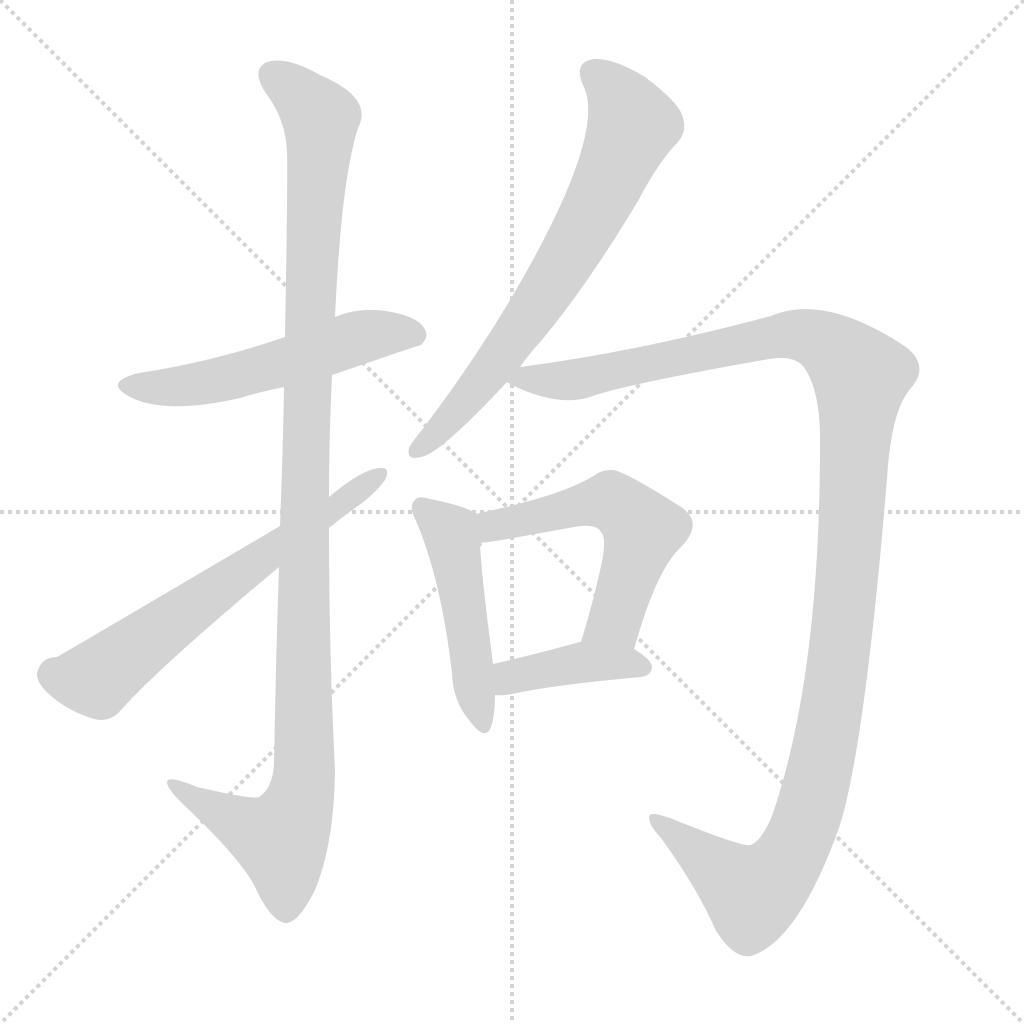
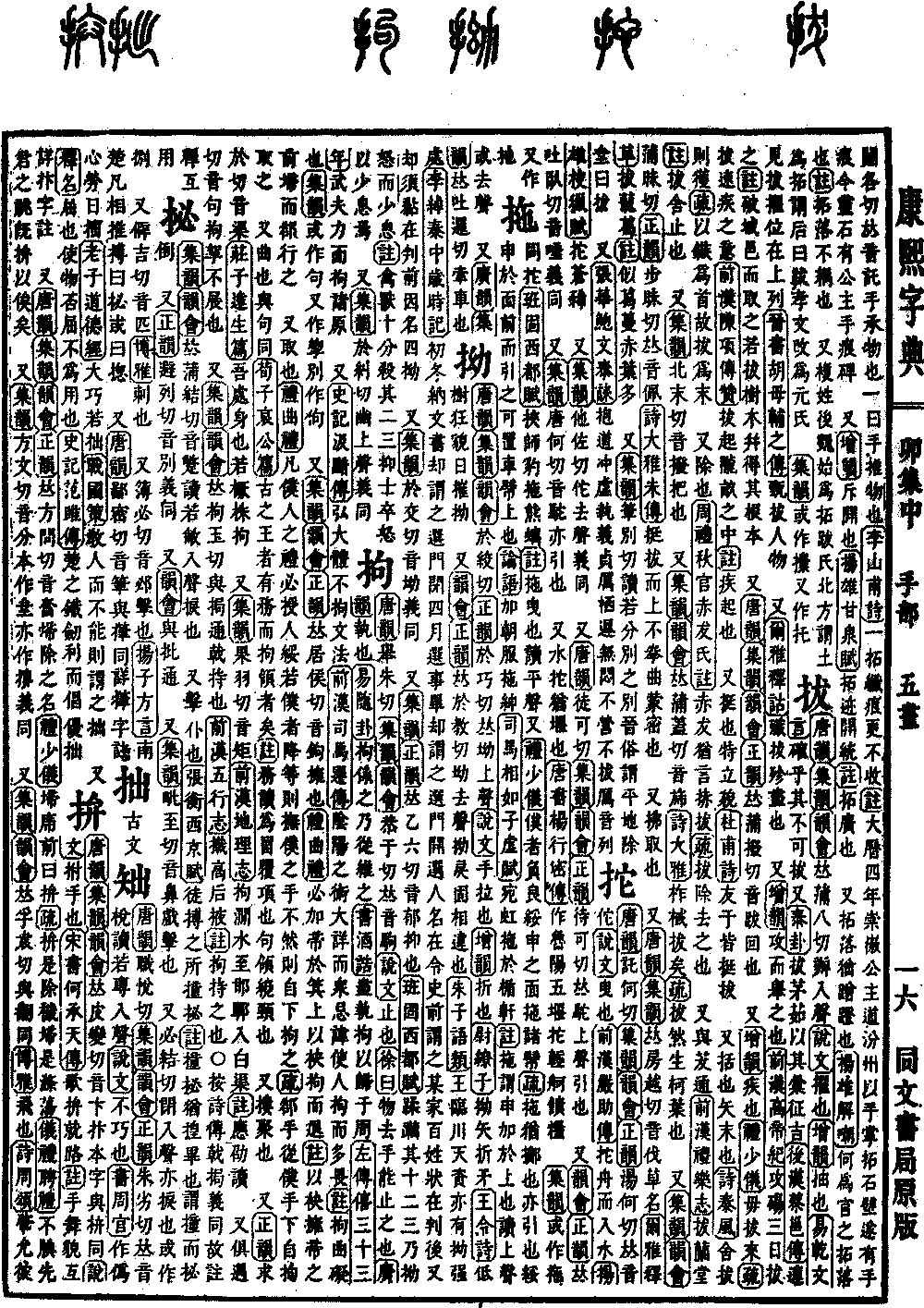
Mao Collection, Middle Volume
Radical: Hand (shǒu)
Kangxi stroke count: 9
Page 426, Entry 05
Pronounced ju.
Shuowen Jiezi (Explanation of Simple and Compound Characters): To stop.
Xu Kai says: When an object is moving away, the hand is able to stop it.
Guangyun (Broad Rhymes): To hold.
Book of Changes (Yijing), Sui Hexagram: Restrained and bound, then following and tied.
Book of Documents (Shangshu), Announcement on Wine (Jiugao): Completely seized and detained them to return to the Zhou state.
Zuo Tradition (Zuo Zhuan), 33rd Year of Duke Xi: The warriors used force to restrain them on the plain.
Records of the Grand Historian (Shiji), Biography of Ji An: He maintained the general framework and was not restricted by legal technicalities.
History of the Former Han (Qian Hanshu), Biography of Sima Qian: The arts of Yin and Yang are extremely detailed and have many taboos, making people restricted and full of fear.
Commentary: Restrictive, hindered, or constrained.
Jiyun (Collection of Rhymes): Sometimes written as a variant form (gou). Also written in a variant form. Also written in a variant form (gou).
Pronounced gou.
To embrace or shield.
Book of Rites (Liji), Summary of the Rules of Propriety (Quli): One must place the broom upon the dustpan, shielding it with the sleeve before retreating.
Commentary: Using the sleeve to shield the front of the broom, sweeping while backing away.
Also: To take.
Book of Rites (Liji), Summary of the Rules of Propriety (Quli): Generally, the etiquette for a servant is to offer the strap to the person; if the servant is of a lower rank, then he should support the servant's hand; otherwise, he should take it from underneath.
Sub-commentary: Withdrawing the hand, one takes it from underneath the servant's hand.
Also: Curved. Same as the variant form (gou).
Xunzi, Lament for Duke Ai: Ancient kings had those who worked to create curved collars.
Commentary: The word "wu" is read as "mao," meaning to cover the neck; "gou" refers to the collar that wraps around the neck.
Also: To gather together.
Pronounced qu.
Zhuangzi, Understanding Life: I dwell in my body as if it were a withered, crooked tree trunk.
Pronounced ju.
History of the Former Han (Qian Hanshu), Treatise on Geography: The Ju River reaches Handan and enters the Bai Canal.
Commentary: Ying Shao reads it as such.
Pronounced ju.
Restricted and unable to unfold.
Pronounced ju.
Also interchangeable with the variant form (ju). To hold or grasp with a weapon.
History of the Former Han (Qian Hanshu), Treatise on the Five Elements: Grasping the Empress Dowager under the arms.
Commentary: This means to hold or restrain her. Note that in the commentaries of the Book of Odes (Shijing), the meanings of the two characters are the same, hence the annotations are used interchangeably.