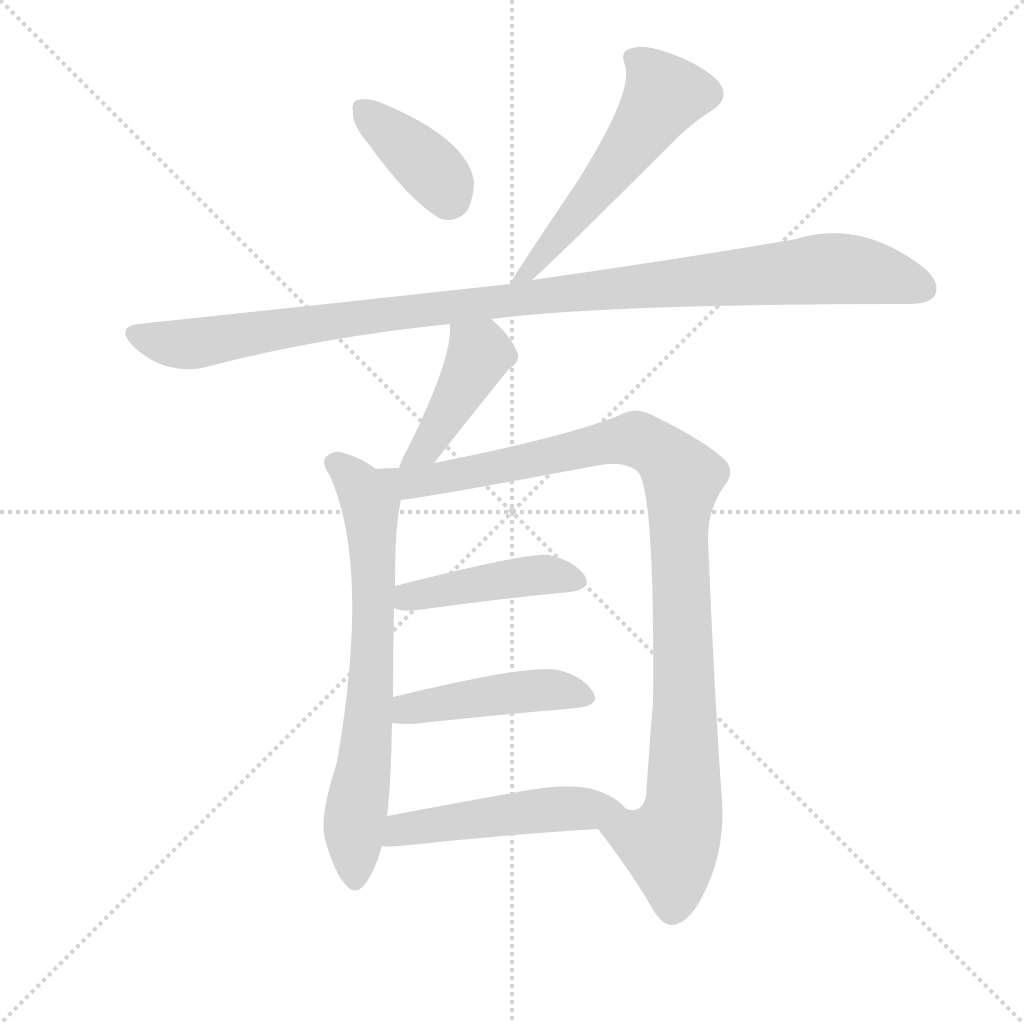
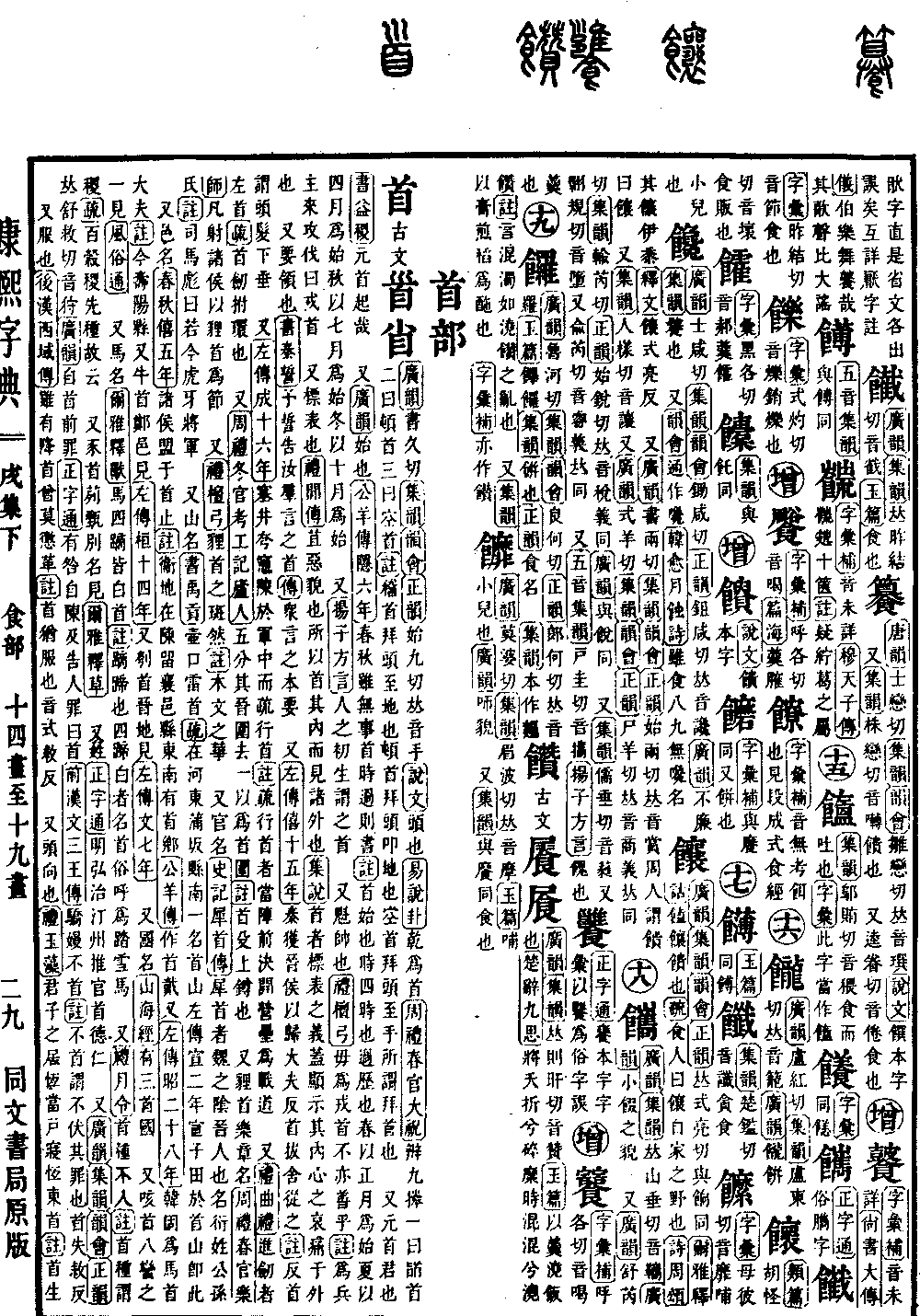
Xu Collection, Lower Volume, Radical: Head (shǒu), Kangxi Stroke count: 9, Page 1427, Entry 32
Ancient form. Guangyun: Pronounced shou. Jiyun, Yunhui, Zhengyun: Pronounced shou. Shuowen Jiezi: The head. Book of Changes (Yijing), Shuo Gua: Qian represents the head. Book of Rites (Zhouli), Spring Officials, Great Invocation: Categorize the nine forms of obeisance; the first is called shou, the second is dunshou, the third is kongshou. Commentary: Jishou is bowing until the head touches the ground. Dunshou is bowing until the head knocks the ground. Kongshou is bowing with the head toward the hands, which is what is meant by baishou.
Also, yuanshou (the head of state) refers to the ruler. Book of Documents (Shangshu), Yiji: The ruler begins his work.
Also, Guangyun: Beginning. Gongyang Zhuan, Yin Year 6: Even if there are no major events in the Spring and Autumn period, if the seasonal beginning passes, it is recorded. Commentary: Shou means beginning. Time refers to the four seasons. Passing means going through. Spring begins with the first month, summer with the fourth, autumn with the seventh, and winter with the tenth.
Also, Yang Xiong, Fangyan: The first moments of a person's life are called shou.
Also, a leader or chief. Book of Rites (Liji), Tangong: Do not be the leader of conflict; would that not be better? Commentary: To be the master of military aggression is called the leader of conflict.
Also, a mark or sign. Book of Rites (Liji), Xianzhuan: Zuo is a sign of sorrow. It marks the inner state and shows it externally. Jishuo: Shou means a sign or marker, indicating that one displays their inner grief externally.
Also, essentials or core. Book of Documents (Shangshu), Qin Oath: I have sworn to tell you the essentials of my words. Commentary: The basis and gist of all words.
Also, Zuo Zhuan, Xi Year 15: Qin captured the Duke of Jin and returned; the high officials let their hair hang down and followed him. Commentary: Fanshou refers to hair hanging down.
Also, Zuo Zhuan, Cheng Year 16: Block the wells and ovens in the camp and clear the main path. Commentary: Clearing the main path means opening up a passage through the encampment for battle.
Also, Book of Rites (Liji), Quli: When presenting a sword, the hilt should be on the left. Commentary: Shou refers to the ring on the sword hilt.
Also, Book of Rites (Zhouli), Winter Officials, Record of Tradesmen: Divide the perimeter of the socket into five parts, remove one to determine the perimeter of the head. Commentary: Shou refers to the metal cap at the end of a spear shaft.
Also, Lishou, name of a musical piece. Book of Rites (Zhouli), Spring Officials, Music Master: In all archery ceremonies, the feudal lords use Lishou as the rhythm.
Also, Book of Rites (Liji), Tangong: The mottled pattern of Lishou. Commentary: The decorative pattern of wood.
Also, a title. Records of the Grand Historian (Shiji), Biography of Xishou: Xishou was a man from Yinjin in the state of Wei. Named Yan, surname Gongsun. Commentary: Sima Biao says: Similar to the present-day Tiger Tooth General.
Also, name of a mountain. Book of Documents (Shangshu), Yu Gong: Hukou and Leishou. Commentary: Located south of Puban County in Hedong, also called Shoushan. Zuo Zhuan, Xuan Year 2, Xuanzi hunted at Shoushan, which refers to this place.
Also, name of a city. Spring and Autumn Annals (Chunqiu), Xi Year 5: Met the King's Heir at Shouzhi. Commentary: Land of Wei, located in Xiangyi County, Chenliu; to the southeast is Shouxiang. Gongyang Zhuan writes it as Shoudui.
Also, Zuo Zhuan, Zhao Year 28: Han Gu was the Minister of Mashou. Commentary: Present-day Shouyang County.
Also, Niushou, a city in Zheng, see Zuo Zhuan, Huan Year 14.
Also, Kushou, a place in Jin, see Zuo Zhuan, Wen Year 7.
Also, name of a state. Classic of Mountains and Seas (Shanhaijing): There is a Three-Headed State.
Also, Keshou, one of the Eight Barbarian tribes, see Fengsu Tong.
Also, name for a horse. Erya, Explanation of Animals: A horse with four white hooves is called shou. Commentary: Du is the hoof. A horse with four white hooves is named shou. Colloquially called a horse that treads on snow.
Also, Book of Rites (Liji), Yueling: If the primary grain is not sown, the harvest will not enter. Commentary: Primary grain refers to millet (ji). Commentary: Millet is the first grain sown, hence the term.
Also, Zhishou, a variant name for a type of rush. See Erya, Explanation of Plants.
Also, a surname. Zhengzitong: Shou Deren, a registrar in Tingzhou during the Hongzhi reign of the Ming dynasty.
Also, Guangyun, Jiyun, Yunhui, Zhengyun: Pronounced shou (falling tone). Guangyun: To confess one's own guilt. Zhengzitong: When one has a fault and confesses to it, it is called shou. History of the Former Han (Qian Hanshu), Biography of the Three Kings of Wen: Arrogant and disobedient. Commentary: Not confessing means failing to acknowledge one's crime.
Also, to submit. History of the Later Han (Hou Hanshu), Biography of the Western Regions: Although they have surrendered, they have not been punished or reformed. Commentary: Shou means to submit.
Also, the direction of the head. Book of Rites (Liji), Yuzhao: The superior person always sleeps with his head to the east. Commentary: Shou is where the vital energy lies.
Also, from the Stratagems of the Warring States (Zhanguoce): Using the power of Qin to face them. Commentary: It means using military force to face them.
Also, rhymes with zhi, pronounced shi. Yang Xiong, Taixuanjing: Frozen ascent to the red sky, darkness acts as the beginning. Voids and weaknesses appearing, the situation remains unending.
Also, rhymes with yu, pronounced shu. Ban Gu, Eulogy of Emperor Gao: The divine mother gave the omen, the crimson flags were raised. Stepping onto the Qin outskirts, Ying came to bow.
Also, rhymes with yu, pronounced shu. History of Jin (Jinshu), Music Records: Attacking Liaodong, the enemy lost their stronghold. The divine power reached the ends of the earth, Gongsun has already bowed his head in surrender.