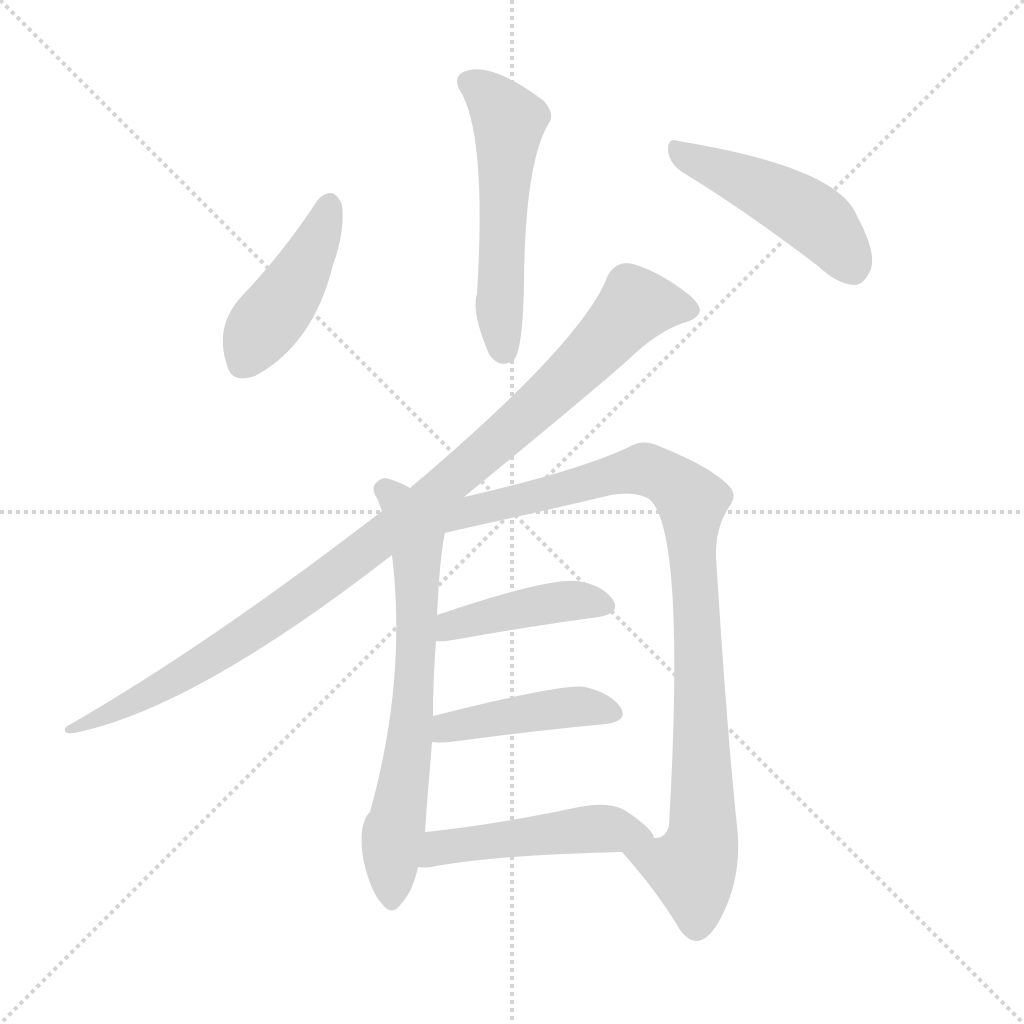
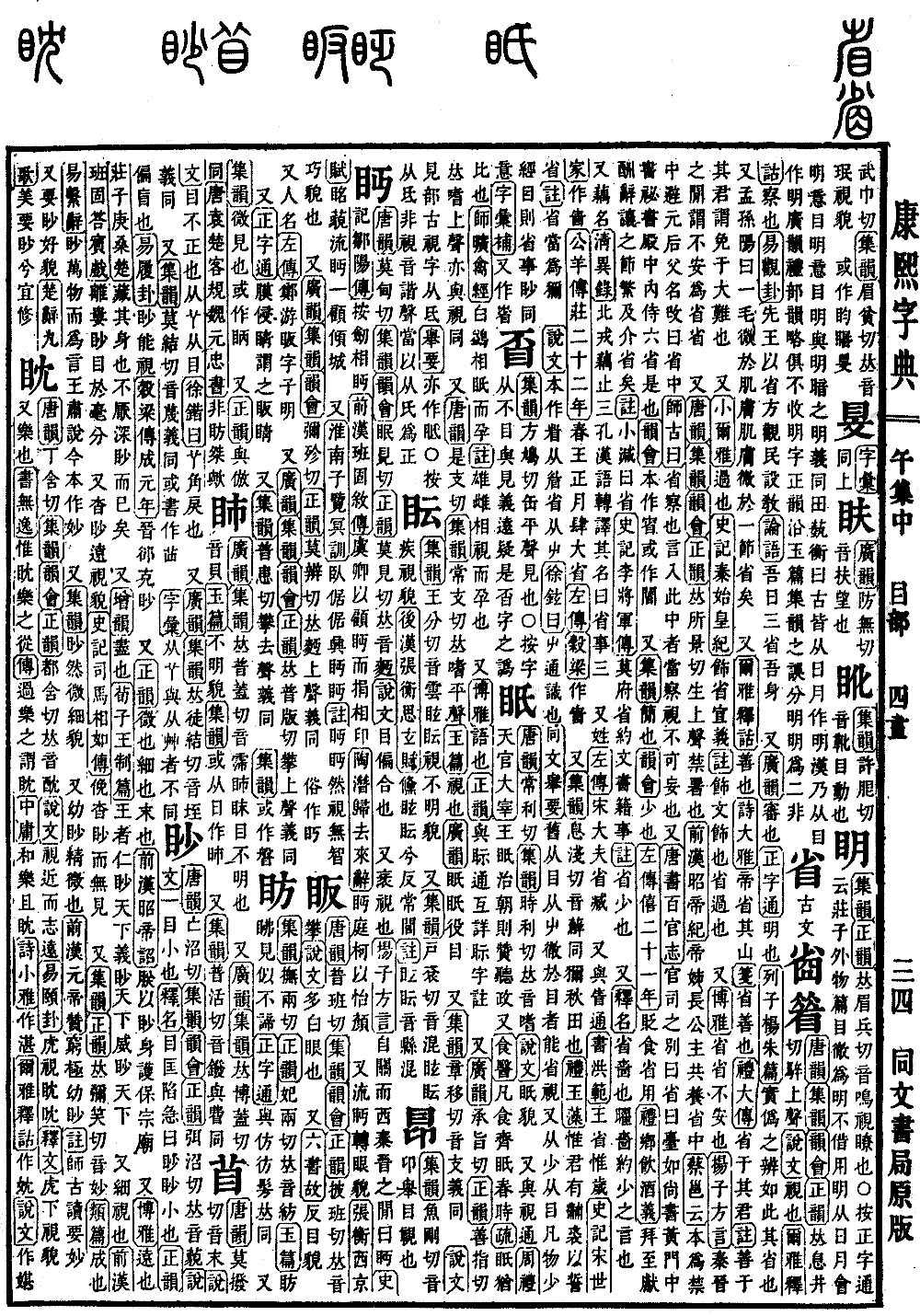
Wu Collection, Middle Volume. Radical: Eye (mù). Kangxi stroke count: 9. Page 802, Entry 05. Ancient form. Pronounced xing (rising tone). From Tang Rhymes (Tangyun), Collection Rhymes (Jiyun), Rhyme Meetings (Yunhui), and Orthodox Rhymes (Zhengyun). In the Shuo Wen Jie Zi dictionary: to look, to inspect. In the Erya (Er Ya): to investigate or examine. Book of Changes (Yijing): Former kings used this to inspect the four directions, observe the customs of the people, and establish teachings. Analects of Confucius (Lunyu): I reflect upon myself many times daily. Also, in the Guangyun dictionary: to examine, to look closely. In the Zhengzitong dictionary: clear, distinct. Book of Liezi (Liezi): The distinction between truth and falsehood is as clear as this. Also, Meng Sunyang said: A single hair is smaller than the skin, the skin is smaller than a joint, this is very clear. Also, in the Erya: good, fine. Book of Odes (Shijing): God considered that mountain to be good. Commentary: Xing means good. Book of Rites (Liji): Good for their ruler. Note: Good for their ruler means being able to avoid great disaster. Also, in the Xiao Erya dictionary: a fault, a mistake. Records of the Grand Historian (Shiji): To gloss over faults and promote righteousness. Note: Glossing over means to decorate or conceal. Xing means fault. Also, in the Boya dictionary: xingxing, describing a state of mental unease. Fangyan: In the Qin and Jin regions, mental unease is called xingxing. Also, from Tang Rhymes (Tangyun), Collection Rhymes (Jiyun), Rhyme Meetings (Yunhui), and Orthodox Rhymes (Zhengyun). Pronounced sheng (rising tone). Refers to palace inner chambers or government offices. Book of Han (Hanshu): The Emperor's sister, the Eldest Princess, cared for the Emperor within the inner chambers. Cai Yong stated: It was originally called "within the forbidden chambers," but was changed to "within the xing" to avoid the naming taboo of the father of Empress Yuan of Han. Shi Gu stated: Xing means to inspect. It implies that those entering here should observe and be careful, and not act recklessly. Also, in the Old Book of Tang (Tangshu): The distinctions between government agencies include the "Sheng" (Department) and the "Tai" (Terrace), such as the Department of State Affairs, the Chancellery, the Secretariat, the Palace Library, the Palace Attendants, and the Palace Domestic Service, known as the Six Departments. In the Rhyme Meetings (Yunhui): Originally written in a variant form. Sometimes also written in a variant form. Also, in the Collection Rhymes (Jiyun): to reduce, to economize. In the Rhyme Meetings (Yunhui): few. Zuo Tradition (Zuozhuan): Reduce food, economize expenses. Book of Rites (Liji): The rules of courtesy involving greetings, toasting, and returning toasts are tedious, but they are reduced when it comes to the assistant (jie). Note: A slight reduction is called xing. Records of the Grand Historian (Shiji): The administrative office simplified documents and registers. Note: Xing means few. Also, in the Shiming dictionary: Xing means stingy. It refers to contracting, being stingy, economizing, and reducing. Also refers to a name for a type of lotus root. Qingyilu: In the northern barbarian regions, the lotus root has only three holes; the Chinese translation of its name is "xingshi san." Also a surname. Zuo Tradition (Zuozhuan): There was a Song state official named Xing Zang. Also interchangeable with sheng (disaster or fault). Book of Documents (Shangshu): The monarch's inspection (or reflection) should consider the omens of the harvest. Records of the Grand Historian (Shiji): Written as sheng. Gongyang Tradition (Gongyangzhuan): In the spring, the first month of the Zhou King, grant amnesty for great faults. Zuo Tradition (Zuozhuan) and Guliang Tradition (Guliangzhuan) write it as sheng. Also, in the Collection Rhymes (Jiyun): Pronounced xian (rising tone). Same as xian. Refers to hunting in autumn. Book of Rites (Liji): Only the sovereign has the axe-patterned fur coat, used to swear in the troops before the autumn hunt. Note: The xing here should be written as xian. In the Shuo Wen Jie Zi dictionary: Originally written as a variant. Derived from eye with the upper part omitted, plus the grass radical. Xu Xuan stated: The grass radical signifies understanding and discerning. In the Tongwen Juyao: The old character form consisted of eye and the grass radical; those who can see through things clearly can be discerning. Also composed of few and eye. Any affair that requires little attention from the eyes can be simplified. It shares a common meaning with the character for "dim-sighted." In the Zihui Bu dictionary: Also written as a variant. This character was originally written with the grass radical above and xing below.