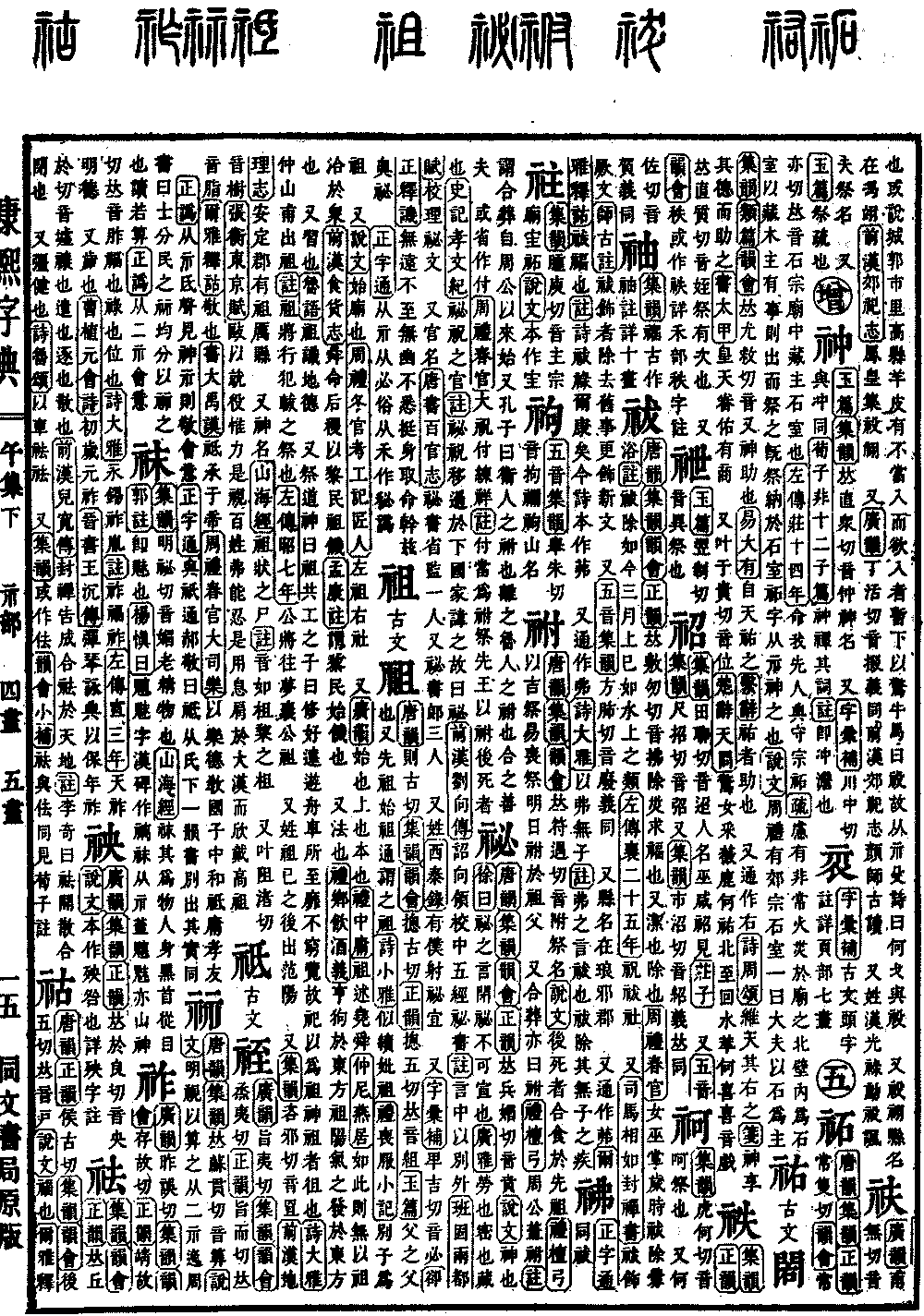
Wu Collection, Lower Volume
Radical: Spirit (shì)
Kangxi Strokes: 10
Page 841, Entry 18
Archaic script.
Pronounced zu (rising tone).
In the Yu Pian dictionary, it refers to the father of one's father. Also, terms such as ancestral forefather and original ancestor are all referred to as zu.
Book of Odes (Shijing), Lesser Odes: To inherit from the female and male ancestors.
Book of Rites (Liji), Xiaoji of Mourning Attire: A son of a concubine who establishes a new line becomes the original ancestor of that clan.
Also, according to the Shuowen Jiezi dictionary, it refers to the temple of an original ancestor.
Book of Rites (Zhouli), Records of Tradesmen in the Winter Officials: On the left is the ancestral temple, and on the right is the altar to the god of the soil.
Also, according to the Guangyun dictionary, it means to commence, to honor as superior, or to serve as a foundation.
Book of Rites (Zhongyong): To emulate Yao and Shun.
Confucian Analects (Zhongni Yanju): In this way, it is impossible to harmonize with the masses.
History of the Former Han (Qian Hanshu), Treatise on Food and Money: Shun gave orders to Hou Ji because the common people began to suffer from hunger.
Commentary by Meng Kang: This refers to the common people beginning to suffer from hunger.
Also, to imitate or follow as a model.
Book of Rites (Xiang Yinjiu Yi): Cooking dog meat in the east is to emulate the rising of the yang energy from the east.
Also, to be familiar with.
Discourses of the States (Luyu): To be familiar with and understand the characteristics of the land.
Also, the sacrifice offered to the god of the road is called zu. The son of Gonggong, named Xiu, loved to travel to distant places. Wherever carts and boats could reach, there was nowhere he did not travel, and therefore he was sacrificed to as the god of the roads. Zu means to depart.
Book of Odes (Shijing), Greater Odes: Zhong Shanfu departed and offered a sacrifice to the god of the road.
Commentary: Zu is the ceremony held to sacrifice to the god of the road when departing on a journey.
Zuo Tradition (Zuozhuan), Seventh Year of Duke Zhao: The lord of the state prepared to depart and dreamed of Duke Xiang sacrificing to the god of the road.
Also, a surname. The descendants of Zu Yi, originating from Fanyang.
Also, pronounced ju.
History of the Former Han (Qian Hanshu), Treatise on Geography: There is a Zuli County in Anding Commandery.
Also, the name of a deity.
Classic of Mountains and Seas (Shanhaijing): The corpse of Zuzhuang.
Commentary: Pronounced like the character for the Zha Li tree.
Also, rhyming with the pronunciation shu.
Zhang Heng, Eastern Metropolis Rhapsody (Dongjing Fu): Driving the common people to perform labor while valuing only their physical strength. The people could not endure this, and thus found rest in the great Han dynasty, joyfully supporting the Exalted Ancestor.