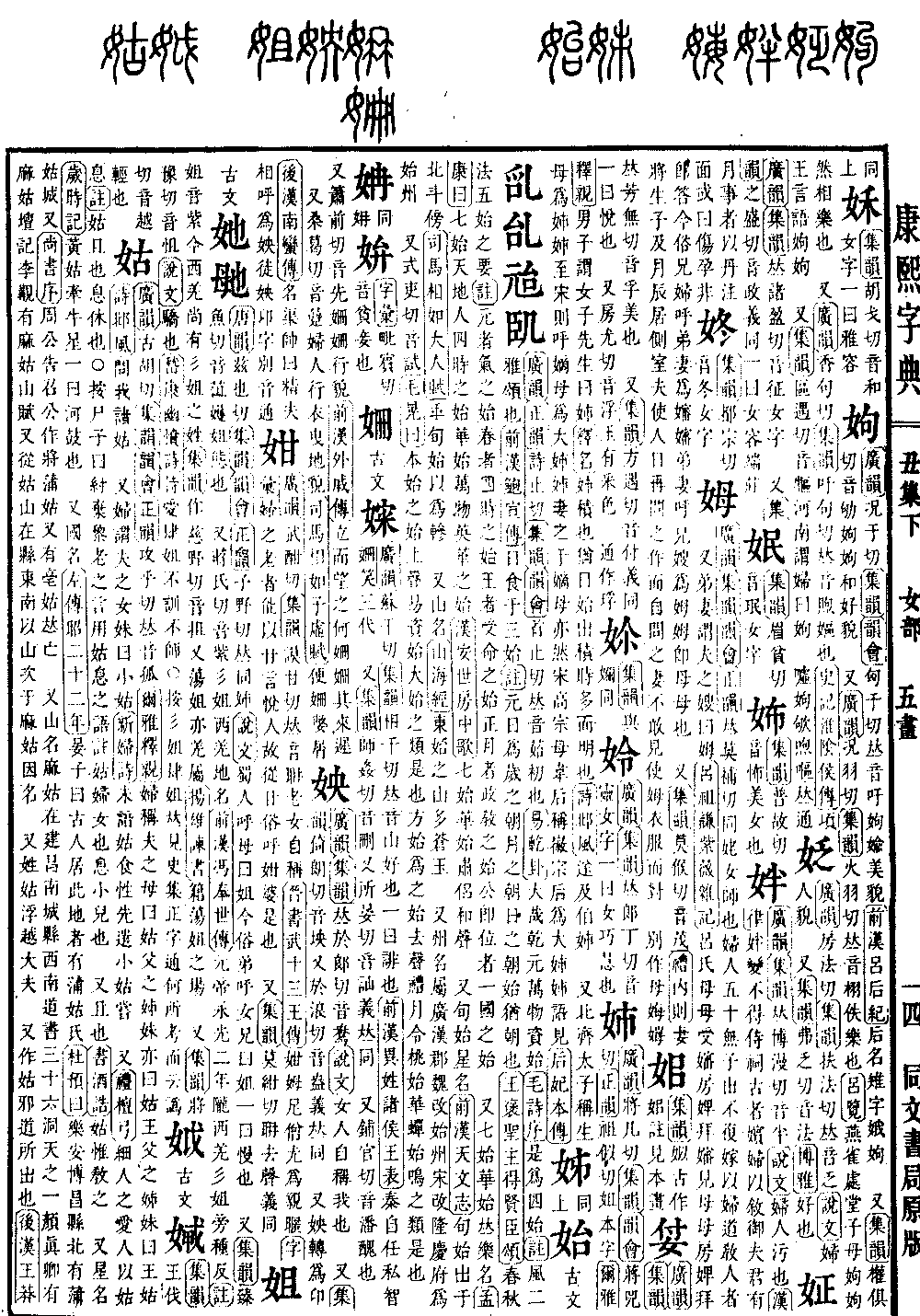
Chou Collection, Lower Volume
Radical: Woman (nǚ)
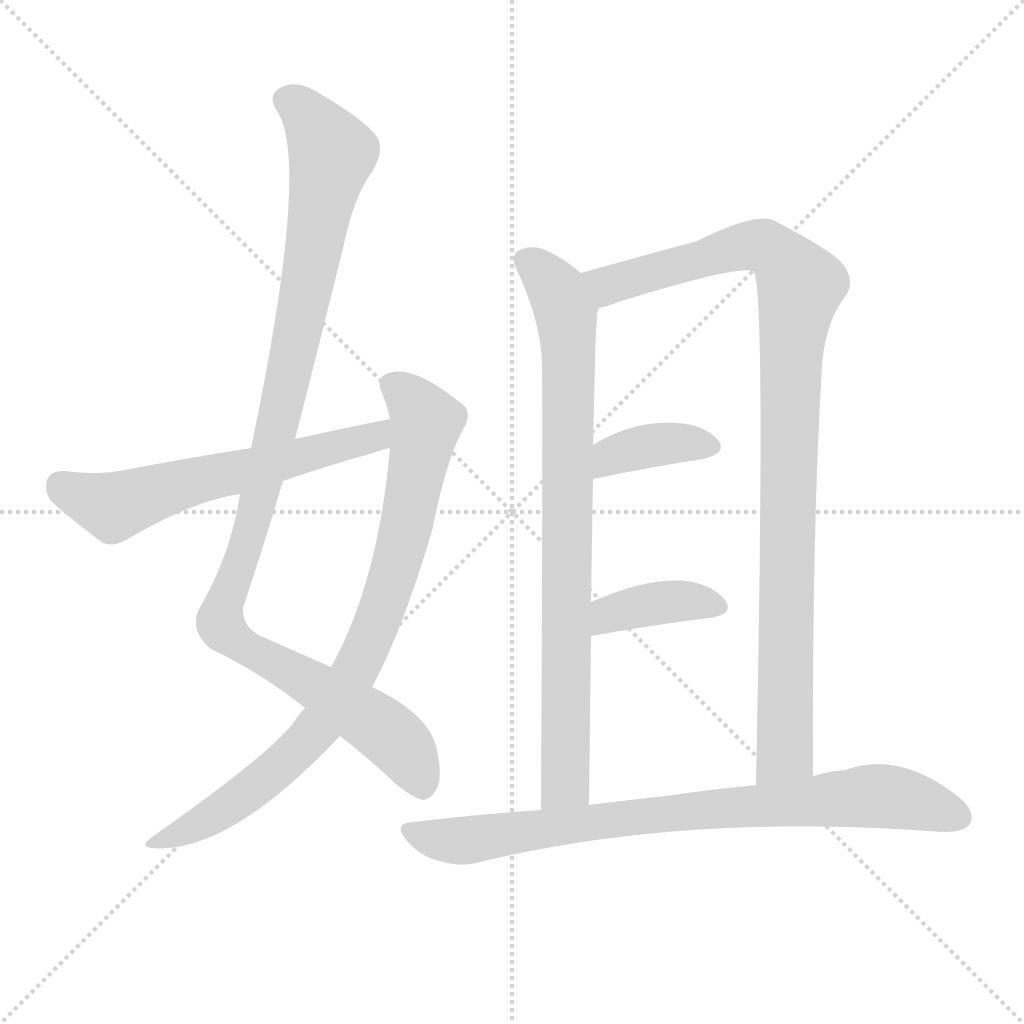
姐
Kangxi stroke count: 8
Page 258, Entry 27
Ancient form is written as she or jie.
Pronounced zi.
Pronounced zi.
Identical to the form for elder sister.
Shuowen Jiezi (Shuowen) states: In the region of Shu, people use this word to address a mother. In current custom, a younger brother addresses an elder sister as this word. One source suggests the term carries a nuance of disrespect.
Pronounced zu.
Wan jie, referring to the appearance or posture of a person.
Pronounced zi.
San Jie, a place name in the Western Qiang territory.
Book of Han (Qian Hanshu), Biography of Feng Fengshi: In the second year of the Yongguang era of Emperor Yuan, the San Jie of the Western Qiang in Longxi, a collateral branch of the tribe, rebelled.
Annotation: Pronounced zi. In current times, there remains a surname San Jie among the Western Qiang.
Pronounced ju.
Tang Jie, also a branch of the Qiang people.
Yang Xiong, Petition Against the Book: Relying on the fields of the Tang Jie.
Pronounced ju.
Shuowen Jiezi (Shuowen) states: The meaning is arrogance.
Xi Kang, Poem on Secluded Resentment: Relying on affection to indulge in arrogance, without instruction or mentorship.
Note: San Jie and Si Jie appear in historical texts and literary collections. The Zhengzitong lexicographical work does not provide the basis for its research when claiming these terms are incorrect.