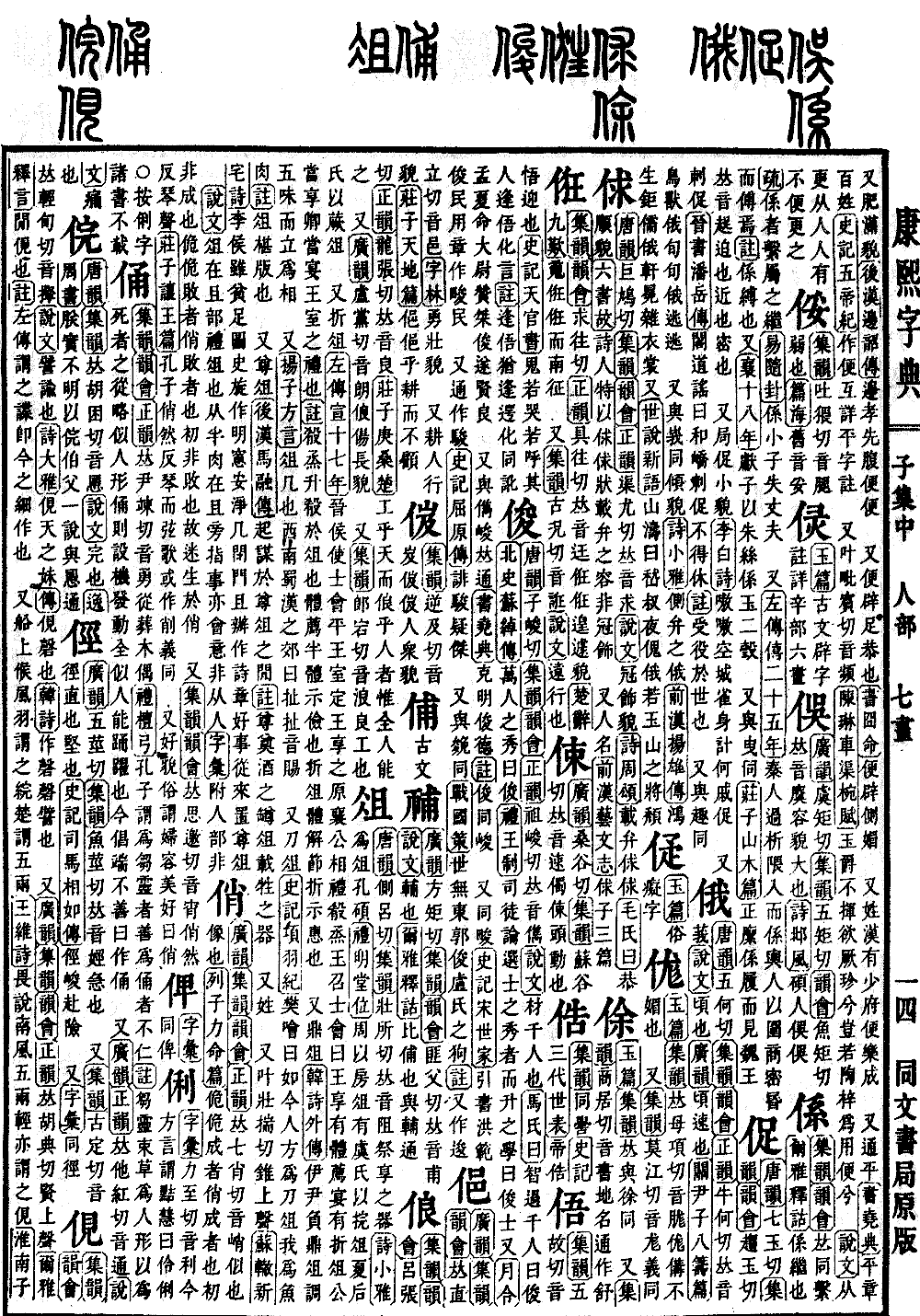
Zi Collection, Middle Volume. Radical: Person (rén). Kangxi stroke count: 9. Page 104, entry 21.
Pronounced zǔ. According to the Tang Rhyme (Tangyun) and Collection Rhymes (Jiyun), the pronunciation is the same as zǔ. It refers to a vessel used to hold sacrificial offerings during rites and feasts. Book of Odes (Shijing), Lesser Odes (Xiaoya) states: The vessels used for the offerings were extremely large. Book of Rites (Liji), Hall of Distinction (Mingtangwei) records: The Zhou dynasty used the fang-zu vessel; the Yu clan used the wan-zu vessel; the Xia dynasty used the jue-zu vessel. There is also the term zhe-zu. Zuo Commentary (Zuozhuan), Year 16 of Duke Xuan: The Marquis of Jin sent Shi Hui to mediate a dispute in the royal court of Zhou. King Ding of Zhou hosted him at a banquet in the city of Yuan. Duke Xiang presided over the rituals and presented meat with bones. King Ding of Zhou summoned Shi Hui and said: The Son of Heaven uses the ti-jian (presentation of half a carcass) for formal banquets and the zhe-zu (dismembered offering) for informal banquets. Entertaining feudal lords uses the xiang-li (offering ritual), while entertaining ministers uses the yan-li (banquet ritual); these are the standards of the royal house. Annotation: Xiao-zheng refers to placing meat with bones onto the sacrificial vessel. Ti-jian refers to offering half a carcass to signify frugality. Zhe-zu refers to dismantling the carcass and breaking the bones, signifying benevolence. There is also the term ding-zu (tripod and sacrificial vessel). Han Poetry Outer Commentary (Hanshi Waizhuan) records that Yi Yin carried a tripod and a sacrificial vessel—cooking utensils—to balance the five flavors, and was later appointed as prime minister. Furthermore, Yangzi’s Regional Dialects (Fangyan) states: A zu is a small table or stand. In the southwest regions of Shu and Han, it is called a si, pronounced the same as cì. There is also the term dao-zu (knife and chopping board). Records of the Grand Historian (Shiji), Annals of Xiang Yu: Fan Kuai said: Right now, others are the knife and the chopping board, and we are the fish and the meat. Annotation: Zu refers to a chopping board. There is also the term zun-zu. Book of the Later Han (Hou Hanshu), Biography of Ma Rong mentions devising strategies while amidst wine vessels and sacrificial vessels. Annotation: Zun is a vessel for holding wine; zu is a vessel for holding sacrificial meat. It is also used as a surname. It also rhymes with zhuài, pronounced with a rising tone like zhuī. Su Zhe’s Poem on the New Residence: Though Li is poor, he has plenty of maps and records; he soon builds a bright window and sets out a clean table. Closing the door, he prepares to write verses; for those who love good things always set out the wine and meat vessels.
Explanation of Graphs and Analysis of Characters (Shuowen Jiezi): The character belongs to the Radical: Qie (qiě) and is a sacrificial vessel. The character shape consists of half a piece of meat beside the qie element. It is an indicative character, and also a phono-semantic character. It does not belong to the Radical: Person (rén). The Dictionary of Characters (Zihui) incorrectly attaches it to the Radical: Person (rén).
Critical Research: Book of Rites (Liji), Hall of Distinction (Mingtangwei): "Zhou used the fang-zu, Yu clan used the wan-zu, Xia dynasty used the jue-zu." Note: The original text wan and jue have been corrected to their proper forms. Zuo Commentary (Zuozhuan), Year 17 of Duke Xuan: "The Marquis of Jin sent Shi Hui to mediate the royal house of Zhou." Note: The original text Year 17 has been corrected to Year 16. Yangzi’s Regional Dialects (Fangyan): "Zu is a small table. In the regions of Shu and Han, it is called a si, pronounced cì." Note: The original text instances of the character have been corrected to si.