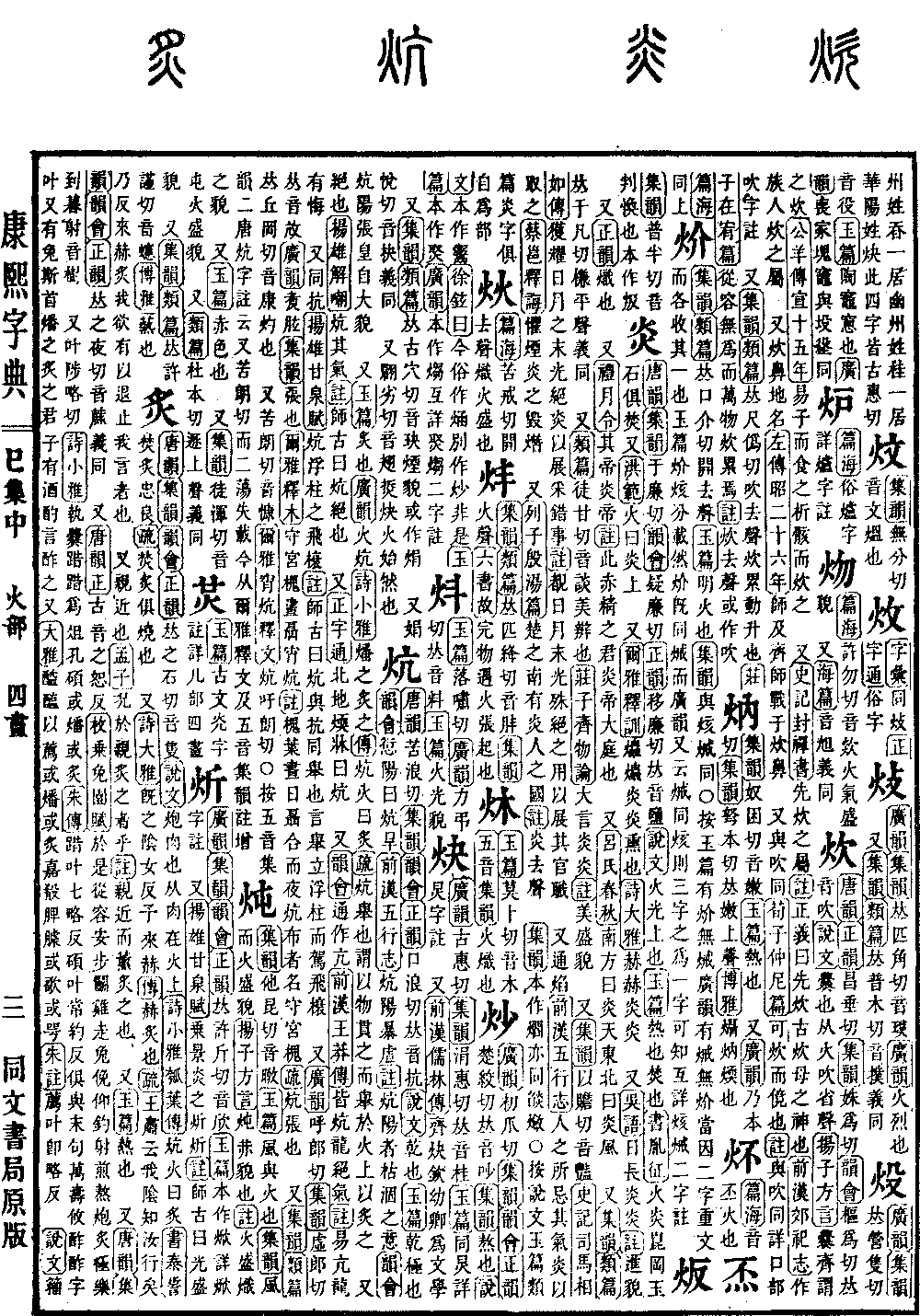
Si Collection, Middle Volume
Radical: Fire (huǒ)
炙
Kangxi Strokes: 8
Page 667, Entry 24
Pronounced zhǐ.
Shuowen Jiezi (Shuowen) states: To roast meat. Composed of meat placed over fire.
Book of Odes (Shijing), Xiaoya, Huye commentary states: To roast over a fire is called zhi.
Book of Documents (Shangshu), Taishi states: To burn and roast the loyal and virtuous. The commentary explains: Fen and zhi both refer to burning.
Also in Book of Odes (Shijing), Daya: Having gone to the secluded lady, she instead comes to scorch me. The commentary states: He, meaning to scorch or roast. The sub-commentary states: Wang Su says, I have secretly known your behavior. You have instead come to scorch me, wishing to retreat and halt my words.
Also means to draw near or become intimate.
Mencius states: How much more so for those who approach and are influenced by him? The commentary notes: To approach and be influenced by his warmth as if by roasting.
Also, Yupian states: To heat.
Pronounced zhè. Meaning the same.
Tang Yun Zheng states: Ancient pronunciation resembles zhu.
Mei Cheng, Tu Yuan Fu: Thus leisurely walking, fighting cocks and running hares, bending and bowing, fishing and shooting, pan-frying and roasting, experiencing supreme joy until dusk. The pronunciation of the word for shoot is shu.
Also rhymes with zhi lue.
Book of Odes (Shijing), Xiaoya: Managing the cooking fire with rapid steps, the meat offerings are very large, some roasted and some grilled. Zhu's commentary states: Ji rhymes with qi lue, shuo rhymes with chang yue; both rhyme with the final word cu in the poem Wan Shou You Cu. Also, there is the head of a hare, roast it and grill it; the gentleman has wine, pour it and offer it.
Also, in Daya: Meat sauce with minced meat is presented, some roasted and some grilled. Excellent delicacies are served, some sung and some chanted. Zhu's commentary states: Jian rhymes with ji lue.
Shuowen Jiezi (Shuowen): The seal script form is written as shown in Mei Cheng's Tu Yuan Fu.