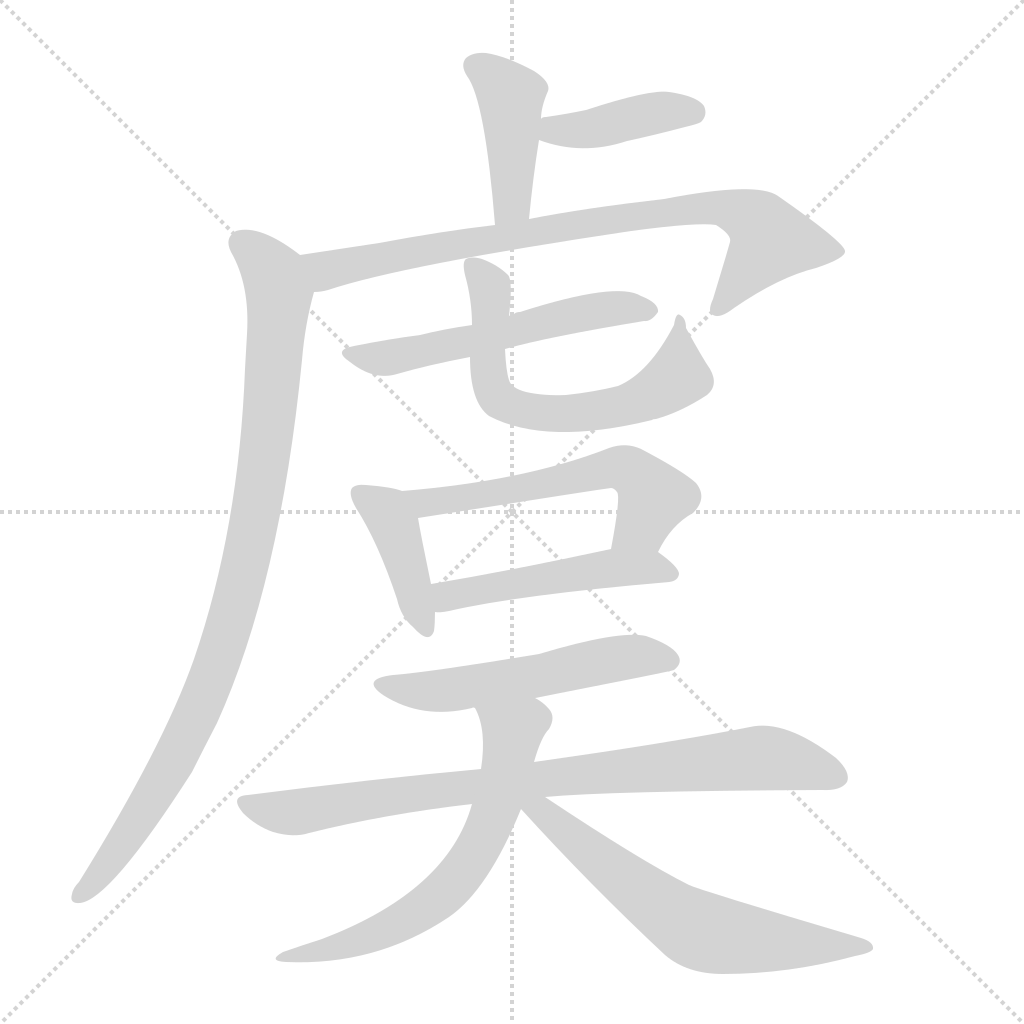
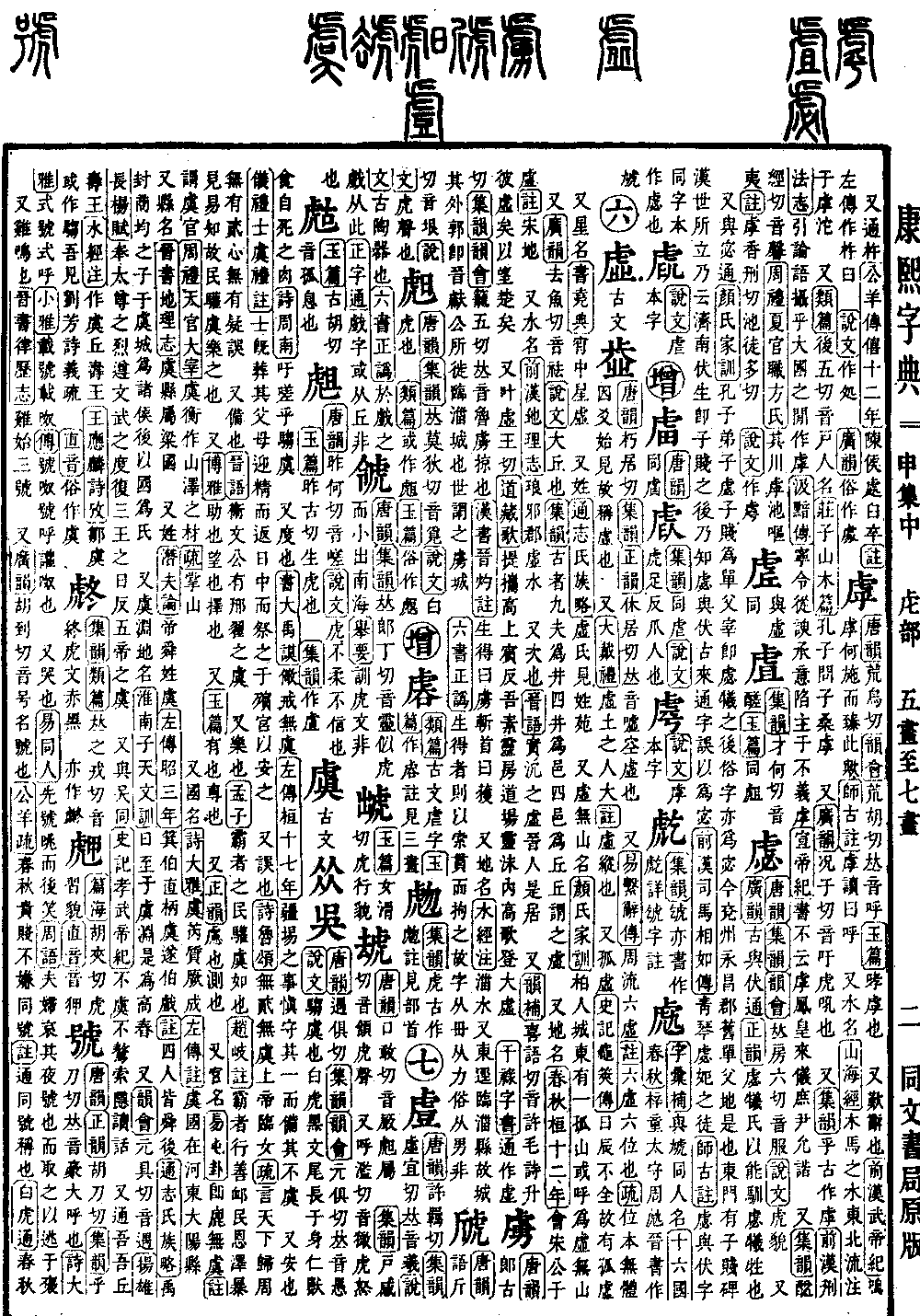
Shen Collection, Middle Volume
Radical: Tiger (hǔ)
Page 1074, Entry 24
Ancient form written as Wu.
Pronounced yu (level tone).
Pronounced yu (level tone).
Defined in Explaining Graphs and Analyzing Characters (Shuowen Jiezi) as a Zouyu. This is a white tiger with black markings, a tail longer than its body, and a benevolent nature, consuming only the meat of animals that have died naturally.
Book of Odes (Shijing), Zhou South (Zhounan) section: Alas for the Zouyu.
Also means to speculate or anticipate.
Book of Documents (Shangshu), Counsels of Great Yu (Dayu Mo): Be vigilant and prepared, do not be caught off guard.
Zuo Commentary (Zuozhuan), Seventeenth Year of Duke Huan: In the affairs of the frontiers, one must cautiously guard one's own territory while preparing for the unexpected.
Also means peace or stability.
Commentary to the Ceremonial Rites (Yili), Master's Yu Rites (Shi Yu Li) states: After burying their parents, men bring back the spirit and perform a sacrifice at home at noon to bring it peace.
Also means error or fault.
Book of Odes (Shijing), Eulogies of Lu (Lusong): Without distraction, without fault, the Almighty God looks down upon you. The commentary states this means the world submits to the Zhou dynasty without distraction or uncertainty.
Also means preparation or defense.
Discourses of the States (Guoyu), Discourses of Jin (Jinyu): Duke Wen of Wei had defenses against attacks from the Xing and Di states.
Also means happiness or joy.
Mencius: The people of a hegemon are joyful and happy. Zhao Qi’s commentary states that a ruler who implements hegemonic rule practices good governance, and since his favors to the people are clear and easily perceived, the people are joyful.
Broadly Elegant (Boya) defines it as to assist, to expect, or to choose.
Jade Chapters (Yupian) defines it as to possess or to be single-minded.
Correct Rhymes (Zhengyun) defines it as to think or to guess.
Also the name of an official post.
Classic of Changes (Yijing), Difficulty at the Beginning (Tun Gua): Chasing the deer without a Yu (an official). The commentary identifies this as the Yu official.
Rites of Zhou (Zhouli), Offices of Heaven (Tianguan), Great Minister (Da Zai) mentions the Yu and Heng, officials in charge of developing mountain and marsh resources. The commentary states that officials in charge of mountains and marshes are called Yu.
Also the name of a vassal state.
Book of Odes (Shijing), Greater Odes (Daya): The states of Yu and Rui achieved their settlement.
Zuo Commentary (Zuozhuan) states: The state of Yu was located in Dayang County, east of the Yellow River.
Also the name of a county.
History of Jin (Jinshu), Treatise on Geography: Yu County belonged to the Liang Kingdom.
Also a surname.
Discourses of the Hidden Man (Qianfulun) states: Emperor Shun’s surname was Yu.
Zuo Commentary (Zuozhuan), Third Year of Duke Zhao mentions: Ji Bo, Zhi Bing, Yu Sui, and Bo Xi. The commentary states these four were descendants of Shun.
Comprehensive Treatise (Tongzhi), Treatise on Clans (Shizulue) records: Yu enfeoffed the son of Shang Jun at Yu City as a vassal, and his descendants later adopted the state name Yu as their surname.
Also Yu Abyss, a place name.
Huainan Masters (Huainanzi), Treatise on Astronomy (Tianwen Xun): When the sun reaches the Yu Abyss, it is the time of dusk.
Pronounced yu (departing tone).
Yang Xiong, Rhapsody on Longyang (Changyang Fu): Respecting the legacy of the high ancestors, following the laws of the Wen and Wu emperors, restoring the hunting field systems of the Three Kings, and returning to the peace of the Five Emperors.
Also interchangeable with the character for amusement (yu).
Records of the Grand Historian (Shiji), Annals of Emperor Wu: Neither amusing oneself nor galloping. The Suoyin commentary notes the pronunciation as hua.
Also interchangeable with the character for I (wu).
Example: Wuqiu Shouwang; in the Commentary on the Classic of Waterways (Shuijing Zhu), it is written as Yuqiu Shouwang.
Wang Yinglin, Exegesis of the Odes (Shikao) mentions Zouyu, sometimes written as Zouwu in some versions. Found in Liu Fang’s Exegesis of the Meanings of the Odes (Shiyi Shu).
Direct Pronunciation (Zhiyin) states: In common usage, it is written as Yu.
Correction: In the line from Yang Xiong’s Rhapsody on Longyang (Changyang Fu), the character for day has been changed to the character for field based on the original text.