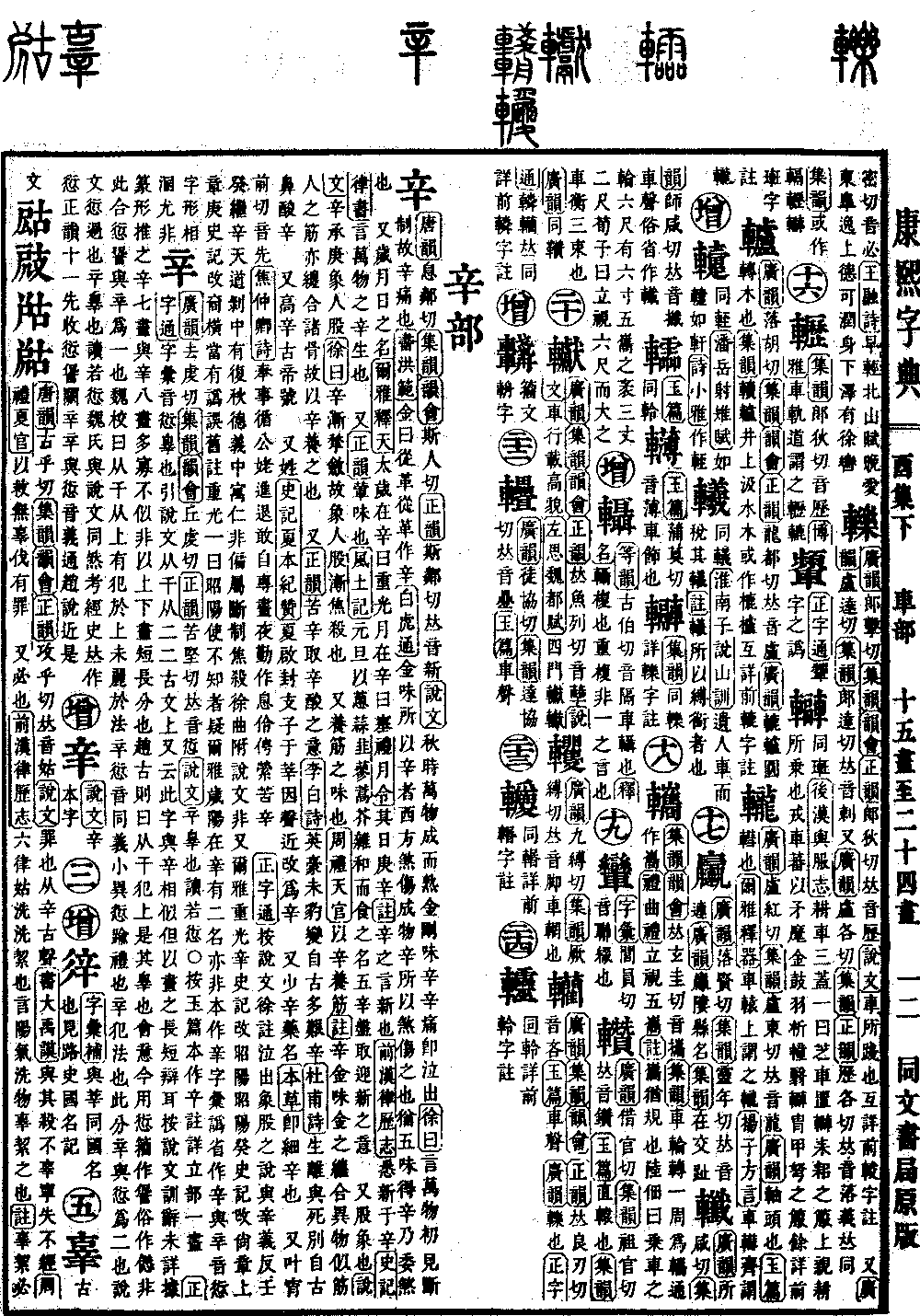
You Collection, Lower Volume
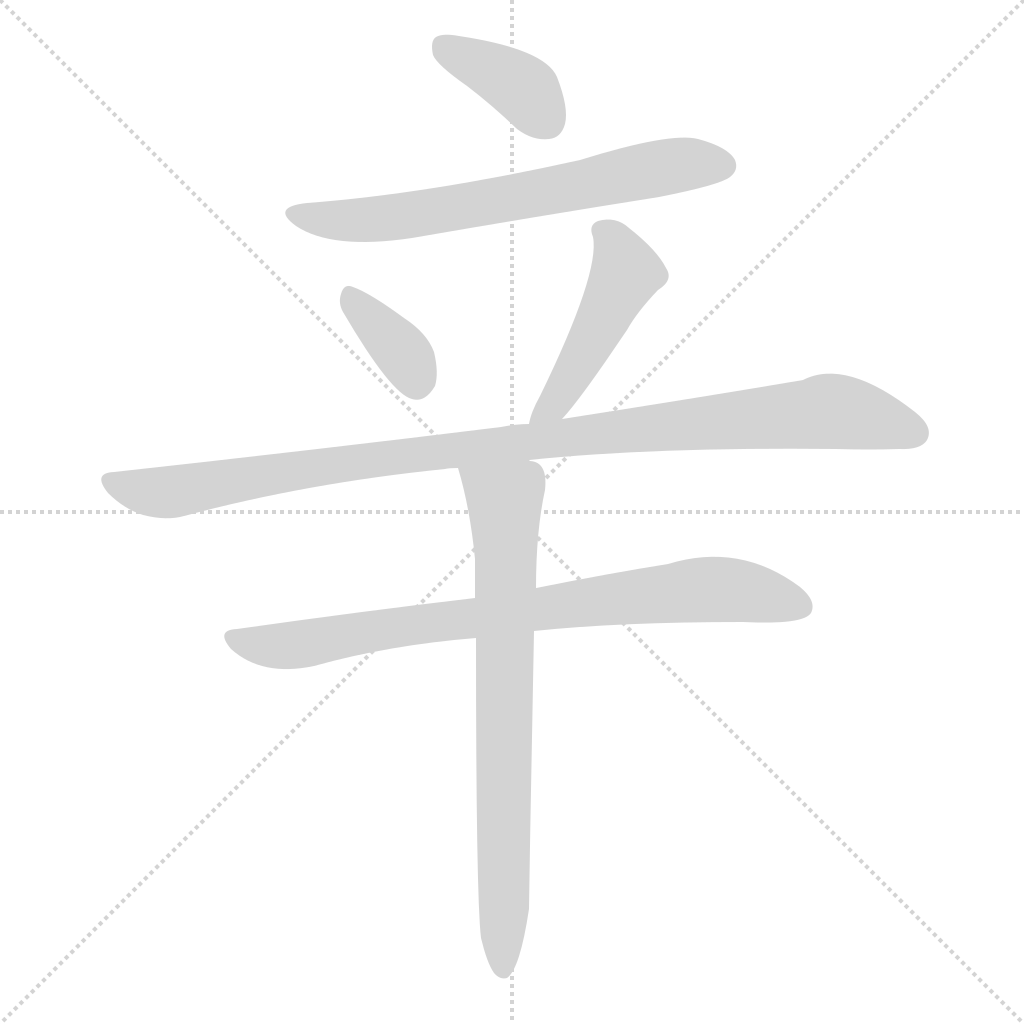
Radical: Bitter (xīn)
Page 1250, Entry 25
Pronounced xīn. According to the Explaining Graphs and Analyzing Characters (Shuowen), in autumn all things reach maturity; metal is hard and its taste is pungent; pungent and painful sensations cause one to shed tears. Master Xu says: This refers to things first experiencing the restraint of the season, hence they feel pungent and painful. Book of Documents (Shangshu), Great Plan (Hongfan): The nature of metal is to follow change; following change produces pungency. White Tiger Hall (Baihutong): The reason the taste of metal is pungent is because the west governs slaughter and damage, causing all things to mature; pungency is used to kill and harm, just as various flavors wither and are overcome when they encounter something pungent.
Also refers to the names of years, months, and days. Literary Expositor (Erya), Explaining Heaven: When the Grand Year (Taisui) is in the xīn year, it is called chongguang; when the month is in the xīn day, it is called sè. Book of Rites (Liji), Monthly Ordinances (Yueling): Those days are gēng and xīn. Commentary: The meaning of xīn is new. Former Han History (Qianhan Shu), Treatise on Harmonics and Calendars: All things are renewed on the xīn day. Records of the Grand Historian (Shiji), Treatise on Harmonics: This states that all things are born anew on the xīn day.
Also refers to pungent or meaty odors. Customs Records (Fengtu Ji): On New Year's Day, one mixes scallions, garlic, chives, smartweed, mugwort, and mustard greens to eat, calling it the five-pungent plate, signifying the welcoming of the new year.
Also refers to the shape of the thigh. Explaining Graphs and Analyzing Characters (Shuowen): The character xīn follows gēng, resembling a human thigh. Master Xu says: Xīn signifies gradual contraction, hence it resembles a human thigh, becoming withered and austere.
Also refers to the taste that nourishes the sinews. Rites of Zhou (Zhouli), Officers of Heaven: Use pungent flavors to nourish the sinews. Commentary: Xīn is the taste of metal; metal can wind around and combine different things like sinews, and human sinews also wind around and combine with the various bones, so one uses pungent flavors to nourish them.
Also refers to hardship, taking the meaning of bitter and sour. Li Bai poetry: Heroes and men of great talent who have not yet achieved their ambitions have long suffered hardship since ancient times. Du Fu poetry: Living separation and parting by death have long caused the nose to turn sour and the heart to turn bitter.
Also refers to Gaoxin, a title of an ancient emperor. Also refers to a surname. Records of the Grand Historian (Shiji), Praise of the Xia Annals: Xia Qi enfeoffed his concubines' children in the Shen territory, and because the pronunciation was similar, it was changed to Xīn. Also refers to Shaoxin, a medicinal name. Materia Medica (Bencao): This is the wild ginger (xìxīn).
Also pronounced xiān. Jiao Zhongqing poetry: In all matters, I obey the wishes of my parents-in-law, and in advancing or retreating, how would I dare to act on my own? Day and night I work hard and labor, surrounded by loneliness and bitterness.
The Correct Character Guide (Zhengzitong) notes: According to the commentary by Master Xu on the Explaining Graphs and Analyzing Characters, the explanation regarding shedding tears and resembling a thigh is contrary to the meaning of the character. Rén and guǐ follow after xīn; the way of heaven includes recovery within destruction, and the virtue of autumn contains benevolence within righteousness, not merely belonging to restraint, withering, and slaughter. Master Xu's interpretation is forced and flawed, and is incorrect. Also, the chongguang mentioned in the Literary Expositor (Erya) is changed to zhaoyang in the Records of the Grand Historian (Shiji). Zhaoyang corresponds to guǐ, yet the Records of the Grand Historian (Shiji) changes it to shangzhang. Shangzhang corresponds to gēng, yet it is changed to shangheng. There must be errors. Old commentaries state that chongguang is also called zhaoyang, which confuses those who do not know better. The fact that the Literary Expositor (Erya) lists duplicate names for the solar year is also incorrect. The original character is written with a simplified form in the Collection of Characters (Zihui), which confuses it with the character pronounced qiān, which is especially wrong.