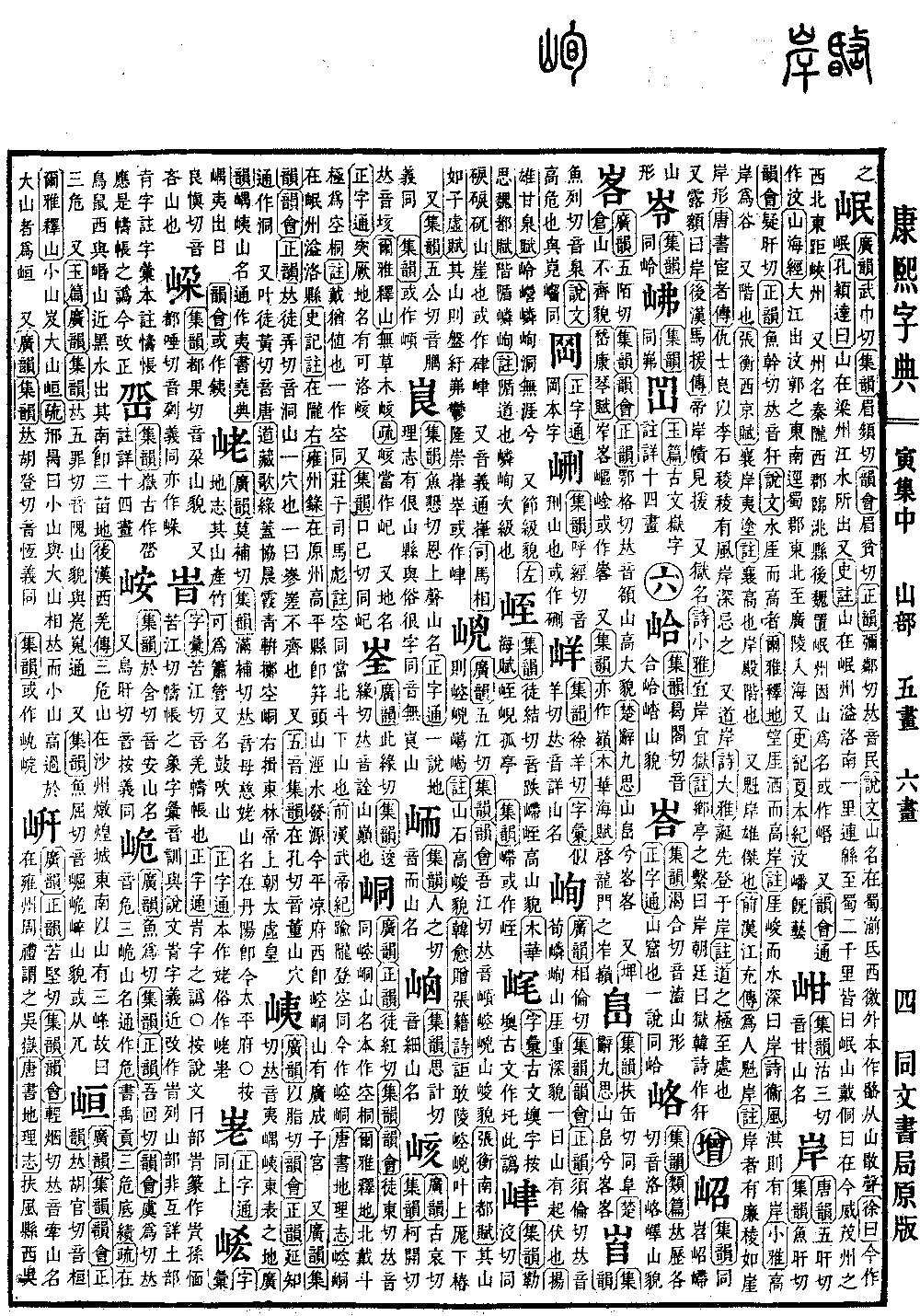
Yin Collection, Middle Volume. Radical: Mountain (shān). Kangxi stroke count: 8. Page 310, Entry 03.
Pronounced an (falling tone).
Shuowen Jiezi (Shuowen): Elevated ground at the water's edge.
Erya (Erya): A steep, towering bank by the water as seen from a distance. Commentary: A steep bank where the water is deep is called an.
Book of Odes (Shijing), Weifeng: The Qi River also has banks.
Book of Odes (Shijing), Xiaoya: High banks become deep valleys.
Also refers to stairs or steps. Zhang Heng, Western Capital Rhapsody (Xijing Fu): Towering steps and level paths. Commentary: Xiang means high. An refers to the steps of a palace.
Also refers to kuian, meaning majestic or outstanding. History of the Former Han (Qian Hanshu), Biography of Jiang Chong: A person who is majestic and imposing. Commentary: An refers to a shape with sharp angles like a cliff.
Old Book of Tang (Tangshu), Biography of Eunuchs: Qiu Shiliang deeply feared Li Shi because of his majestic, upright, and principled demeanor.
Also refers to daoan. Book of Odes (Shijing), Daya: Leading the way to the highest realm. Commentary: Refers to the highest and deepest level of the Way (dao).
Also, to expose the forehead is called an. Book of the Later Han (Hou Hanshu), Biography of Ma Yuan: The Emperor lifted his head covering to show his forehead while receiving Ma Yuan.
Also refers to a type of prison. Book of Odes (Shijing), Xiaoya: Should be detained in a local or imperial prison. Commentary: Local detention facilities are called an, while imperial ones are called yu. The Han version of the Odes writes this as an (àn).