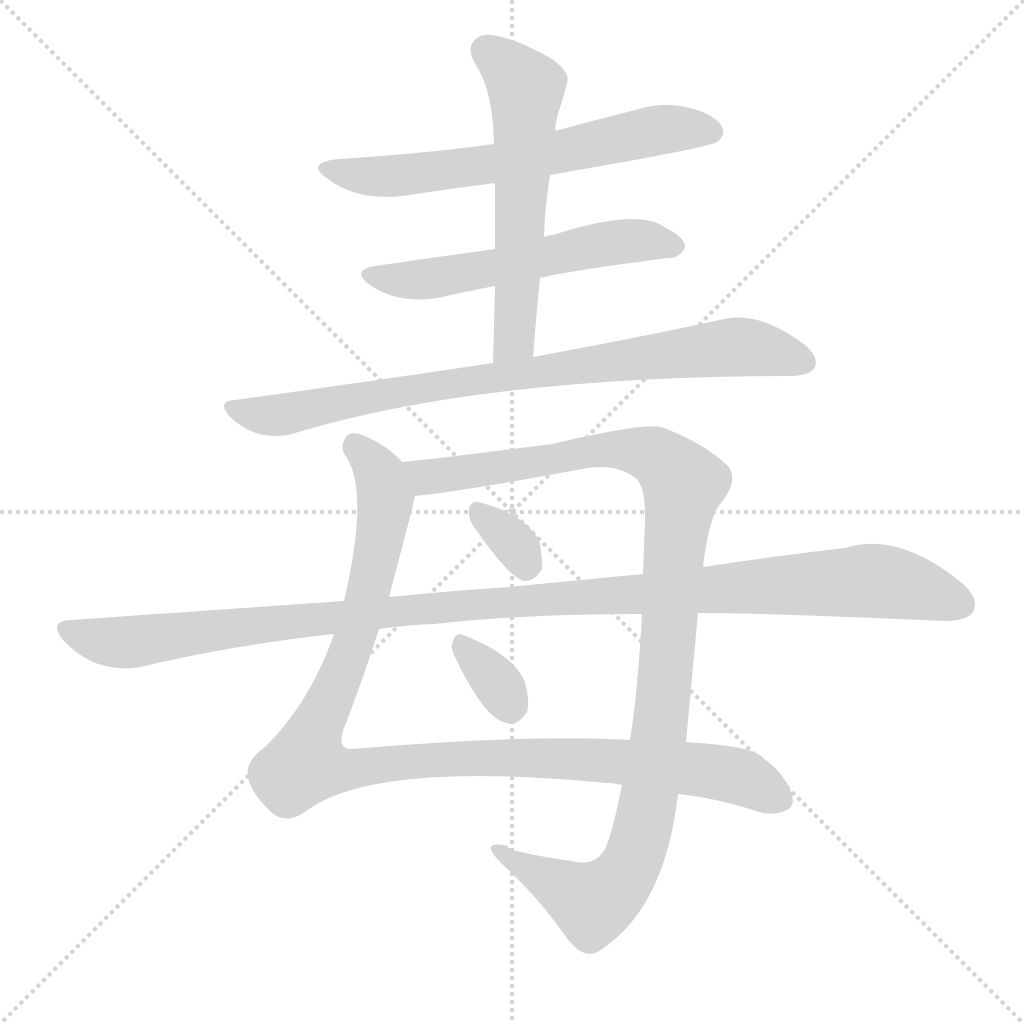
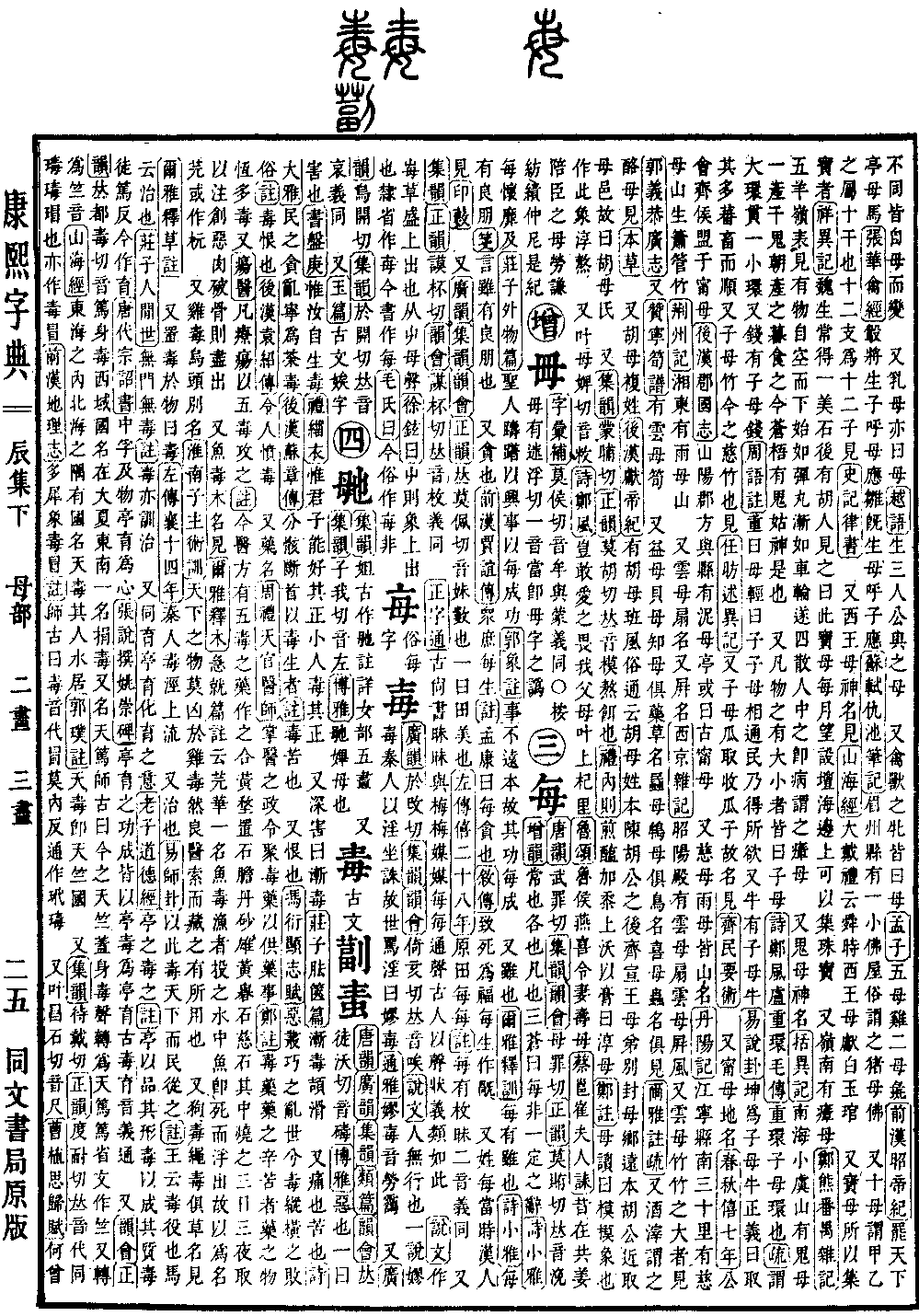
Chen Collection, Lower Volume, Radical: Poison (dú); Kangxi stroke count: 8; Page 589, Entry 06.
Ancient phonetic records in Tangyun, Guangyun, Jiyun, Leipian, and Yunhui state it is pronounced tu (rising tone), with the same reading as the character zhuo. Boya defines it as evil. Another view defines it as harm. Book of Documents (Shangshu), Pan Geng section: Only you yourselves invite disaster. Book of Rites (Liji), Ti Yi section: Only the gentleman can love what is upright, while the petty man hates what is upright.
It also refers to severe harm, known as jandu. Zhuangzi, Opening Trunks chapter: Severe harm and cunning deceit.
It also refers to pain or suffering. Book of Odes (Shijing), Greater Odes: The common people covet turmoil, preferring to suffer calamity. History of the Later Han (Hou Hanshu), Biography of Su Zhang: Dismembering corpses and beheading heads to cause suffering to the living. Note: Du means bitter.
It also refers to resentment. Feng Yan, Xian Zhi Fu: Hating tricks that disturb the world, loathing the unrestrained who corrupt customs. Note: Du means hatred. History of the Later Han (Hou Hanshu), Biography of Yuan Shao: Causing people to feel resentment.
It also refers to the names of drugs. Rites of Zhou (Zhouli), Heaven's Officials, Physician: Overseeing the orders of medicine, collecting poisonous drugs to provide for medical use. Zheng's note: Poisonous drugs refers to herbs with bitter and pungent properties. Most drugs possess toxic qualities.
Also, in the section on ulcer physicians: For the treatment of ulcers, use the five poisons to attack and cure them. Note: In current medical prescriptions, there are five poisonous herbs. When preparing them, mix with yellow clay, place realgar, cinnabar, orpiment, arsenolite, and magnetite among them, burn for three days and nights, and apply to the wound; the necrotic tissue and decayed bone will all be discharged.
There is also fish poison, a name for a tree. Seen in Erya, Interpretation of Trees. The commentary on the Jijiupian says: Yuanhua is also known as fish poison. Fishermen throw it into the water, and the fish die and float to the surface, hence the name. Yuan is sometimes written as yuan.
There is also chicken poison, which is an alias for aconite. Huainanzi, Principles of the Sovereign: Among all things in the world, none is more dangerous than chicken poison, yet skilled physicians seek and store it because it has its uses.
There are also dog poison and rope poison; both are names of herbs, as seen in the sub-commentary to Erya, Interpretation of Herbs.
Putting poison into items is called du. Zuo Tradition (Zuozhuan), Year 14 of Duke Xiang: The Qin people put poison in the upper reaches of the Jing River.
It also means to govern. Classic of Changes (Yijing), Shi hexagram: By this, govern the world, and the people will submit. Note: Wang Bi says: Du means to employ. Ma Rong says: To govern. Zhuangzi, In the World of Men: Without an entrance and without governance. Note: Du is also interpreted as governance.
It is also synonymous with yu, meaning to nurture or raise. Laozi, Dao De Jing: To settle it, to nurture it. Note: Ting (to settle) settles its form, du (to nurture) completes its substance. Du is pronounced tu (rising tone) reversed. It is now written as yu. Edict of Emperor Daizong of Tang: Sincerity extends to all things, taking nurture as the heart. Zhang Shuo, Inscription for Yao Chong: The achievements of nurturing are completed. Both treat tingdu as tingyu. In ancient times, du and yu were synonymous in meaning.
Also, Yunhui and Zhengyun read it as du (falling tone), sounding like du. Shendu is the name of a country in the Western Regions, located southeast of Daxia. Also called Juandu, and also named Tiandu. Shigao says: It is today's Tianzhu (India). Probably Shendu shifted in sound to Tiandu; du was abbreviated to zhu, and the sound further shifted to zhu. Classic of Mountains and Seas (Shanhaijing): Within the Eastern Sea, at the corner of the Northern Sea, there is a country named Tiandu, where the people live in the water. Guo Pu's note: Tiandu is the country of Tianzhu.
Also, Jiyun reads it as dai (falling tone) and Zhengyun reads it as du (falling tone) and nai (falling tone), sounding like dai. It is the same as the character dai. It refers to tortoiseshell. Also written as dumao. History of the Former Han (Hanshu), Geography Treatise: Abundant in rhinoceroses, elephants, and tortoiseshell. Note: Shigao says: Du is pronounced dai. Mao is pronounced mo (falling tone). Commonly used as daimao.
Also rhymes with chang and shi, sounding like chi. Cao Zhi, Si Gui Fu: Why do the layered clouds congregate so, mourning the sun as it hides from view? The rain pours down incessantly, my heart is filled with resentment, sorrow, and bitterness.
Shuowen Jiezi: Means thickness. Poisonous herbs that grow everywhere. The character is composed of the radical for sprout and the character du. Guangyun: Originally written as the variant character. Current classical texts omit the sprout radical and write it as du.
Critical revision: Rites of Zhou (Zhouli), Heaven's Officials, Physician: Overseeing the orders of medicine, collecting poisonous drugs to provide for medical affairs. Note: Regarding the original text, changed medical affairs. Dog poison and rope poison are both herb names. Seen in the sub-commentary to Erya, Interpretation of Herbs. Note: Regarding the original book, changed note to sub-commentary.