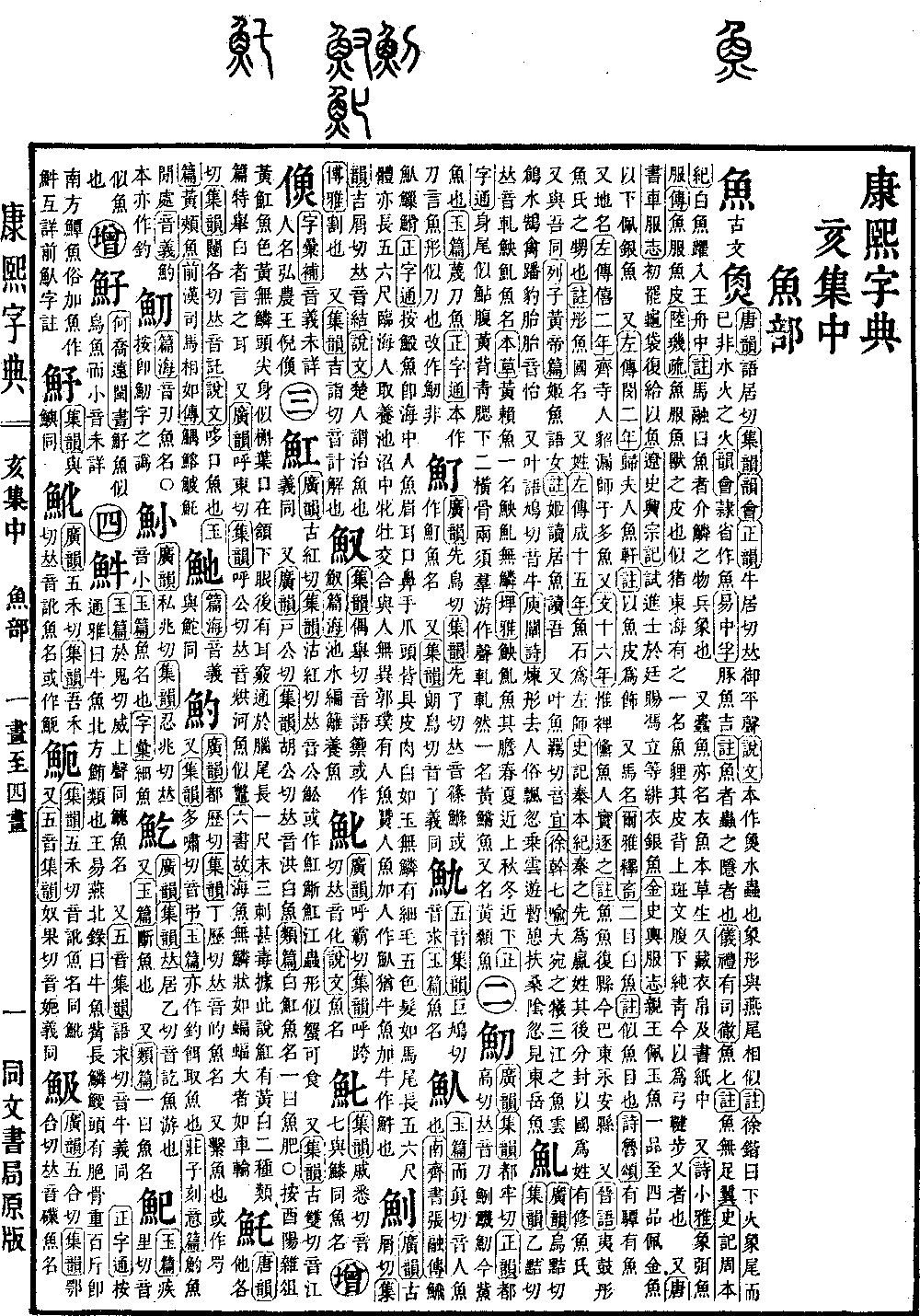
Hai Collection, Middle Volume. Radical: Fish (yú). Kangxi brush strokes: 11. Page 1465, Entry 01.
Ancient form. Pronounced yú (falling tone). According to the Shuowen Jiezi (Shuowen), originally written as the character for water creatures. It is a pictograph, similar to the shape of a swallow's tail. Xu Kai notes that the lower part resembles fire, but it does not represent water or fire. The Yunhui states the current form is the simplified clerical script. In the Book of Changes (Yijing), section on Inward Sincerity (Zhongfu), it says: "Pigs and fish are auspicious." The commentary notes: "Fish are creatures that hide." In the Book of Etiquette and Ceremonial (Yili), section on the Duties of Officials (Yousi Che), it mentions fish. The commentary notes: "Fish have no feet or wings." In the Records of the Grand Historian (Shiji), Annals of Zhou, it says: "A white fish leaped into the King's boat." Ma Rong notes: "Fish are creatures with scales, representing military force."
Also refers to the silverfish, also known as the clothes moth; the Ben Cao (Compendium of Materia Medica) states they grow in paper and silk stored for a long time. In the Book of Odes (Shijing), Lesser Odes of the Kingdom, it mentions ivory-tipped bows and fish-skin quivers. The commentary explains that fish-skin quivers are made of fish hide. Lu Ji's commentary states: "Fish-skin quivers are made from the hide of fish-like beasts, which resemble pigs and are found in the East Sea. They are also called fish-tan; the patterns on the back of the hide are variegated, while the abdomen is solid blue. These are used to make bows and weapon cases."
According to the History of the Tang Dynasty (Tangshu), Treatise on Carriages and Clothing, officials initially stopped wearing tortoise-shaped pouches and were issued fish-shaped ones. The History of the Liao Dynasty (Liaoshi) mentions that during an imperial examination, the emperor bestowed crimson robes and silver fish ornaments upon Feng Li and others. The History of the Jin Dynasty (Jinshi), Treatise on Carriages and Clothing, states that imperial princes wore jade fish, while officials from the first to fourth rank wore gold fish, and those below wore silver fish.
In the Zuo Tradition (Zuo Zhuan), second year of Duke Min, it mentions presenting the wife with a fish-ornamented carriage, decorated with fish skin. Also a name for a type of horse. According to the Erya, a dictionary on animals, a horse with two white eyes is called a fish. The Book of Odes, Eulogies of Lu, mentions these horses. Also a place name. In the Zuo Tradition, second year of Duke Xi, it mentions Qi official Diao leaking information at Duoyu. In the sixteenth year of Duke Wen, it mentions the territory of Yufu, now Yong'an County in Badong.
In the Discourses of the States (Jin Yu), it mentions that Yigu was the nephew of the Tongyu clan, named after the Tongyu state. Also a surname. In the Zuo Tradition, fifteenth year of Duke Cheng, Yushi was a commander. In the Records of the Grand Historian, Annals of Qin, it states the ancestors of Qin were of the Ying surname, and later branches took their state names as surnames, such as the Xiuyu clan.
Also synonymous with the word for I/my. In the Liezi, Huangdi chapter, it says: "Ji, fish (I) speak to you." The commentary notes that the character Ji is read as the word for dwelling, and fish is read as the word for I. Also rhymes with yí. In Xu Gan's Seven Persuasions (Qi Yu), it mentions the steeds of Dayuan and the fish of the three rivers. Also rhymes with niú. In Yu Chan's poetry, it mentions departing from the mundane world and seeing the fish of the Eastern Peak.