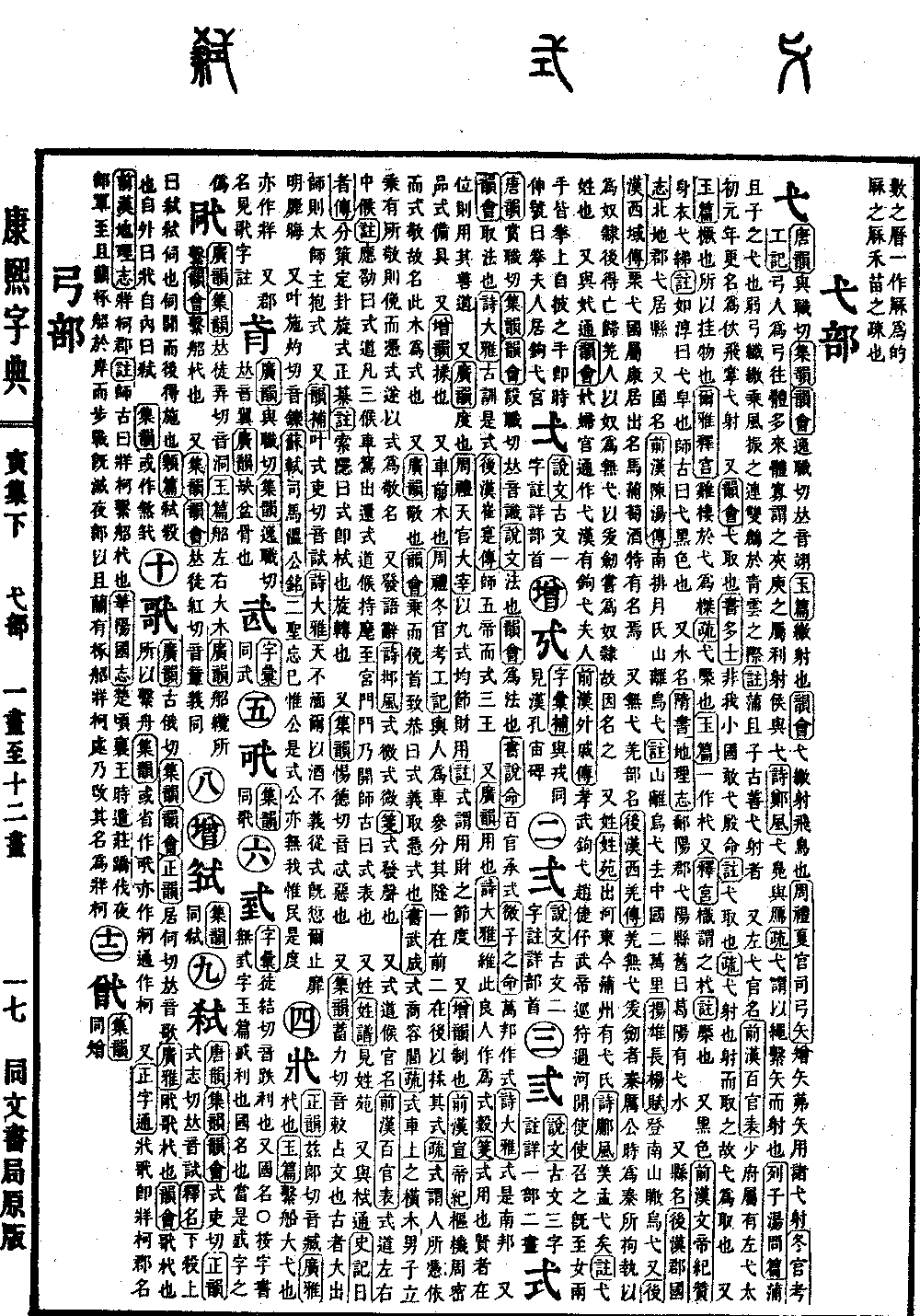
Yin Collection, Lower Volume
Radical: Spear (yì)
Kangxi Strokes: 6
Page 355, Entry 06
Tang Rhymes (Tangyun): Pronounced shi. Collected Rhymes (Jiyun) and Collection of Rhymes (Yunhui): Pronounced shi.
Shuowen Jiezi (Shuowen): Law or standard.
Collection of Rhymes (Yunhui): To serve as a law.
Book of Documents (Shangshu): The hundred officials followed the standard.
Book of Documents (Shangshu): All states took it as a model.
Book of Odes (Shijing): Take this southern state as a model.
Also, Collection of Rhymes (Yunhui): To take as a model.
Book of Odes (Shijing): Follow the ancient teachings as a model.
History of the Later Han (Hou Hanshu): Modeled after the Five Emperors and followed the Three Kings.
Also, Extensive Rhymes (Guangyun): To use.
Book of Odes (Shijing): This good man, makes use of the good.
Commentary (Jian): Shi means to use. When a virtuous person is in office, one uses his good path.
Also, Extensive Rhymes (Guangyun): A standard or measure.
Rites of Zhou (Zhouli): Use the nine standards to balance and regulate wealth and expenditure.
Note: Shi refers to the standard of using wealth.
Also, Enlarged Rhymes (Zengyun): To regulate.
History of the Former Han (Qian Hanshu): The mechanisms were secure, and the regulations were complete.
Also, Enlarged Rhymes (Zengyun): A particle.
Also, a wooden crossbar in front of a carriage.
Rites of Zhou (Zhouli): The carriage maker builds a carriage, dividing the length into three parts; one in front and two in back to shape the crossbar.
Sub-commentary (Shu): Shi refers to the wooden bar that people lean on to show respect; therefore, this wood is called the crossbar (shi).
Also, Extensive Rhymes (Guangyun): To respect.
Collection of Rhymes (Yunhui): Leaning forward in a carriage to bow in respect is called shi, deriving the meaning from leaning on the crossbar.
Book of Documents (Shangshu): Showed respect at the gate of Shang Rong.
Sub-commentary (Shu): Shi is the horizontal wooden bar on a carriage. When a man stands in a carriage, if he wishes to show respect, he leans forward onto the crossbar; thus, the word shi came to mean respect.
Also, a sentence-initial particle.
Book of Odes (Shijing): How humble, how humble.
Commentary (Jian): Shi is a sound-introducing particle.
Also, Shidao, an official title.
History of the Former Han (Qian Hanshu): The Left and Right Shidao.
Note: Ying Shao states: There were three Shidao. When the imperial carriage went out or returned, the Shidao held a pennant until reaching the palace gate, at which point the gate would open. Yan Shigu states: Shi means to represent or mark.
Also, a surname.
Surname Genealogy (Xingpu): Found in the Surname Garden (Xingyuan).
Also, interchangeable with the character shi (a divining board).
Records of the Grand Historian (Shiji): Divining with stalks and setting the hexagrams, rotating the divining board and setting the game pieces.
Note: The Suoyin commentary states: Shi is the same as the divining board, used for rotating.
Also, Collection of Rhymes (Jiyun): Pronounced te. Evil or wicked.
Also, Collection of Rhymes (Jiyun): Pronounced chi. A form of divination text. In ancient times, when a great army was dispatched, the Grand Master would be in charge of holding the divination board.
Also, Rhyme Supplement (Yunbu): Rhymes with shi.
Book of Odes (Shijing): Heaven does not confuse you with wine, do not later take an unrighteous model. Once your conduct deviates, there is neither light nor darkness.
Also, rhymes with shuo.
Su Shi (Su Shi): The two sages forgot themselves, only the Duke was their model. The Duke also had no self, only the people were his measure.