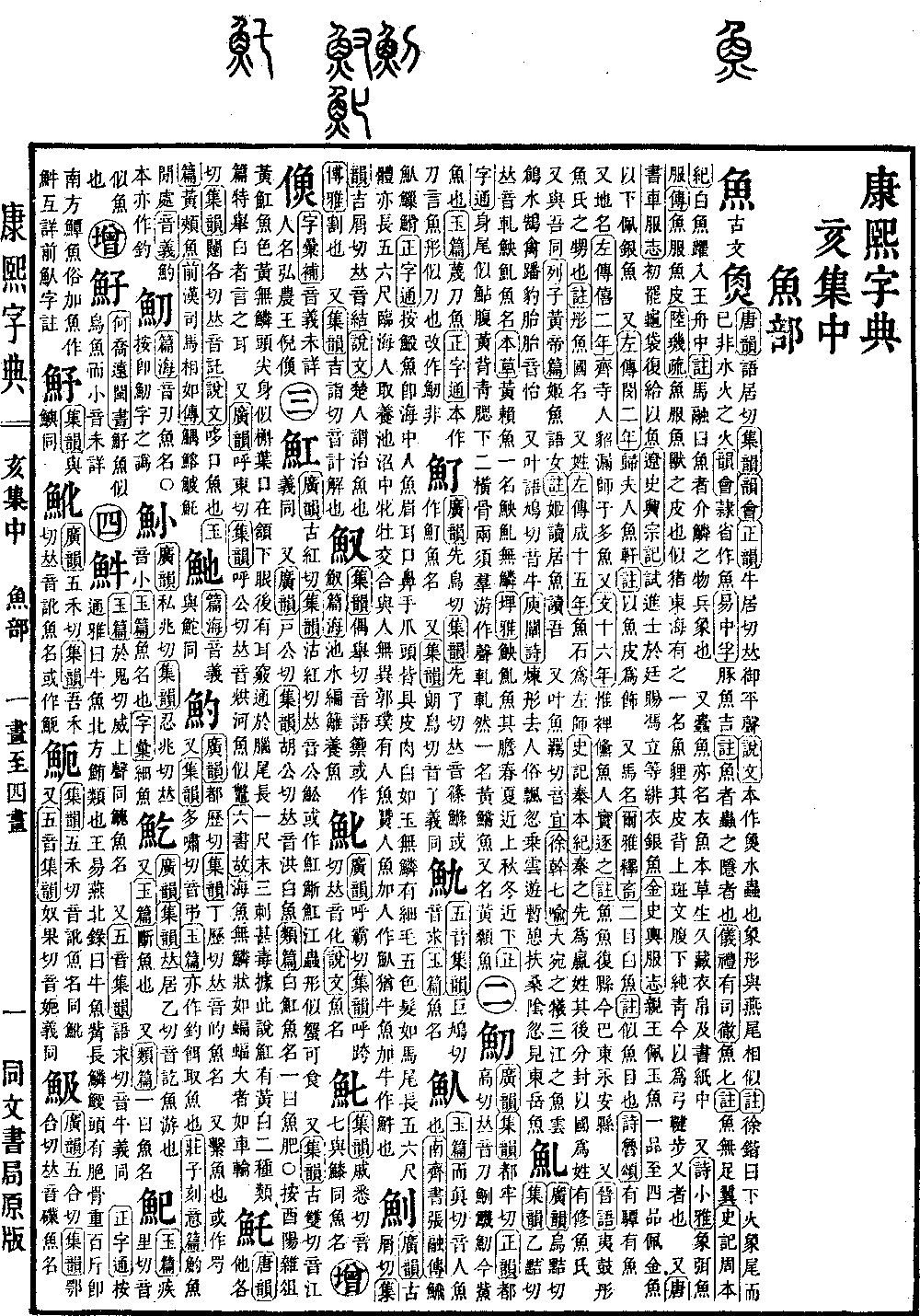
Hai Collection, Middle Volume. Radical: Fish (yú). Kangxi strokes: 11. Page 1465, Entry 01.
Ancient character. Pronounced yú (rising tone) according to Tang Rhyme (Tangyun), also pronounced yú (rising tone) according to Collected Rhymes (Jiyun), Rhyme Meetings (Yunhui), and Orthodox Rhymes (Zhengyun). Pronounced yú (even tone) according to Royal Rhyme (Yu). According to Explaining Graphs and Analyzing Characters (Shuowen), originally written as the current form, it represents a water creature. It is a pictograph, resembling a fish tail. The commentary by Xu Kai states: the fire component at the bottom represents the tail and nothing more; it is not the fire of water and fire. The Rhyme Meetings (Yunhui) notes the clerical script simplifies it to the current form. In the Book of Changes (Yijing), section Inner Truth (Zhongfu): The hog and the fish are auspicious. The commentary notes: The fish is a creature that hides. In the Book of Etiquette and Ceremonial (Yili), section Duties of Officers (Yousiche): Fish. The commentary notes: The fish has no feet or wings. In the Records of the Grand Historian (Shiji), Annals of Zhou: A white fish leaped into the king's boat. The commentary of Ma Rong states: The fish is a creature with scales and shells, symbolizing military forces. Also, the bookworm, also called the clothes moth, as stated in the Materia Medica (Bencao), is born when clothes, silk, and paper are stored for a long time. In the Book of Odes (Shijing), section Lesser Odes (Xiaoya): An ivory-adorned bow with a fish-skin quiver. The commentary states: Fish quiver, a quiver made of fish skin. The commentary by Lu Ji states: The fish quiver is made from the skin of a fish-like beast. It resembles a pig and is found in the East Sea. Another name is the fish-marten; the markings on the back are spotted, and the belly is pure blue. It is currently used for bow cases and quivers. In the Book of Tang (Tangshu), Treatise on Carriages and Attire: Initially the tortoise bags were abolished, and replaced with fish bags. In the History of Liao (Liaoshi), Annals of Emperor Xingzong: Scholars were examined at the court, and Feng Li and others were granted purple robes and silver fish emblems. In the History of Jin (Jinshi), Treatise on Carriages and Attire: Princes wore jade fish, officials of the first to fourth rank wore gold fish, and those below wore silver fish. In the Zuo Tradition (Zuozhuan), Min Year 2: Returned the lady's fish-adorned carriage. The commentary notes: Adorned with fish skin. Also a name for a horse. In the Erya, section Explaining Domestic Animals: Those with white eyes are called fish. The commentary notes: They resemble fish eyes. In the Book of Odes (Shijing), section Odes of Lu (Lusong): There are horses with white shins and there are fish-eyed horses. Also a place name. In the Zuo Tradition (Zuozhuan), Xi Year 2: The Qi eunuch Diao leaked the army at Duoyu. In the sixteenth year of Duke Wen: Only Pi and Shu fish, people actually chased them. The commentary notes: Yu, Yu-fu County, currently Yong'an County in Ba-dong. In the Discourses of Jin (Jinyu): Yi-gu is the nephew of the Tong-yu clan. The commentary notes: Tong-yu is the name of a state. Also a surname. In the Zuo Tradition (Zuozhuan), Cheng Year 15: Yu Shi served as a left division commander. In the Records of the Grand Historian (Shiji), Annals of Qin: The ancestors of the Qin were of the Ying surname, later they were divided and enfeoffed, taking the state as their surname, including the Xiu-yu clan. Also used as the word for I/me (wú). In the Liezi, section Huangdi: Ji, fish speak to you. The commentary notes: Ji is read as ju, and fish is read as wú. Also rhymed with yú (even tone), pronounced yí. From the Seven Exhortations (Qiyu) by Xu Gan: The sacrificial horses of Da-wan, and the fish of the three rivers. Cloud-birds and water-swans, leopard fetuses for food. Fetus is pronounced yí. Also rhymed with yú (rising tone), pronounced yú (even tone). In a poem by Yu Chan: Refining the form to leave the common human world, drifting away to ride the clouds. Briefly resting in the shade of the Fusang tree, suddenly seeing the fish of the Eastern Peak. Research note: The original text of Lu Ji's commentary states it is used for bow cases and quivers; according to the original text of Lu Ji, it has been corrected to quiver.