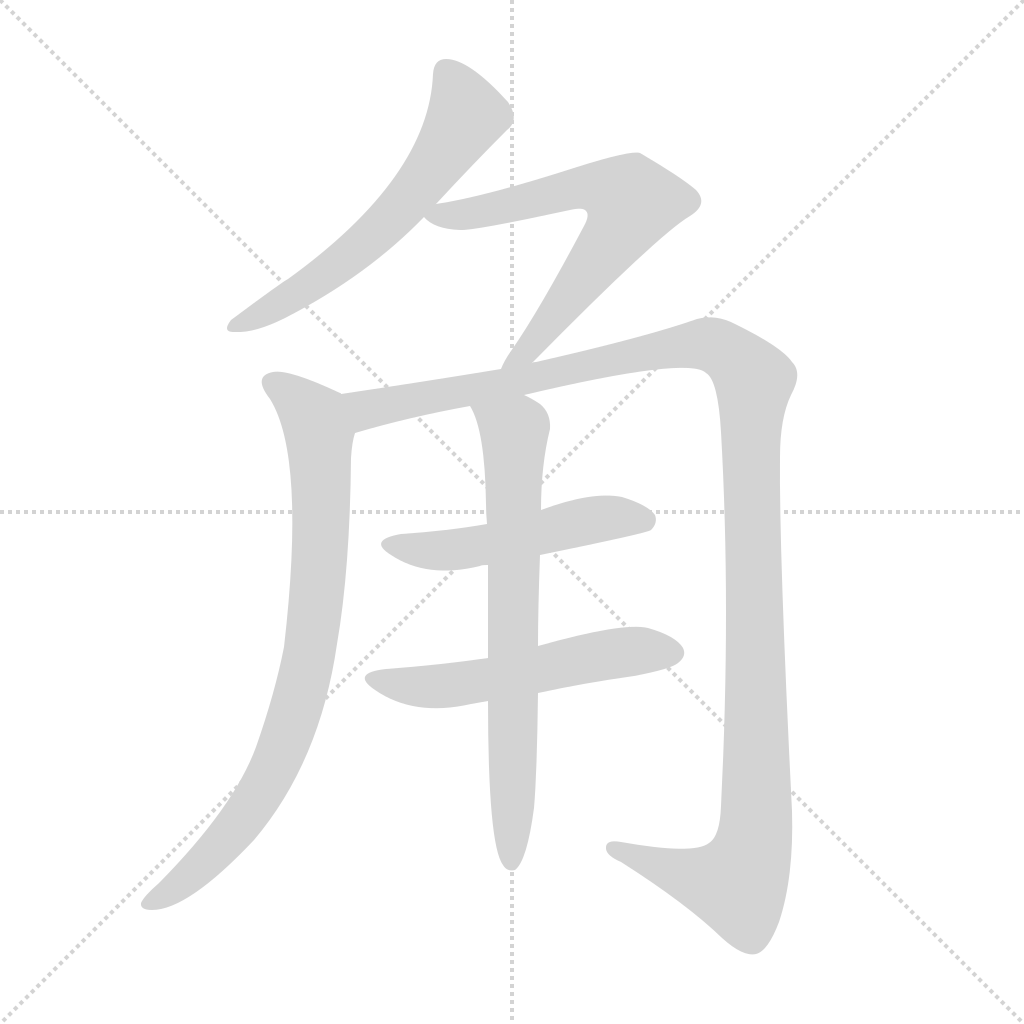
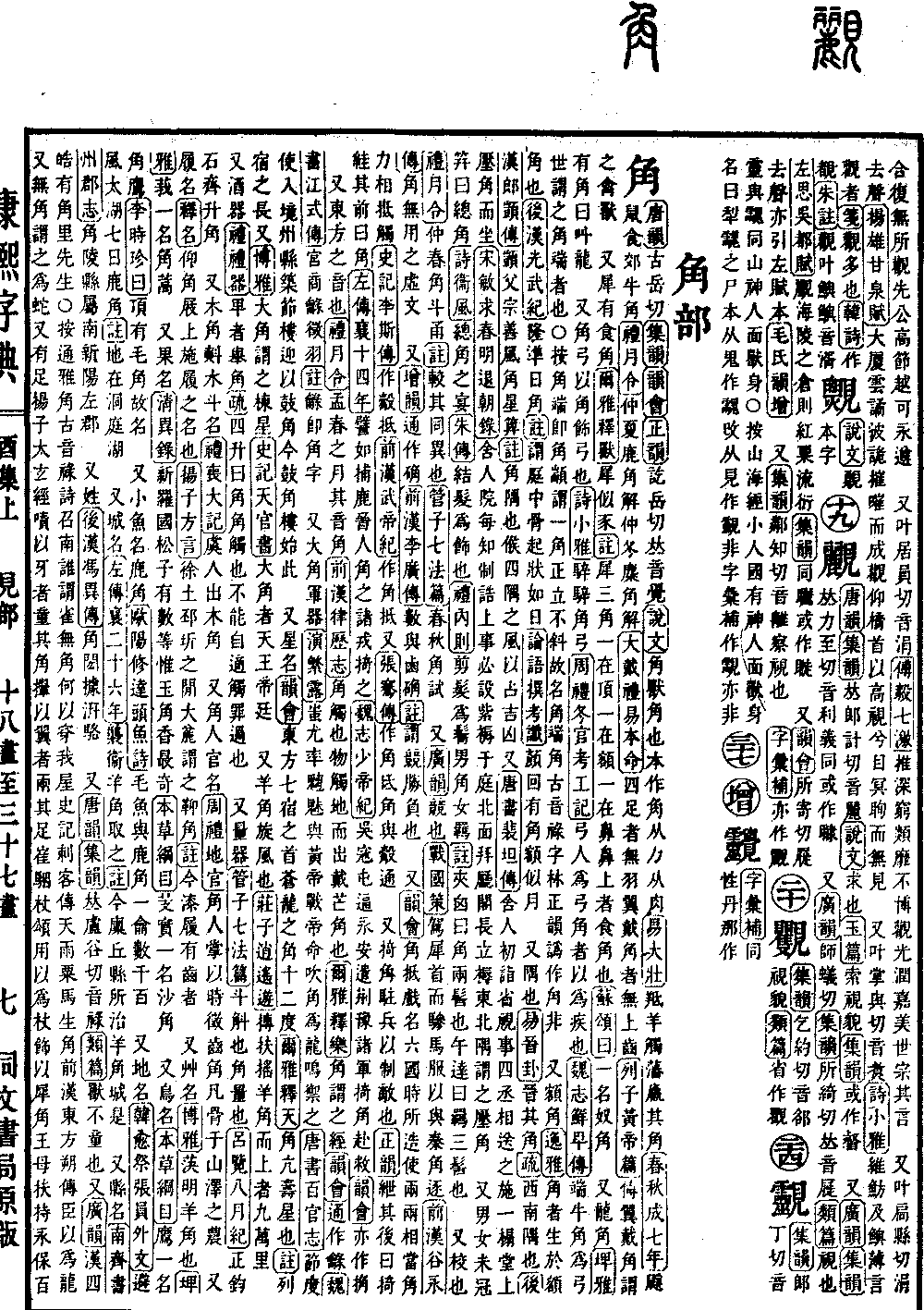
You Collection, Upper Volume. Radical: Horn (jiǎo); Kangxi stroke count: 7; Page 1139, Entry 06.
Pronounced jue. According to the Tang Rhyme (Tangyun), the Collected Rhymes (Jiyun), the Rhyme Assembly (Yunhui), and the Correct Rhymes (Zhengyun), it is pronounced jue.
According to the Explaining Graphs and Analyzing Characters (Shuowen), horn refers to the horn of an animal. It was originally written as a character composed of strength and meat.
Book of Changes (Yijing), Great Invigorating hexagram: A ram butts a fence, entangling its horns.
Spring and Autumn Annals (Chunqiu), seventh year of Duke Cheng: A mole cricket ate the horn of a sacrificial ox.
Book of Rites (Liji), Monthly Ordinances: In the middle of summer, deer shed their horns; in the middle of winter, elk shed their horns.
Great Dai Book of Rites (Daidai Liji), Origins of the Yi: Those with four feet have no feathers or wings; those with horns have no upper teeth.
Liezi, Yellow Emperor chapter: To have wings and horns is what is called a bird or beast.
Also, the rhinoceros has an eating horn.
Erya, Explaining Beasts: The rhinoceros resembles a pig.
Commentary: The rhinoceros has three horns, one on the top of the head, one on the forehead, and one on the nose. The one on the nose is the eating horn.
Su Song stated: It is also called the slave horn.
Also refers to dragon horns.
Piya: That which has horns is called a qiu-dragon.
Also, a horn bow, which is a bow decorated with horn.
Book of Odes (Shijing), Minor Odes: The reddish horn bow.
Book of Rites (Liji), Winter Officials, Record of Tradesmen: When a bow-maker makes a bow, he adds horn to make it swift.
Records of Wei (Weizhi), Record of the Xianbei: Using the horn of an ox to make a bow, which is why the world calls them horn-tips (jiao-duan). Note: Jiao-duan is also written as jiao-zhuan, meaning a single horn standing straight without leaning, hence the name jiao-duan. Horn (jiao) had an ancient pronunciation of lu. The works Dictionary (Zilin) and Correct Rhymes (Zhengyun) mistakenly wrote it as lu (甪), which is incorrect.
Also refers to the forehead horn.
Yi Ya: A horn is something that grows on the forehead.
History of the Later Han (Hou Hanshu), Chronicle of Guangwu: High bridge of the nose and sun-like horns.
Commentary: This refers to the bones in the forehead rising like the sun.
Analects (Lunyu), Compilation of Portents: Yan Hui had a horn on his forehead, resembling the moon.
Also means a corner.
Book of Changes (Yijing), Jin hexagram: Advance its horn.
Commentary: This refers to the southwest corner.
History of the Later Han (Hou Hanshu), Biography of Lang Yi: Yi’s father, Zong, was skilled in wind-corner astrology and calculation.
Commentary: Horn means corner. The winds from the four corners are used to predict good and bad fortune.
Also: In the History of the Tang (Tangshu), Biography of Pei Tan: When an official first arrived at the ministry to attend to duties, the four chancellors sent him off, placed a mat in the hall, and sat pressing the corner.
Song Minqiu, Spring Dawn Court Records: Whenever an official in the Drafting Office was on duty, a purple mat was laid in the courtyard; he would bow facing north, and the chief of the cabinet would stand at the northeast corner of the mat, which was called pressing the corner.
Also, young men and women who have not yet reached the age of adulthood are called zong-jiao (gathered horns).
Book of Odes (Shijing), Odes of Wei: The joy of the zong-jiao days.
Zhu’s Commentary: This refers to hair tied up as an ornament.
Book of Rites (Liji), Inner Patterns: Hair is cut into tufts; for boys, they are horns (jiao), for girls, they are knotted (ji).
Commentary: Hair on both sides of the fontanelle is called jiao, meaning two buns. A straight line is called ji, meaning three buns.
Also means to compare or compete.
Book of Rites (Liji), Monthly Ordinances: In the middle of spring, compare the measurements of the vessels.
Commentary: To compare their similarities and differences.
Guanzi, Seven Methods chapter: Spring and Autumn examinations and competitions.
Also: According to Guangyun, it means to contend.
Strategies of the Warring States (Zhanguoce): Driving the rhino-horn carriage and the flank horses, to compete with Qin.
History of the Former Han (Qian Hanshu), Biography of Gu Yong: Competing over useless empty rhetoric.
Also: According to Zengyun, it is interchangeable with the character que.
History of the Former Han (Qian Hanshu), Biography of Li Guang: Frequently competed with the enemy.
Commentary: Refers to competing for victory or defeat.
Also: According to Yunhui, jiao-di (horn-resisting) is the name of a game. Created during the time of the Six States, it involved two people facing each other, using their strength to resist each other.
Records of the Grand Historian (Shiji), Biography of Li Si: Written as hu-di.
History of the Former Han (Qian Hanshu), Annals of Emperor Wu: Written as jiao-di.
History of the Former Han (Qian Hanshu), Biography of Zhang Qian: Written as jiao-di. Jiao is interchangeable with hu.
Also refers to ji-jiao (clamping horns), stationing troops to control the enemy.
Correct Rhymes (Zhengyun): To pull from behind is called ji, to entangle from the front is called jiao.
Zuo Tradition (Zuozhuan), 14th year of Duke Xiang: Like catching a deer; the people of Jin clamped it, and the Rong tribes entangled it.
Records of Wei (Weizhi), Annals of the Young Emperor: Wu troops pressed upon Yong'an, so forces from Jing and Yu were dispatched to clamp down and rescue.
Yunhui: Also written as jiao.
Also refers to the Eastern note in music.
Book of Rites (Liji), Monthly Ordinances: In the first month of spring, the note is jiao.
History of the Former Han (Qian Hanshu), Treatise on Harmonics and Calendars: Jiao means to touch; things touch the earth and come out, wearing horns.
Erya, Explaining Music: Jiao is called jing.
Yunhui: Interchangeable with the character jiao.
History of Wei (Weishu), Biography of Jiang Shi: Gong, shang, jiao, zhi, yu.
Commentary: Jiao is the same as the character jiao.
Also, the Great Horn (da-jiao), a military instrument.
Yan Fan Lu: Chiyou led demons to fight the Yellow Emperor; the Emperor ordered horns to be blown like dragon calls to defend against them.
History of the Tang (Tangshu), Treatise on Officialdom: When a regional commander entered the border, the state and county would build a horn tower to welcome him with drums and horns. The drum and horn tower began here.
Also, the name of a star.
Yunhui: The head of the seven mansions of the East, twelve degrees of the Azure Dragon's horn.
Erya, Explaining Heavens: Longevity Star, Jiao and Kang.
Commentary: The leader of the various mansions.
Also: According to Boya, the Great Horn is called the Ridge Star (dong-xing).
Records of the Grand Historian (Shiji), Treatise on Celestial Offices: The Great Horn is the Heavenly King’s Imperial Court.
Also, sheep-horn, meaning a whirlwind.
Zhuangzi, Free and Easy Wandering: One who swirls up like a sheep’s horn for ninety thousand miles.
Also, a wine vessel.
Book of Rites (Liji), Ritual Vessels: Those who drink, lift the horn.
Commentary: Four sheng is called a horn. Horn means to touch; one cannot manage oneself and touches upon transgression.
Also, a measuring vessel.
Guanzi, Seven Methods chapter: Bushels and pecks; the horn is a measure.
Lüshi Chunqiu, Eighth Month Chronicle: Rectify the weights and stones, standardize the sheng and the horn.
Also, wood-horn, the name of a water bucket.
Book of Rites (Liji), Record of Mourning: The forest ranger brings out the wood-horn.
Also, Jiao-ren, an official title.
Book of Rites (Zhouli), Earth Officials: The Jiao-ren is in charge of collecting teeth, horns, and all bone materials from the farmers in mountains and marshes.
Also, a type of shoe.
Explaining Names (Shimingshi): Upward-horn, the name of an ornament on wooden clogs.
Yangzi, Dialects: In the region of Xutu and Piqi, very coarse items are called jiao.
Commentary: Today's lacquered shoes with teeth.
Also, the name of a plant.
Boya: Fan is sheep-horn.
Piya: E is also called jiao-hao.
Also, the name of a fruit.
Qing Yi Lu: Pine nuts from Silla have various grades, but the jade-horn fragrance is the most exceptional.
Compendium of Materia Medica (Bencao Gangmu): The water chestnut fruit is also called sand-horn.
Also, the name of a bird.
Compendium of Materia Medica (Bencao Gangmu): The hawk is also called the horn-hawk.
Li Shizhen said: It has hairy horns on its head, hence the name.
Also, a small fish called deer-horn.
Ouyang Xiu, Poem on the Da-tou Fish: Hairy fish and deer-horn fish, a scoop worth hundreds of thousands.
Also, a place name.
Han Yu, Sacrificial Text for Zhang Yuanwai: Avoiding wind at Taihu Lake, seven days at Lu-jiao.
Commentary: The place is in Dongting Lake.
Also, a city name.
Zuo Tradition (Zuozhuan), 26th year of Duke Xiang: Attacked Yang-jiao of Wei and captured it.
Commentary: The current Yang-jiao city administered by Linqiu County is this.
Also, a county name.
History of the Southern Qi (Nan Qishu), Treatise on Prefectures and Counties: Jiaoling County, belonging to the Southern Xinyang Left Prefecture.
Also, a surname.
History of the Later Han (Hou Hanshu), Biography of Feng Yi: Jiao Hong occupied Qianluo.
Also: According to the Tang Rhyme (Tangyun) and Collected Rhymes (Jiyun), it is pronounced lu.
Lei Pian: The beast is not hornless.
Also: According to Guangyun, the four elders of Han included Master Jiao-li. According to Tongya: Jiao had an ancient pronunciation of lu. Book of Odes (Shijing), Odes of Shao: Who says the sparrow has no horn, how does it pierce my roof? Records of the Grand Historian (Shiji), Biography of the Assassins: Heaven rained millet, horses grew horns. History of the Former Han (Qian Hanshu), Biography of Dongfang Shuo: I thought the dragon had no horns, and called it a snake, which has feet. Yangzi, Great Mystery Classic: Those that sting with teeth are hornless, those with wings have two feet. Cui Yin, Ode to the Staff: Use it as a staff, decorate it with rhinoceros horn, the Queen Mother supports it, forever preserving a hundred blessings. All rhyme with lu. Li Yindu said: Du Fu's Red Sky Journey, "The peacock does not know the ox has horns, thirsty, it drinks cold spring water and encounters conflict." Tang writers also wrote it as lu, pronounced lu. Li Jiweng's Records of Leisurely Observations says: Of the four elders of Han, one was named Master Jiao-li. Jiao is pronounced lu; today it is mostly called by the jue pronunciation, which is a mistake. As for reading jiao as jue, and the pronunciation of Jiao-li as lu, then changing it to the character lu (甪) is even more erroneous. Also, in the Accounts of the Eastern Capital, Cui Duoqian says: Using the character dao under yong is pronounced que, using two dots under it is pronounced lu, one dot and one stroke do not make a character, which is not yet clarified. The Tang Rhyme says jiao is pronounced lu and also jue, but in fact, the character does not have two forms. Shuowen defines jiao as depicting the shape of an animal's horn; there is no story about dao, yong, or two dots. Duoqian's subjective theory cannot be followed. The Peiqi Collection and Dictionary Rhyme Assembly incorrectly split jiao and lu into two.
Also: According to Zi Hui Bu, it is pronounced gu.
Han Yu, Poem Presented to Zhang Ji: Jiao-jiao, the male pheasant crows.
Fang Songqing said: Jiao is pronounced gu.
Also: According to Five Books on Phonology, it rhymes with lu-ju, pronounced lu.
Wei Liaozi, Military Talks: The troops are like gathering wood, the crossbows are like sheep-horns, everyone is without fear, soaring with courage, without doubt or hesitation, impressive and resolute as they depart.
Jiyun: Also written as jiao.