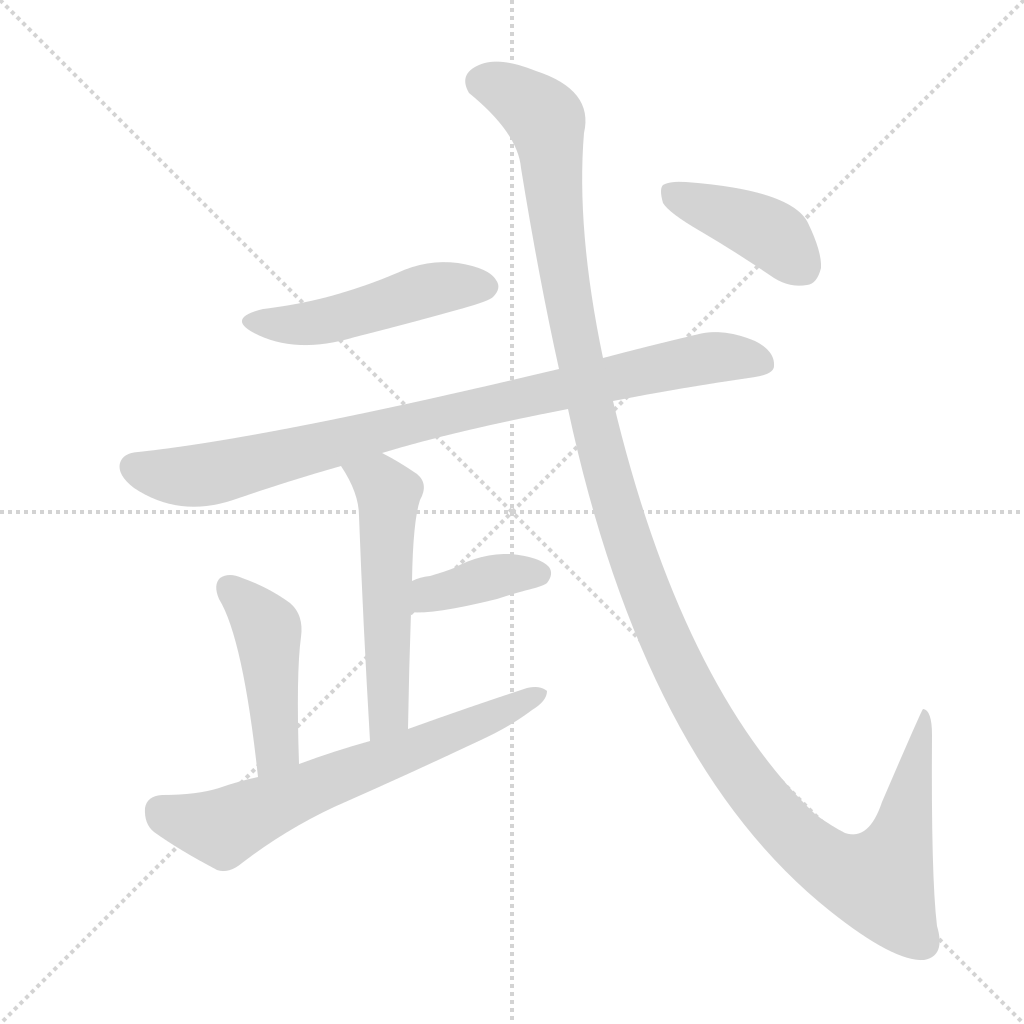
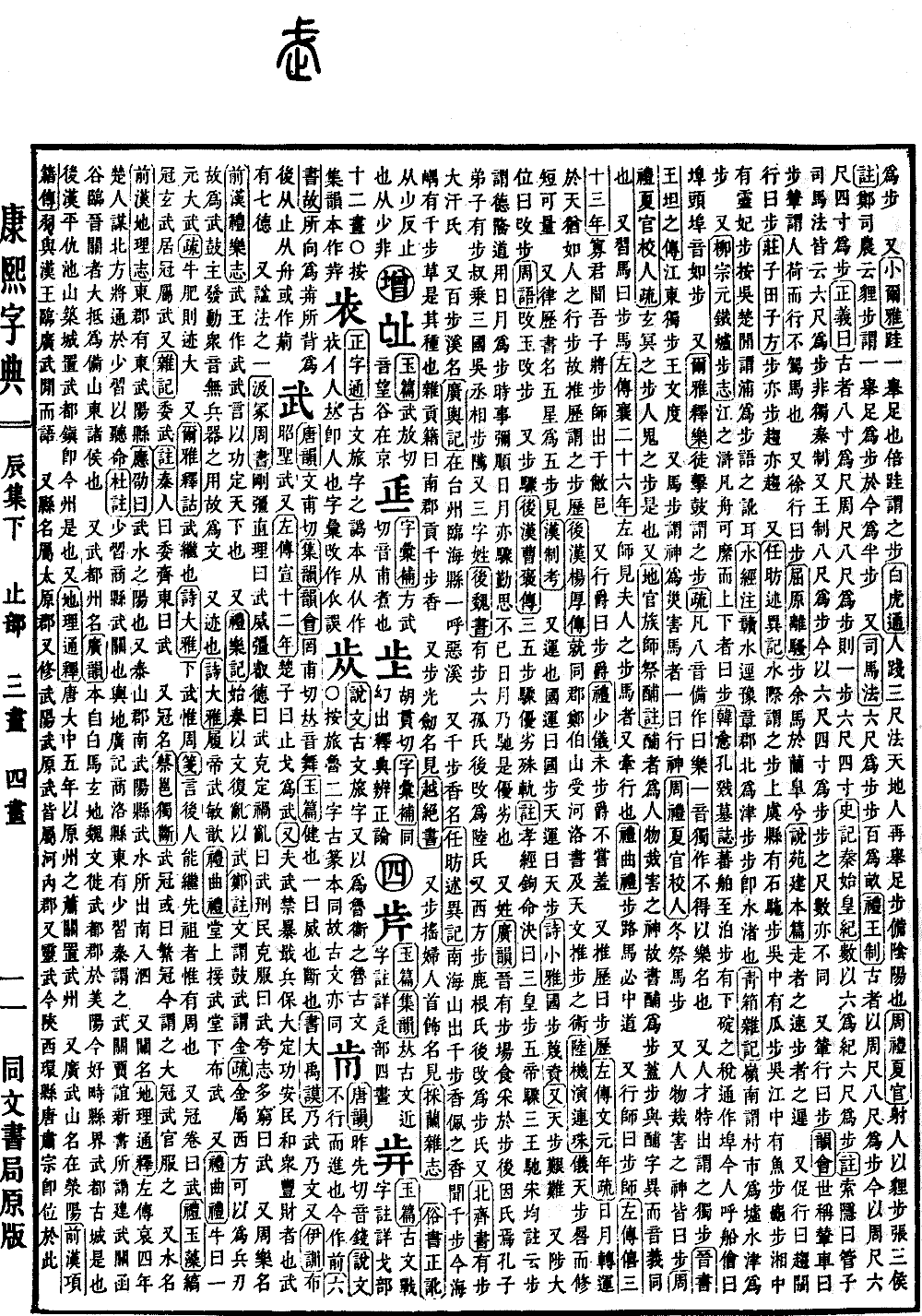
Chen Collection, Lower Volume, Radical: Stop (zhǐ), Kangxi Stroke Count: 8, Page 575, Entry 09.
Pronounced wu.
In Tangyun, pronounced wu. In Jiyun and Yunhui, pronounced wu. In Yupian, it means strong. Another definition is power or severity; to cut off or cease. In Book of Documents (Shujing): "Both martial and civil." Also in I Xun: "To manifest holy martial power." In Zuo Commentary (Zuozhuan), Year 12 of Duke Xuan: The Lord of Chu said: "To stop the spear is the definition of martial (wu)." Also: "Martial power is that which forbids violence, stills weaponry, preserves greatness, fixes accomplishments, settles the people, harmonizes the masses, and makes wealth abundant." There are seven virtues of martial power.
Also one of the methods for posthumous titles. In Jizhong Zhou Shu (Yi Zhou Shu): "To be firm, strong, and righteous in principles is called wu; to be powerful, strong, wise, and virtuous is called wu; to be able to settle calamities and chaos is called wu; to be able to overcome the people is called wu; to have an arrogant will with many dead ends is called wu."
Also the name of Zhou music. In History of the Former Han (Qian Hanshu), Records of Rites and Music: "King Wu created the music titled Wu." Wu signifies using military achievements to settle the world. In Book of Rites (Liji), Record of Music: "Start by playing the civil, then return to the martial." The commentary by Zheng Xuan states: "Civil refers to the drum; martial refers to the metal bells." The sub-commentary adds: "Metal belongs to the west and can be used for weapons, hence it is martial. The drum controls the release of various sounds and has no use as a weapon, hence it is civil."
Also footprints. In Book of Odes (Shijing), Daya: "Stepping in the footprints of the Emperor, [the people] were moved." In Book of Rites (Liji), Quli: "Walking on the hall, one steps in the footprints; below the hall, one spreads the footprints."
Also in Book of Rites (Liji), Quli: "A cow is called one yuan da wu (great prime martial)." The sub-commentary states: "If a cow is fat, its footprints are large."
Also in Er Ya, Shigu: "Wu means to continue." In Book of Odes (Shijing), Daya: "The succeeding martiality belongs only to Zhou." The commentary by Mao states: "It means that later generations are able to succeed their ancestors, and only the Zhou dynasty does this."
Also, a hat edge is called wu. In Book of Rites (Liji), Yuzao: "The white hat has a wu edge; the daily hat attaches a wu."
Also in Zaji: "Wei-wu." The commentary states: "People of Qin say wei, people of eastern Qi say wu."
Also a type of hat. In Cai Yong’s Unique Judgments (Duduan): "The Wu hat, or sometimes called the Fan hat, is what we now call the Great Hat, worn by military officials."
Also a river name. In History of the Former Han (Qian Hanshu), Treatise on Geography: "Dongjun has Dongwuyang County." Ying Shao states: "It is on the north bank of the Wu River." Also, Taishan Commandery has Nanwuyang County, where the Wu River originates and flows south into the Si River.
Also a pass name. In Comprehensive Explanations of Geography (Dili Tongshi), Zuo Commentary (Zuozhuan), Year 4 of Duke Ai: "The Chu people plotted to the north, intending to open a path to Shaoxi to hear orders." Du Yu’s commentary states: "Shaoxi is the Wu Pass of Shang County." In Universal Records of Geography (Yudi Guangji): "To the east of Shangluo County is Shaoxi, which the Qin called Wu Pass." In Jia Yi’s New Book (Xinshu), the mention of establishing the Wu Pass, Hangu Pass, and Linjin Pass was generally to prepare against the feudal lords of the east.
Also Wudu, a state name. In Guangyun: "Originally the land of the Baima Di people. During the Wei dynasty, Emperor Wen moved Wudu Commandery to Meiyang, the current boundary of Haozhi County, where the ancient city of Wudu is located." Later, during the Eastern Han, they leveled the Qichou Mountain, built a city, and established the Wudu Garrison, which is the current state.
Also in Comprehensive Explanations of Geography (Dili Tongshi): In the fifth year of the Dazhong era of the Tang dynasty, Wu State was established at the Xiaoguan Pass of Yuanzhou.
Also Guangwu, a mountain name located in Xingyang. In History of the Former Han (Qian Hanshu), Biography of Xiang Ji: "Xiang Yu and the King of Han stood across from Guangwu to speak."
Also a county name belonging to Taiyuan Commandery. Also Xiuwu, Yangwu, Yuanwu, all belonging to Henei Commandery.
Also Lingwu, currently in Huan County, Shaanxi, where Emperor Suzong of the Tang dynasty ascended the throne.
Also a lake name. In Guangyu Ji: Located in Huangpi County, Huangzhou Prefecture; legend says it is where Huang Zu practiced archery.
Also a stream name, also a mountain name. In Guangyu Ji: Located in Luxi County, Chenzhou Prefecture. A student of Ma Yuan was good at playing the flute, and Ma Yuan composed a song to accompany it, saying: "The rushing Wu Stream, how deep it is," which refers to this place. Wu Mountain is also in Luxi County.
Also Zhenwu, a lake name. In Records of the Six Dynasties (Liuchao Shiji): "In the first year of the Baoding era of the Last Emperor of Wu, a canal was opened north of the city, leading water from the Rear Lake into the new palace." There is an ancient pond thirteen li north of the current city, commonly called the Rear Lake.
Also a star name. In Dream Pool Essays (Mengxi Bitan): "The seven mansions of the Northern Zhenwu originate at Dongjing and end at Jiao."
Also Wu, the seven mansions of the north. In Book of Rites (Liji), Quli: "In front is the Vermilion Bird, behind is Wu."
Also a surname. In Guangyun, Customs (Fengsu Tong) says: "Descendants of Wu Gong of Song. In the Han dynasty, there was Wu Chen."
Also six types of Han dynasty compound surnames. In the Han dynasty, there was the Commandery Prefect Wu'an Gong, descended from Lord Wu'an, Bai Qi. Customs (Fengsu Tong) says: "Wang Liang, the Marquis of Wuqiang in the Han dynasty; his descendants took this as their surname due to his enfeoffment." Shi Ben says: "During the Xia dynasty, there was the Wu-Luo state, and their descendants took it as a surname." He Shi Xingyuan lists the Guangwu, Wucheng, and Wuzhong clans. The Western Qin Records (Xiqin Lu) lists the Wudu clan.
Also interchangeable with wu (a stone resembling jade). In Records of the Grand Historian (Shiji), Biography of Sima Xiangru: "Ruan stone and wu-fu."
Also in Zheng Yun, pronounced wu. Interchangeable with wu (not). In Book of Rites (Liji), Liji: "At the Zhou burial, one instructed the master of the dead, [saying] to assist with the wu." Zheng Xuan's commentary: "Wu is read as wu (not)."