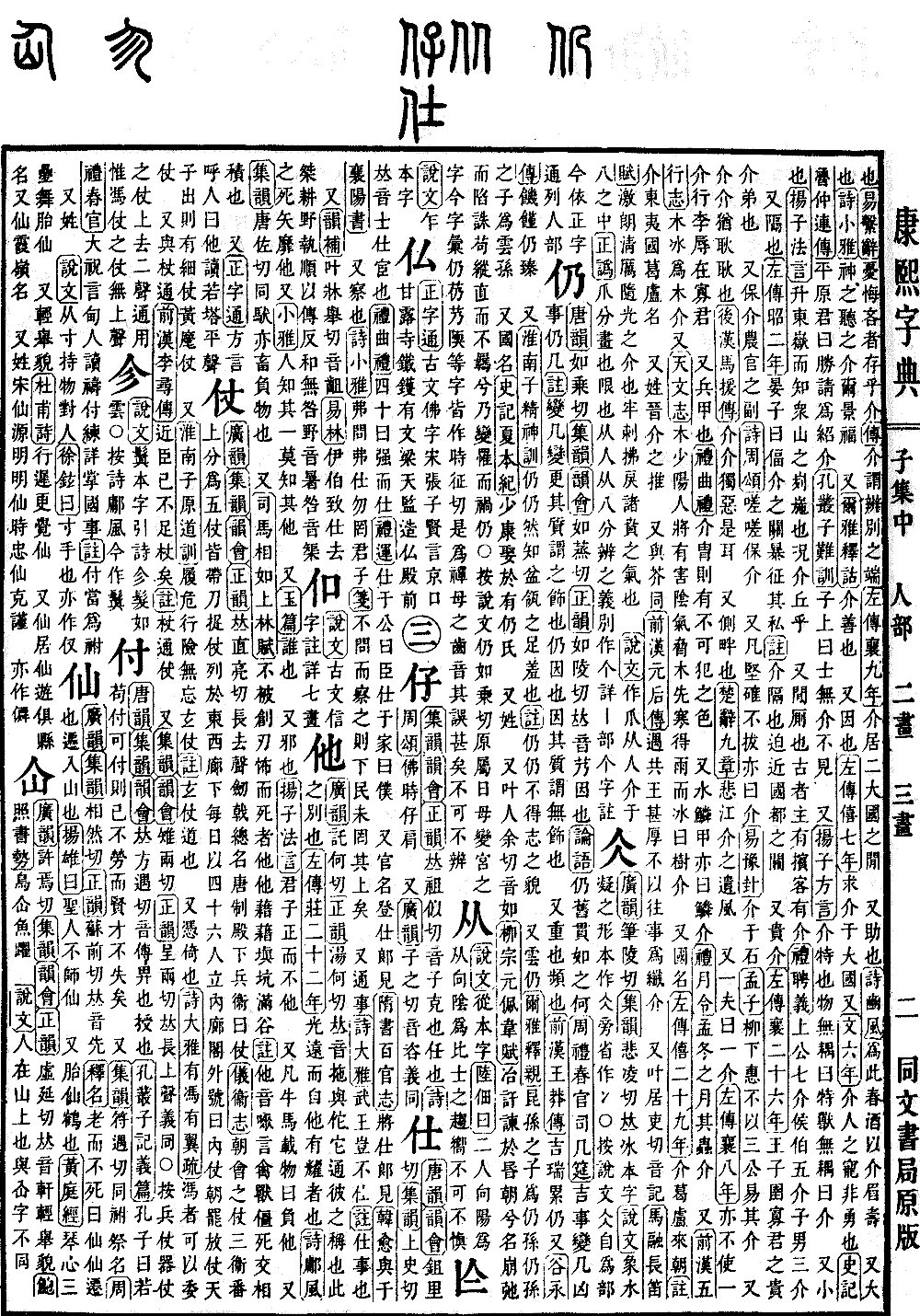
Zi Collection, Middle Volume
Radical: Person (rén)
Kangxi strokes: 11
Page number: 92, entry 03
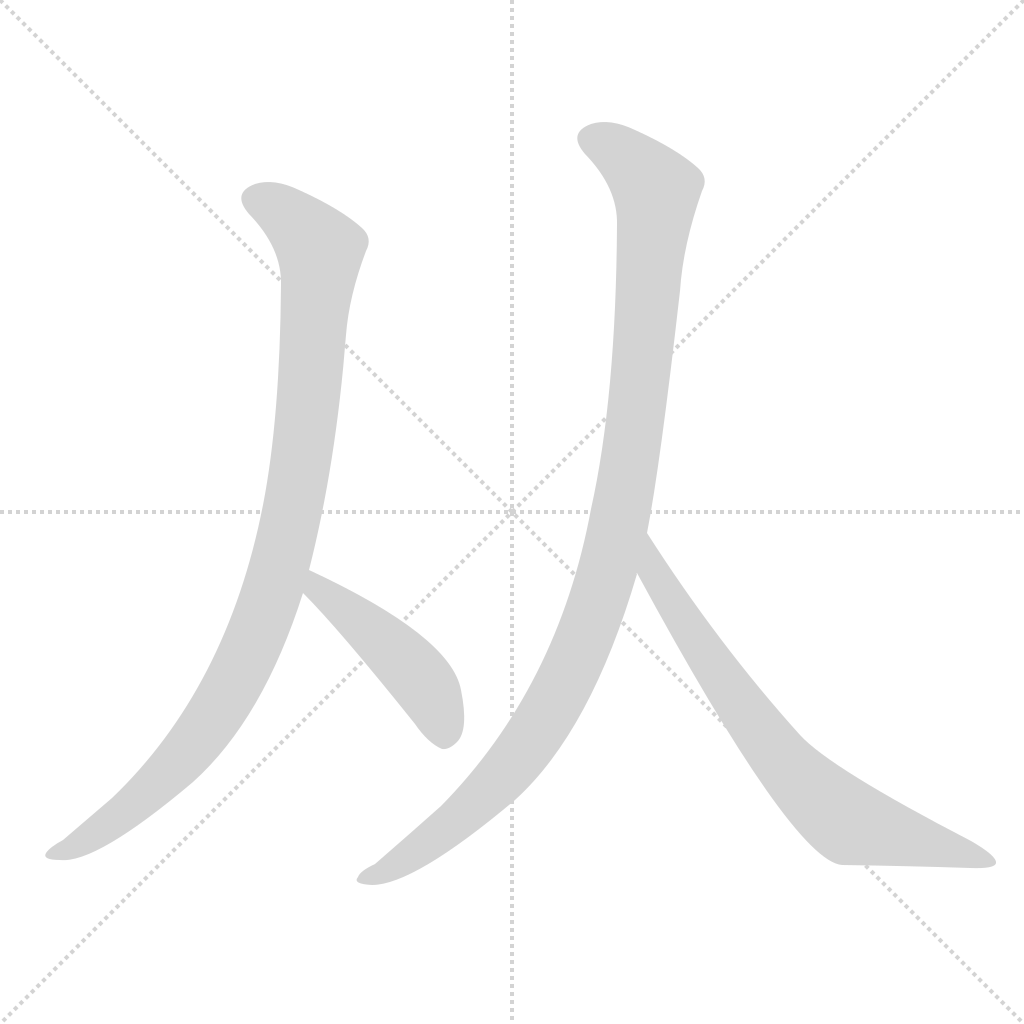
Shuowen Jiezi (Explanation of Simple and Compound Characters) states: The original form of 'cóng'.
Lu Dian said: Two people facing the sun is 'cóng', two people with their backs to the sun is 'bǐ'. The aspirations and inclinations of a scholar must not be taken lightly.
Cóng
From Guangyun (Guangyun): Jírong qie. From Jiyun (Jiyun), Yunhui (Yunhui), Zhengxun (Zhengxun): Qiángrong qie. Commonly read as a level tone. Shuowen Jiezi (Explanation of Simple and Compound Characters) states: Originally written as 'cóng'. Meaning: to mutually obey or comply.
In the Book of Documents (Shangshu), Yì Jì: "Do not outwardly comply."
In Yuè Mìng: "If the ruler listens to admonitions, he will become enlightened."
Also from Guangyun: To go towards, to follow closely. In the Book of Changes (Yijing), Qian hexagram: "Clouds follow the dragon, winds follow the tiger." In the Book of Rites (Liji), Qū Lǐ: "When consulting an elder for advice, one must carry a small table and a staff and follow him."
Also from Erya (Erya), Shì Gǔ: From, by. In the Book of Odes (Shijing), Xiao Ya: "Who said this?" Commentary states: "The one who slandered and harmed me, from whom did these words originate?" In the Book of Jin (Jinshu), Annals of Emperor Ming: "It has not been heard that anyone came from the side of the sun."
Also a surname. From Guangyun: In the Han dynasty, there was General Cóng Gōng. Hè Shì Xìng Yuàn states: "Currently from Dongguan."
Also from Guangyun and Jiyun: Qī Gōng qie. Read as a level tone with a constricted sound. From Guangyun: Unhurried and calm. From Zhengxun: Cóngróng means relaxed and unhurried. In the Book of Documents, Jūn Shì: "Calm and harmonious." In the Book of Rites, Zhōngyōng: "Calmly conforming to the Mean."
Also from Jiyun: Shū Róng qie, pronounced chōng. Cóngróng means a long duration. In the Book of Rites, Xué Jì: "One must wait for it to be long and unhurried before its sound can be fully expressed."
Also from Jiyun: Jiāng Róng qie, pronounced zōng. East-west direction is called héng, north-south direction is called zòng. In the Book of Odes, Qí Fēng: "Plowing fields in horizontal and vertical directions." In the Records of the Grand Historian (Shiji), Biography of Su Qin: "If the Vertical Alliance (hézòng) succeeded, Chu would become king; if the Horizontal Alliance (liánhéng) succeeded, Qin would become emperor."
Also interchangeable with 'zōng' (footprint). In the Records of the Grand Historian, Biography of Nie Zheng: "Severely cut off his own traces." In the Book of Han (Hanshu), Biography of Zhang Tang: "Where did the traces originate?"
Also from Jiyun: Zǔ Dòng qie, pronounced zǒng. Meaning: tall and imposing. From Yunhui: "Hair bun is high." In the Book of Rites, Tán Gōng: "Do not tie your hair up too high."
Also from Jiyun: Chú Jiāng qie, zhuó read as a level tone. Meaning is the same.
Also from Tangyun (Tangyun): Cí Yòng qie. From Jiyun, Leipian (Leipian), Yunhui: Cái Yòng qie. Commonly read as a departing tone. Shuowen Jiezi (Explanation of Simple and Compound Characters) states: Originally written in a variant form. Meaning: to follow and walk. In the Book of Odes, Qí Fēng: "His followers are as numerous as clouds." In the Analects (Lunyu): "Those who can follow me are probably Zhong You."
Also from Yunhui: Following the Son of Heaven is called fǎcóng, meaning attendants. In the Book of Documents, Jiǒng Mìng: "Those who serve, drive, and attend." In the Book of Han, Biography of Yang Xiong: "Zhao Zhaoyi, whenever she went to Ganquan Palace, often had fǎcóng." Commentary by Shigu says: "They should follow according to law." Another interpretation is that cóng refers to the Son of Heaven's carriage. In the Book of Later Han (Hou Hanshu), Treatise on Officials: "The Yǔlín Láng were in charge of night watch and attendance."
Also from Jiyun and Leipian: Sì Yòng qie, pronounced sòng. Of the same clan. In Erya, Shì Qīn: "A father's paternal uncles are called cóngzǔzǔfù (granduncles). A father's paternal aunts are called cóngzǔzǔmǔ (grandaunts)." In Shiming (Shiming): "Cóngzǔzǔfù and cóngzǔzǔmǔ mean that they are descended from one's own paternal grandfather, or named following one's own grandfather."
Also from Jiyun: Zǐ Yòng qie. Same as 'zòng' (to indulge). In the Book of Rites, Qū Lǐ: "Desires should not be indulged." In the Analects: "To indulge it, in its pure form."
Research note on 'cóng': In the Book of Odes, Qí Fēng: "Plowing fields cónghéng." Carefully corrected 'cónghéng' to 'héngcóng' according to the original text.